
Education
Bali Peptide Sellers Are Advertising “Independent Lab Testing”. What Does That Actually Prove?
Published 25 Sept 2026, 21:00 Bali time
Bali peptide sellers are displaying Janoshik lab reports. Learn what peptide purity tests prove, what they miss and why a certificate does not guarantee safety.
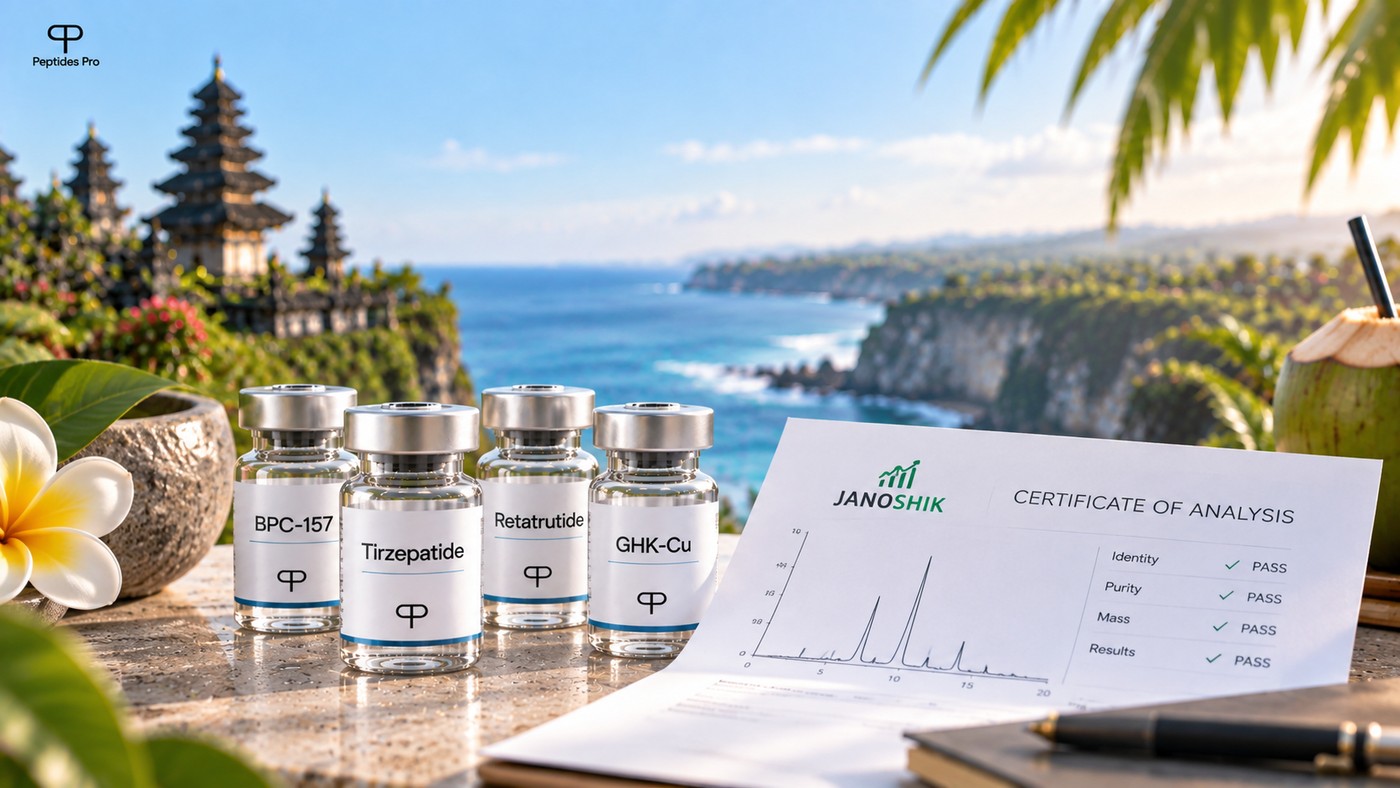
A laboratory report has become one of the most powerful marketing tools in Bali's growing peptide market.
Online sellers are publishing certificates from independent laboratories, including Janoshik Analytical, alongside products such as BPC-157, tirzepatide, retatrutide and GHK-Cu.
Some reports display purity percentages, laboratory identification numbers and testing dates. Others include links or verification codes that allow readers to retrieve the original document.
The message is clear: these products have been independently tested.
But there is a crucial distinction between proving that a laboratory analysed a sample and proving that a product is safe, effective or approved for human use.
A genuine laboratory report can provide valuable evidence about what was found in a particular sample. It does not automatically establish that every vial being sold contains the same material, that the product is sterile, or that the substance is an approved medicine.
For someone researching peptides in Bali, understanding that difference is more useful than simply looking for the highest purity percentage.
The short answer: What does independent peptide lab testing prove?
Independent testing can provide evidence about a sample's chemical identity, purity and quantity, depending on which analyses were performed.
Some laboratories also offer separate tests for bacterial endotoxins, sterility and other quality attributes.
However, a certificate only supports conclusions about the properties actually tested.
A report showing 99% chromatographic purity does not establish that a product is sterile, free from all potentially harmful contaminants, clinically effective or approved by Indonesia's National Agency of Drug and Food Control (BPOM).
The report must also be authentic and connected to the actual product or manufacturing batch being evaluated.
These are separate questions, and a responsible interpretation should not collapse them into a single claim that a peptide is "lab-tested and safe".
| Question | Can an independent laboratory report answer it? |
|---|---|
| Does the sample contain the claimed peptide? | It can provide evidence if appropriate identity testing was performed. |
| How pure is the sample? | It can report purity under the specified analytical method. |
| How much peptide is present? | It can measure quantity if an appropriate quantitative assay was performed. |
| Is the sample sterile? | Only if appropriate sterility testing was performed and reported. |
| Does it contain bacterial endotoxins? | Only if specific endotoxin testing was performed. |
| Does every vial contain the same material? | Not established by testing a single sample. |
| Is the peptide safe for humans? | No. Analytical testing alone cannot establish clinical safety. |
| Does the peptide work? | No. Effectiveness requires appropriate clinical evidence. |
| Is the product BPOM-approved? | No. Regulatory authorisation must be verified separately. |
The useful question is not simply whether a certificate exists.
It is what the certificate actually measures and how confidently its results can be connected to the product being advertised.
Why independent testing is appearing in Bali's peptide market
The trend is visible on public-facing peptide websites.
For example, the Bali-based retailer BioPepTech displays a section headed "Independent Lab Testing" that identifies Janoshik Analytical and lists 16 sample reports.
The page includes laboratory task numbers and analysis dates for products labelled BPC-157, tirzepatide, retatrutide, GHK-Cu and other compounds.
Among the displayed entries are a BPC-157 report dated 28 August 2026, a GHK-Cu report from the same date, and tirzepatide and retatrutide reports dated 22 July 2026.
These details were visible on the retailer's public website in September 2026.
Source: BioPepTech's public testing information.
This is a useful illustration of how analytical documentation is being presented to consumers.
However, the presence of report numbers and dates on a seller's website is not, by itself, independent confirmation of the results. Peptides Pro has not commissioned testing of this retailer's products or independently authenticated each displayed report.
Nor does displaying analytical reports establish wrongdoing. Independent testing can be a legitimate and valuable quality-control measure.
The issue is how the results are interpreted.
A report may establish something meaningful about one submitted sample while leaving several clinically important questions unanswered.
What is Janoshik Analytical?
Janoshik Analytical is a laboratory that provides chemical-analysis services for peptides, steroids and other compounds.
Its services are used by customers who submit material for analysis.
The laboratory's own website describes a process in which customers select a test, send a sample, receive laboratory analysis and obtain a digital report.
Janoshik also operates a verification system allowing people to confirm the authenticity of reports issued by the laboratory.
This is an important feature.
A PDF uploaded to a seller's website can look convincing, but appearance alone does not establish authenticity.
An independently retrievable laboratory record provides a stronger basis for confirming that the document was actually issued by the named laboratory.
Nevertheless, authentication and product quality remain different questions.
Verifying that Janoshik issued a report does not independently establish where the submitted sample came from or whether it represents every product a retailer subsequently sells.
1. A 99% purity result does not mean everything in the vial is 99% peptide
Purity is frequently the largest number displayed on a peptide laboratory report.
A seller might highlight a result such as 99.2%, 99.5% or 99.9%.
These figures can be meaningful, but only when the analytical method and definition of purity are understood.
One commonly used technique is high-performance liquid chromatography, or HPLC.
HPLC separates components of a sample as they pass through a chromatographic system.
A detector records signals from the separated components, producing a graph known as a chromatogram.
The main peak may correspond to the intended peptide, while additional peaks may represent impurities, degradation products or other substances detectable under the test conditions.
When purity is expressed as a percentage of chromatographic peak area, the figure represents the proportion of the measured signal attributed to the main component.
It is not necessarily the percentage of the vial's total mass that consists of the intended peptide.
Why the distinction matters
A sample may contain water, salts, counterions or other substances that are not adequately represented in a particular chromatographic purity measurement.
Different compounds may also produce different detector responses.
Consequently, a high peak-area purity result does not automatically establish the quantity of peptide present by mass.
It also does not prove that every possible impurity was detected.
The FDA's biotechnology inspection guidance distinguishes purity from other quality attributes, including potency and stability, and identifies additional tests that may be needed to characterise biological products.
Source: FDA Biotechnology Inspection Guide.
A purity percentage describes a measurement under specified conditions. It is not a comprehensive safety assessment.
2. Purity and identity answer different questions
Suppose a laboratory examines a sample and finds that one component accounts for nearly all of the detected chromatographic signal.
That may indicate high chromatographic purity.
But what is the dominant component?
This is where identity testing becomes important.
Mass spectrometry measures properties of ions that can help identify a compound, including its molecular mass.
When combined with appropriate analytical methods and reference information, it can provide evidence that the sample contains the intended molecule.
However, a molecular-mass match alone may not distinguish every possible structural isomer, sequence variant or closely related compound.
The strength of the identification depends on the method used.
Why a purity report alone is incomplete
A sample can be highly pure without being the substance claimed on its label.
Conversely, a sample may contain the intended peptide but also contain substantial impurities.
Identity and purity therefore need to be considered separately.
For multi-peptide products, there is an additional complication.
A blend containing BPC-157, TB-500 and GHK-Cu requires analytical methods capable of distinguishing and appropriately measuring the individual components.
A single overall purity percentage does not automatically establish the identity, content and purity of every ingredient in the mixture.
This is especially relevant to the growing interest in peptide combinations such as the Wolverine stack.
3. A purity percentage does not tell you how much peptide is present
Quantity is another distinct analytical question.
A vial may be labelled as containing a particular mass of peptide.
A quantitative assay can help determine how much of the target compound was actually present in the submitted sample.
But this cannot necessarily be calculated by multiplying the label claim by the chromatographic purity percentage.
For example, a report showing 99% chromatographic purity does not, by itself, establish that a vial labelled 10 mg contains 9.9 mg of peptide.
The actual quantity must be measured using an appropriate method.
This distinction matters particularly when products are being compared on the basis of advertised purity.
Two samples can have similar purity percentages but different measured quantities of the intended substance.
Analytical quality also involves more than quantity alone. The FDA distinguishes identity, strength, quality and purity as separate characteristics of drug products.
A report addressing only one or two of these characteristics should not be treated as though it addresses all of them.
4. A clean chemical analysis does not prove that an injectable is sterile
This is one of the most important limitations of many peptide certificates.
Chemical purity testing and microbiological testing answer fundamentally different questions.
HPLC may provide information about the chemical composition of a sample.
It does not establish that the sample is free from viable microorganisms.
For an injectable product, microbial contamination is a particularly important concern because the product bypasses some of the body's normal protective barriers.
The FDA has warned that contaminated injectable drug products can cause serious harm.
In guidance for investigational injectable medicines, the agency identifies sterility, pyrogenicity, endotoxin levels and particulate matter as important quality considerations.
These are assessed separately from chemical identity and purity.
Sterility testing is not the same as purity testing
A product can have excellent chromatographic purity and still contain microorganisms.
A product can also pass a sterility test on a particular sample without that result guaranteeing that every other vial is sterile.
Sterility assurance depends on appropriate manufacturing controls, validated processes, container integrity and relevant testing.
Testing a small sample cannot replace control of the entire manufacturing process.
The United States Pharmacopeia recognises sterility testing under USP General Chapter 71.
This is a separate category of testing from chemical purity analysis.
For someone evaluating a peptide laboratory report, the absence of a sterility result means that sterility has not been established by that report.
It does not necessarily prove that the product is contaminated.
It means the certificate does not answer the question.
5. Sterility and bacterial endotoxins are not the same thing
Even a report containing sterility results may leave another important question unanswered.
Bacterial endotoxins are components associated with certain bacteria, particularly Gram-negative bacteria.
They can remain present after the bacteria themselves are no longer viable.
As a result, a preparation may contain bacterial endotoxins even when a sterility test does not detect living microorganisms.
Endotoxins can provoke significant inflammatory reactions.
This is why bacterial endotoxin testing is a separate quality-control consideration for injectable medicines.
USP General Chapter 85 addresses bacterial endotoxin testing.
The FDA also identifies endotoxin levels separately from sterility in its guidance for investigational injectable products.
What does an endotoxin result prove?
An appropriate test can establish the measured endotoxin level of the submitted sample under the stated analytical conditions.
However, the result must be interpreted against a relevant specification for the product and its intended use.
A numerical result without a clear unit, method or acceptance criterion may be difficult to interpret.
An endotoxin result also does not establish chemical identity, peptide effectiveness or overall product safety.
The important point is that a sterile product is not automatically endotoxin-free, and a low endotoxin result does not establish sterility.
These are different quality attributes requiring different assessments.
6. Testing one sample does not guarantee every vial matches
Another major limitation concerns traceability.
When a laboratory receives a sample, it can analyse the material submitted.
Unless the laboratory independently collected the sample under a documented procedure, it may not be able to verify where the material originated.
It may not know whether the sample came from a particular production batch, a selected vial or another source.
This creates a distinction between three different claims:
- A laboratory tested a sample.
- The tested sample came from a particular manufacturing batch.
- Every vial sold under that batch identifier meets the same specifications.
The first claim may be supported by an authentic laboratory report.
The second requires reliable sample and batch traceability.
The third requires appropriate manufacturing controls, sampling and batch-release procedures. It cannot be established solely by testing one selected vial.
Why batch numbers matter
A report may contain a batch or lot identifier.
The product being evaluated should have a corresponding identifier that can be linked to the tested material.
If the report describes one batch and the product comes from another, the report cannot automatically be used as evidence about the second batch.
The same concern applies when a seller publishes an old certificate without showing how it relates to current stock.
A certificate issued in February does not establish the composition of a different batch manufactured in August.
This does not mean an older report is necessarily invalid.
It means its relevance depends on whether it can be reliably connected to the product in question.
7. A genuine report does not establish what happened during storage and transport
Peptides can be susceptible to chemical and physical changes.
Depending on the specific compound and formulation, stability may be affected by factors such as temperature, moisture, oxidation and other environmental conditions.
However, the stability requirements of one peptide cannot automatically be applied to another.
The FDA's biotechnology inspection guidance explains that stability studies are used to determine whether a product continues to meet relevant specifications over time.
These investigations may involve testing under defined storage conditions and evaluating changes in properties such as potency, clarity and chemical stability.
That is different from examining a sample at a single point in time.
Why this matters in Bali
Bali's tropical climate makes storage and transport conditions a relevant consideration, particularly for products requiring controlled temperatures.
But a laboratory result obtained before shipment does not establish that a product remained within specification after international transport, local distribution or prolonged storage.
A seller may display an authentic laboratory report from the manufacturing stage without supplying evidence of stability through the product's stated shelf life.
A certificate also does not automatically establish that a product has remained sterile after its container has been opened or otherwise compromised.
For an approved medicine, product-specific storage instructions and stability information form part of its regulated documentation.
For experimental peptides, comparable information may be absent or inadequately established.
8. Independent testing does not establish clinical effectiveness
A laboratory may establish that a submitted sample contains BPC-157.
That does not establish that BPC-157 heals tendons in humans.
It may confirm the chemical identity of retatrutide.
That does not establish that an unapproved commercial preparation has the same clinical effects as the investigational product used in controlled trials.
This distinction is fundamental.
Analytical testing examines the characteristics of a material.
Clinical research examines what happens when a substance is administered to people under defined conditions.
The two forms of evidence answer different questions.
BPC-157
BPC-157 has been studied primarily in laboratory and animal research involving tissue repair and gastrointestinal conditions.
Human evidence remains limited, and its therapeutic effectiveness has not been established through adequately controlled clinical trials.
An authentic laboratory report cannot fill that evidence gap.
Retatrutide
Retatrutide is an investigational compound that acts on GIP, GLP-1 and glucagon receptors.
The FDA has stated that retatrutide is not a component of an FDA-approved drug and has not been established as safe and effective for any condition.
A laboratory report demonstrating chemical identity or purity does not transform a commercial retatrutide preparation into an approved medicine.
GHK-Cu
GHK-Cu is a copper-containing peptide investigated in areas including skin biology and tissue repair.
Its use in a cosmetic formulation should not be treated as equivalent to its use in an injectable preparation.
The FDA has specifically identified potential immunogenicity concerns involving compounded injectable GHK-Cu, including risks associated with aggregation and peptide-related impurities.
A high chromatographic purity result does not resolve those concerns.
Sources: FDA concerns about unapproved GLP-1 medicines and FDA information on peptide-related safety risks.
9. Tirzepatide shows why chemical identity and regulatory approval must be separated
Tirzepatide provides a particularly useful comparison because it has an established regulatory history in Indonesia.
In February 2026, BPOM granted marketing authorisation for tirzepatide for type 2 diabetes.
In July 2026, the regulator approved an additional indication for weight management.
BPOM confirmed these developments in an official announcement dated 4 July 2026.
Source: BPOM's tirzepatide announcement.
However, that authorisation applies to specific registered medicinal products.
It does not automatically extend to every vial sold online under the name tirzepatide.
A seller may publish a laboratory report indicating that a submitted sample contains tirzepatide.
That is not equivalent to establishing that the product is the authorised medicine Mounjaro KwikPen.
A chemically similar preparation may differ in formulation, manufacturing controls, container integrity and other quality characteristics.
Nor does a laboratory report establish that an unregistered preparation has undergone the regulatory evaluation applicable to an approved finished medicine.
For a more detailed explanation, see Tirzepatide vs BPC-157 in Bali: Why One Is a Medicine and the Other Isn't.
10. Can you verify whether a Janoshik report is genuine?
Janoshik provides a public verification service through its official website.
The verification page requests two pieces of information:
- A laboratory task number.
- A unique verification key.
These details allow the laboratory's system to check the authenticity of a report.
The official verification page is available at janoshik.com/verification.
This matters because a screenshot or PDF hosted exclusively on a seller's website could be altered, incomplete or unrelated to the advertised product.
Independent retrieval provides a way to check the laboratory's own record.
However, verification establishes only that the report is genuine and what the laboratory reported.
It does not independently establish the origin of the sample or whether the product being sold is identical to it.
What to examine when reading a report
A useful review considers the following questions:
| Report detail | Why it matters |
|---|---|
| Laboratory name | Identifies who performed the analysis |
| Task number and verification key | Allow authentication where the laboratory offers verification |
| Sample description | Identifies what the laboratory was told it was testing |
| Analytical method | Establishes which characteristics were measured |
| Identity results | Provide evidence about the compound present |
| Purity results | Describe chemical purity under the stated test conditions |
| Quantitative assay | Measures the amount of the intended substance, if performed |
| Batch identifier | Helps connect the tested sample to a manufacturing lot |
| Analysis date | Establishes when the sample was tested |
| Sterility and endotoxin results | Address separate microbiological concerns, if included |
The presence of these details improves the information available for evaluation.
Their presence alone does not establish that the product is suitable for human use.
11. Does a Janoshik report prove that a peptide is approved by BPOM?
No.
BPOM is Indonesia's national authority responsible for regulating medicines and other specified product categories.
Its marketing-authorisation process is separate from private laboratory testing.
A laboratory report may be relevant to pharmaceutical quality, but regulatory authorisation involves a much broader evaluation of the specific medicinal product.
This may include pharmaceutical quality, manufacturing controls, clinical evidence, labelling and the proposed therapeutic indication.
An independent laboratory cannot grant Indonesian marketing authorisation.
How to check a medicinal product's registration
BPOM operates an official public product database called Cek Produk BPOM.
The database allows searches using information such as a product name, brand, registrant or marketing authorisation number, known in Indonesia as the Nomor Izin Edar (NIE).
The medicinal-product register is available at cekbpom.pom.go.id/produk-obat.
For example, BPOM's registration records identify authorised Mounjaro KwikPen products containing tirzepatide.
A laboratory certificate for a different tirzepatide preparation does not establish that it shares that registration.
Likewise, the presence of a Janoshik report for BPC-157 or retatrutide does not establish Indonesian marketing authorisation.
Where a product's regulatory status is unclear, the relevant record should be confirmed directly with BPOM.
The absence of an identified authorisation should not be turned into an unsupported claim that every activity involving the substance is necessarily illegal. Research, importation and commercial therapeutic use may involve different requirements.
What people often misunderstand about peptide testing
"99.9% pure means it is safe"
No.
A high chromatographic purity result does not establish sterility, endotoxin levels, long-term safety or clinical effectiveness.
"If Janoshik tested it, the product must be legitimate"
An authentic laboratory report provides evidence about the tested sample.
It does not automatically authenticate every vial sold by a retailer or establish regulatory approval.
"Independent testing means the laboratory approved the product"
No.
Performing chemical analysis and approving a medicine are different activities.
A laboratory reports analytical findings. A medicine regulator evaluates products under the applicable legal framework.
"A certificate of analysis proves a product is pharmaceutical grade"
Not by itself.
Pharmaceutical quality involves appropriate specifications, validated processes, manufacturing controls, stability and other requirements.
A certificate may document some of those characteristics but does not automatically establish compliance with an entire pharmaceutical quality system.
"A sterile product cannot contain bacterial toxins"
Incorrect.
Bacterial endotoxins may remain even when viable bacteria are absent.
Sterility and endotoxin testing address different risks.
"A certificate proves the product contains exactly what the label says"
Only to the extent supported by the actual tests and reliable sample traceability.
A purity result alone does not establish quantitative content, and one tested sample cannot guarantee every other vial.
Frequently Asked Questions
What does independent peptide lab testing in Bali actually prove?
It can provide evidence about the chemical identity, purity or quantity of a submitted sample, depending on the tests performed.
It does not automatically establish sterility, clinical safety, effectiveness or Indonesian regulatory approval.
Is Janoshik a real laboratory?
Yes. Janoshik Analytical provides chemical-analysis services and operates a report-verification system on its official website.
However, an authentic Janoshik report should not be confused with confirmation that every product sold by a particular retailer meets the same specifications.
Does 99% peptide purity mean the product is safe to inject?
No.
Chromatographic purity does not establish sterility, endotoxin levels, manufacturing quality or human clinical safety.
Can a peptide have high purity but contain the wrong substance?
Yes.
A sample may be chemically pure without being the compound claimed on its label.
Appropriate identity testing is needed to provide evidence about the substance present.
What is the difference between HPLC and mass spectrometry?
HPLC separates components of a sample and can be used to assess chromatographic purity.
Mass spectrometry provides molecular information that can support compound identification.
The methods answer related but distinct analytical questions.
Can I verify a Janoshik certificate online?
Janoshik provides an official verification page that accepts a task number and unique verification key.
A successful verification confirms the authenticity of the corresponding laboratory record, not the identity or quality of every product a seller associates with it.
Does a lab report make BPC-157 legal to sell in Bali?
No.
A laboratory report does not establish legal permission to market a medicine.
The regulatory status of a specific product and activity must be determined under applicable Indonesian requirements.
Does BPOM approval of tirzepatide cover every tirzepatide product?
No.
BPOM's authorisation applies to specific registered medicinal products.
A different preparation advertised as tirzepatide does not automatically share the authorisation of Mounjaro KwikPen.
The Bottom Line
Independent laboratory testing has a legitimate place in peptide research and pharmaceutical quality control.
An authentic report can provide valuable information about a sample's chemical identity, purity and quantity.
It may also identify quality problems that would otherwise remain undetected.
But the value of the report depends on what was tested, how it was tested and whether the sample can be reliably connected to the product being evaluated.
A 99% purity result does not establish sterility. A sterility result does not establish the absence of bacterial endotoxins. An authentic certificate does not establish that every vial is identical.
And none of these measurements establishes that an experimental peptide works in humans or has received Indonesian marketing authorisation.
For Bali's peptide market, the essential distinction is between evidence that a sample was analysed and evidence that a finished medicine is safe, effective and legally authorised for its intended use.
Those are not interchangeable claims.
A laboratory report can answer an important question about a peptide.
It cannot answer every question that matters.
Sources
- Janoshik Analytical. Official laboratory website and report-verification service. Explains its sample-submission process, analytical services and public authentication system. Laboratory website | Official report verification.
- U.S. Food and Drug Administration. IND Applications for Clinical Investigations: Chemistry, Manufacturing, and Control (CMC) Information. Describes pharmaceutical quality requirements, including identity, strength, purity, stability, sterility, endotoxin levels and particulate matter. Read the FDA guidance.
- U.S. Food and Drug Administration. FDA's Concerns with Unapproved GLP-1 Drugs Used for Weight Loss. Explains the distinction between approved medicines and unapproved preparations, including concerns relating to retatrutide and unapproved tirzepatide products. Read the FDA safety information.
- Badan Pengawas Obat dan Makanan (BPOM), Indonesia. BPOM Dorong Akses Terapi Inovatif untuk Penanganan Penyakit Metabolik dengan Zat Aktif Tirzepatide. Official announcement dated 4 July 2026 confirming Indonesian marketing authorisation for tirzepatide. Read the BPOM announcement. Check the official medicinal-product database.
- U.S. Food and Drug Administration. Certain Bulk Drug Substances for Use in Compounding That May Present Significant Safety Risks. Describes concerns involving experimental peptides, including BPC-157 and injectable GHK-Cu. Read the FDA safety review.
Local market reference: BioPepTech's public website was reviewed as an example of laboratory-report advertising in Bali. Its displayed reports were not independently authenticated or used to draw conclusions about the quality or safety of its products.
Medical Disclaimer
This article is for educational and research-information purposes only. It does not provide medical advice, diagnosis, treatment recommendations or individual legal advice. Laboratory testing does not independently establish that a peptide is suitable for human use. Experimental peptides may lack adequate clinical evidence and regulatory approval. Consult a qualified healthcare professional about personal medical decisions and BPOM for current Indonesian product-registration requirements.