
Education
BPC-157 vs TB-500 in Bali: Why Are They Often Compared?
Published 15 Sept 2026, 21:00 Bali time
BPC-157 and TB-500 are often discussed together in Bali's wellness and recovery scene. Here is how they differ, why they are compared, and what the evidence actually shows.
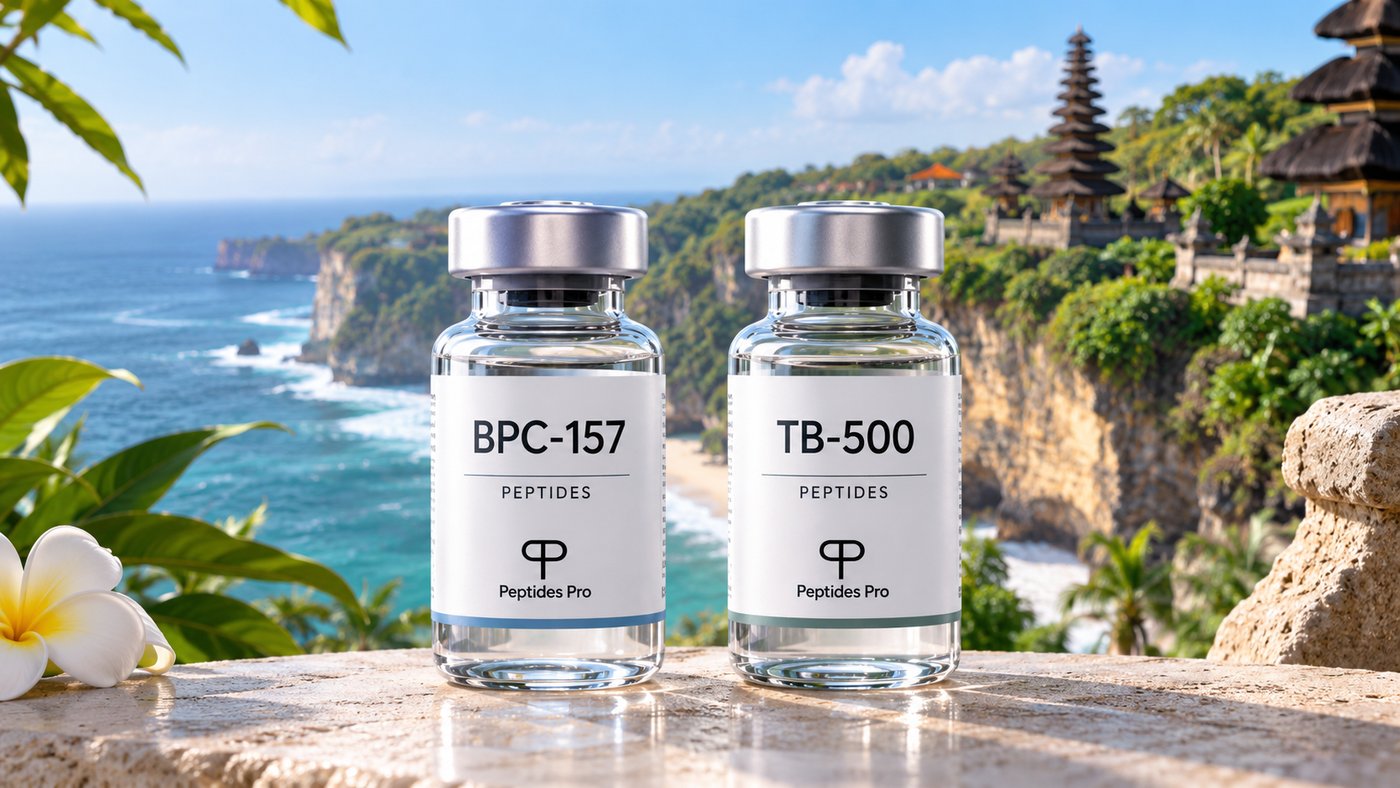
BPC-157 and TB-500 are two experimental peptides that are frequently mentioned together in conversations about recovery, soft-tissue injuries, exercise and regenerative medicine.
That comparison is particularly common in wellness and biohacking circles, including Bali, where visitors may encounter discussions about peptides alongside fitness, recovery and longevity services.
But BPC-157 and TB-500 are not the same peptide.
They have different structures, different biological backgrounds and different levels of human research. Much of the interest surrounding both compounds comes from laboratory and animal research rather than large, high-quality clinical trials in people.
That distinction matters.
If you see BPC-157 and TB-500 presented as interchangeable "recovery peptides", it is worth understanding what they actually are, what researchers have studied, and where the evidence remains incomplete.
What Is BPC-157?
BPC-157 stands for Body Protection Compound 157. It is a synthetic peptide consisting of 15 amino acids.
Researchers have investigated BPC-157 in areas including tissue repair, inflammation, blood-vessel formation and gastrointestinal biology. Much of the research has been conducted in laboratory and animal models.
This has helped generate interest in BPC-157 for conditions involving tendons, muscles, ligaments, wounds and other forms of tissue injury.
However, promising laboratory results do not automatically translate into an established treatment for humans.
A 2025 review of BPC-157 described the human evidence as extremely limited, with only a small number of exploratory human studies available. More recent research has continued to highlight the gap between the large amount of preclinical interest and the limited amount of rigorous clinical evidence.
A small 2025 pilot study investigated intravenous BPC-157 in only two people. Although the participants did not experience reported adverse effects during the study, two participants are nowhere near enough to establish long-term safety or effectiveness.
BPC-157 therefore remains an investigational compound rather than an established medical treatment.
What Is TB-500?
TB-500 is generally described as a synthetic fragment related to thymosin beta-4, a naturally occurring peptide found in human tissues.
This distinction is important because thymosin beta-4 and TB-500 are often treated as though they are exactly the same substance.
They are not.
Thymosin beta-4 is a naturally occurring 43-amino-acid peptide that has been investigated for biological processes including cell migration, angiogenesis and tissue repair.
TB-500 is commonly described as a synthetic fragment associated with thymosin beta-4. Products marketed as TB-500 should therefore not automatically be assumed to have the same clinical evidence as studies conducted using full-length thymosin beta-4.
Research involving thymosin beta-4 has reached human clinical studies in certain areas. For example, an early randomised study investigated intravenous synthetic thymosin beta-4 in healthy volunteers.
That does not mean the findings establish the safety or effectiveness of commercially marketed TB-500 products.
The distinction between the parent molecule and a synthetic fragment is one of the most important things to understand when reading claims about TB-500.
Why Are BPC-157 and TB-500 Compared So Often?
The main reason is their reputation within the recovery and regenerative-medicine space.
Both have been investigated in relation to biological processes involved in tissue repair. Both are also frequently discussed by athletes, gym users and people interested in experimental approaches to recovery.
Online discussions often place them in the same category because people associate both compounds with:
- muscle recovery
- tendon and ligament research
- soft-tissue repair
- inflammation
- wound-healing research
- regenerative medicine
- sports recovery
That does not mean they work in the same way.
It also does not mean that taking them together has been proven to provide additional benefits.
The comparison is largely driven by overlapping areas of research and marketing rather than strong head-to-head clinical evidence.
BPC-157 vs TB-500: What Is Actually Different?
| Feature | BPC-157 | TB-500 |
|---|---|---|
| Basic identity | Synthetic 15-amino-acid peptide | Synthetic fragment associated with thymosin beta-4 |
| Research background | Primarily preclinical research | Primarily preclinical research for the TB-500 fragment |
| Common research interest | Tissue repair, inflammation and gastrointestinal biology | Tissue repair, cell migration and regenerative processes |
| Human evidence | Very limited | Very limited for the TB-500 fragment |
| Full-length parent molecule | BPC-157 itself is the research compound | Related to thymosin beta-4, a 43-amino-acid peptide |
| Approved human medicine | No | No for TB-500 |
| Sports status | Prohibited by WADA | Thymosin beta-4 and derivatives such as TB-500 are prohibited in sport |
| Evidence strength | Not established as a clinical treatment | Not established as a clinical treatment |
The table highlights an important point: similarity in marketing does not equal similarity in scientific evidence.
What Does the Research Say About BPC-157?
BPC-157 has attracted considerable scientific attention because of findings from laboratory and animal studies.
Researchers have reported effects involving several biological pathways associated with tissue repair, blood-vessel formation, inflammation and cellular signalling.
Animal studies have investigated BPC-157 in models involving tendons, muscles, bones, gastrointestinal injury and other conditions.
However, the number of controlled human clinical studies remains very small.
A 2025 narrative review concluded that BPC-157 had substantial preclinical interest but very limited human evidence. A 2026 review similarly highlighted major barriers to clinical development, including limited human data, formulation challenges and the absence of an established pharmaceutical development pathway.
This is why phrases such as "clinically proven recovery peptide" should be treated cautiously.
There is a difference between:
"Researchers have observed an effect in an animal model"
and:
"Clinical trials have demonstrated that the treatment works safely in humans."
Those statements are not interchangeable.
What Does the Research Say About TB-500?
TB-500 is more complicated because the scientific literature surrounding thymosin beta-4 is sometimes discussed alongside the synthetic fragment marketed as TB-500.
Thymosin beta-4 itself has been studied in experimental and clinical settings, including research involving tissue repair and wound healing.
The biology of thymosin beta-4 is also well documented. It interacts with actin, a structural protein involved in cell movement and other cellular processes.
Researchers have therefore investigated whether thymosin beta-4 could influence processes such as:
- cell migration
- angiogenesis
- wound healing
- tissue regeneration
- inflammation
- cellular survival
However, evidence involving the full-length thymosin beta-4 molecule should not automatically be presented as evidence proving that TB-500 products produce the same effects.
This is one of the biggest sources of confusion surrounding the peptide.
Is There Strong Human Evidence for Either One?
No.
That is probably the most important answer in this entire comparison.
There is considerably more research available than the average social-media post might suggest, but a large proportion of that research is preclinical.
A recent scoping review examining emerging peptides used in sports medicine found that the evidence base for compounds including BPC-157 and thymosin-related peptides remains limited, with many studies conducted in animals rather than people.
BPC-157 has begun to appear in small human studies, but these studies are not sufficient to establish broad clinical effectiveness or long-term safety.
For TB-500 specifically, the evidence gap is even more important because research on the full-length thymosin beta-4 molecule cannot simply be transferred to every product labelled TB-500.
Large, well-designed clinical trials are still needed.
Why Is This Important in Bali?
Bali has become a major destination for wellness tourism, fitness, longevity services and biohacking-oriented businesses.
That means visitors may encounter peptide discussions in environments ranging from online communities to wellness businesses and clinics.
The important point is that availability does not automatically prove regulatory approval.
A product being offered somewhere in Bali does not necessarily mean that it has been approved as a medicine by Indonesian regulators.
Indonesia's drug regulator, BPOM, regulates medicines distributed within the country. Under BPOM Regulation No. 5 of 2026, medicines distributed through pharmaceutical service facilities and other regulated facilities must meet applicable requirements, including having marketing authorisation where required.
This is particularly relevant for experimental peptides.
A product being described as "research use only" does not automatically transform it into an approved medicine, nor does the label itself establish that the product is suitable for human use.
Are BPC-157 and TB-500 Approved Medicines in Bali?
There is an important distinction between being discussed, being available and being approved.
BPC-157 is not an approved human therapeutic medicine.
TB-500 is also not an approved human medicine.
Neither should therefore be treated as equivalent to an established prescription medicine simply because a supplier, wellness provider or online seller describes it as a peptide therapy.
Indonesia also has mechanisms governing the importation of medicines that do not have local marketing authorisation.
BPOM's Special Access Scheme can allow certain unregistered medicines to enter Indonesia for specific purposes and under specified conditions. The scheme is not a general permission to commercially sell unregistered medicines.
For personal imports, BPOM states that medicines from overseas may be subject to conditions including limited quantities and requirements relating to medical necessity, and such products cannot simply be resold.
This is why the phrase "available in Bali" should never be confused with "approved for general medical use in Bali."
What About Buying BPC-157 or TB-500 Online?
Online availability creates another layer of uncertainty.
With experimental peptides, the label on a vial does not by itself establish:
- the identity of the substance
- the concentration
- sterility
- purity
- stability
- storage conditions
- manufacturing quality
- whether the contents match the label
The FDA has specifically raised safety concerns regarding compounded BPC-157 and TB-500-related substances, including potential immunogenicity and peptide-related impurities.
For TB-500, FDA materials have also noted the absence of human exposure data for drug products containing the TB-500 fragment.
That does not mean every product is necessarily contaminated or dangerous.
It means that consumers cannot assume pharmaceutical-level quality simply because a vial has a professional-looking label.
What About Athletes?
This is another major difference between ordinary wellness discussions and competitive sport.
BPC-157 is prohibited under the World Anti-Doping Agency's rules as a non-approved substance.
Thymosin beta-4 and its derivatives, including TB-500, are also prohibited under anti-doping rules.
For competitive athletes, this is not simply a question of whether a peptide is legally sold somewhere.
A substance can create an anti-doping issue even when it is not classified as a conventional controlled drug.
Athletes should therefore check the current prohibited list and obtain guidance from their relevant anti-doping organisation before using any experimental peptide.
Are BPC-157 and TB-500 the Same Thing?
No.
They are separate substances.
BPC-157 is a synthetic 15-amino-acid peptide.
TB-500 is generally described as a synthetic fragment associated with thymosin beta-4.
Their biological research overlaps in areas involving tissue repair and regenerative processes, which helps explain why they are frequently compared.
But their molecular identities are different, and the scientific evidence supporting one cannot automatically be transferred to the other.
Are They Proven to Work Better Together?
There is not enough high-quality human evidence to make that conclusion.
You may see online protocols that combine BPC-157 and TB-500 and describe the combination as a recovery strategy.
Those claims should not be confused with evidence from large randomised clinical trials.
The fact that two compounds affect related biological processes does not automatically mean that combining them produces a better clinical outcome.
Combination therapy also introduces additional uncertainties because the safety of one experimental compound does not establish the safety of using multiple experimental compounds together.
The Biggest Problem With Online Peptide Claims
One of the biggest problems in the peptide market is the jump from laboratory research to consumer claims.
The progression often looks like this:
Animal study → biological mechanism → online claim → "proven treatment"
The scientific process is much more demanding.
A promising laboratory result generally needs to be followed by carefully controlled human studies examining:
- safety
- pharmacokinetics
- appropriate formulation
- effectiveness
- adverse effects
- interactions
- appropriate patient populations
- long-term outcomes
BPC-157 and TB-500 have not completed that journey as established mainstream treatments.
A Simple Checklist for Evaluating BPC-157 or TB-500 Claims in Bali
Before believing a claim about either peptide, ask:
1. Is the claim based on humans or animals?
Human clinical evidence carries considerably more weight than an animal study when discussing treatment in people.
2. Is the research about the exact compound?
This is particularly important with TB-500.
Research on full-length thymosin beta-4 should not automatically be presented as research proving the effectiveness of TB-500.
3. Is the product actually authorised?
Being sold, advertised or offered by a business is not the same as having regulatory approval.
4. Is the source transparent?
A legitimate scientific discussion should allow you to identify what compound was studied and where the evidence came from.
5. Are the claims stronger than the evidence?
Words such as "guaranteed", "proven", "instant healing" and "zero side effects" should immediately raise questions.
6. Are you an athlete subject to anti-doping rules?
If so, the status of BPC-157 and TB-500 matters regardless of where you obtained them.
BPC-157 vs TB-500: The Bottom Line
BPC-157 and TB-500 are often compared because they occupy a similar corner of the experimental peptide world.
Both are associated with research into tissue repair and regenerative biology. Both have generated considerable interest among athletes, fitness enthusiasts and people interested in recovery.
But they are not the same peptide.
BPC-157 is a synthetic 15-amino-acid peptide with a predominantly preclinical research history and very limited human data.
TB-500 is generally described as a synthetic fragment associated with thymosin beta-4, and the distinction between TB-500 and full-length thymosin beta-4 is essential when evaluating scientific claims.
Neither should be treated as a proven recovery treatment simply because it is popular online or available through a wellness market.
For people in Bali, the most useful approach is to separate three different questions:
What does the science suggest?
What is actually approved?
What is simply being sold or promoted?
Those three things are not always the same.
Frequently Asked Questions
Is BPC-157 the same as TB-500?
No. BPC-157 is a synthetic 15-amino-acid peptide. TB-500 is generally described as a synthetic fragment associated with thymosin beta-4. They are separate substances.
Which one has more human research, BPC-157 or TB-500?
Neither has the kind of large, high-quality human evidence expected for an established medical treatment. BPC-157 has appeared in a small number of exploratory human studies, while the human evidence specifically for the TB-500 fragment remains particularly limited.
Why do people compare BPC-157 and TB-500?
They are commonly discussed together because both are associated with experimental research into tissue repair, recovery and regenerative processes.
Are BPC-157 and TB-500 approved medicines in Bali?
They should not be treated as approved mainstream medicines. Their presence in the wellness or online market does not establish Indonesian regulatory approval.
Can athletes use BPC-157 or TB-500?
Athletes subject to anti-doping rules should be aware that BPC-157 is prohibited and thymosin beta-4 and derivatives such as TB-500 are also prohibited under anti-doping rules.
Does research on thymosin beta-4 prove that TB-500 works?
No. Thymosin beta-4 and TB-500 are related, but they are not automatically interchangeable for the purpose of interpreting clinical evidence. Research involving one should not simply be presented as proof for the other.
Are peptides automatically safe because they occur naturally in the body?
No. A peptide's biological origin does not automatically establish that an externally administered version is safe. Purity, formulation, route of administration, dose, immune reactions and other factors can affect safety.
Conclusion
BPC-157 and TB-500 have become two of the most frequently discussed experimental peptides in recovery and regenerative medicine.
Their popularity is understandable. Laboratory research has produced interesting findings, and both compounds have biological properties that researchers continue to investigate.
But the scientific story is more complicated than the marketing story.
BPC-157 and TB-500 are different compounds, the evidence for each is limited, and research involving related molecules cannot automatically be transferred between them.
For anyone encountering these peptides in Bali, the safest starting point is not asking which one is "better".
It is asking a more important question:
What evidence actually exists for the exact compound, and what is its regulatory status?
That distinction can make the difference between understanding peptide research and simply believing peptide marketing.
> Disclaimer: This article is for educational and informational purposes only. It is not medical advice and does not recommend the use of BPC-157, TB-500 or any other experimental peptide. BPC-157 and TB-500 are investigational substances, and their safety and effectiveness for human medical use have not been established through adequate clinical evidence. Anyone considering an experimental substance should discuss the issue with a qualified healthcare professional and check applicable Indonesian regulations and anti-doping rules where relevant.
Sources
- U.S. Food and Drug Administration (FDA), information on bulk drug substances including BPC-157 and TB-500-related substances and identified safety concerns.
- U.S. Food and Drug Administration, July 2026 Pharmacy Compounding Advisory Committee materials concerning BPC-157 and TB-500.
- PubMed, 2025 review of BPC-157 and its limited human evidence.
- PubMed, research and reviews concerning thymosin beta-4 and tissue repair.
- World Anti-Doping Agency (WADA), Prohibited List.
- Badan Pengawas Obat dan Makanan (BPOM) Indonesia, Regulation No. 5 of 2026 and Special Access Scheme information.