
Education
Can Clinics in Bali Legally Offer Retatrutide?
Published 12 Sept 2026, 21:00 Bali time
Can Bali clinics legally offer retatrutide? We look at its current regulatory status, Indonesian medicine rules, clinical-trial pathways, and what consumers should know before trusting a clinic's claim.
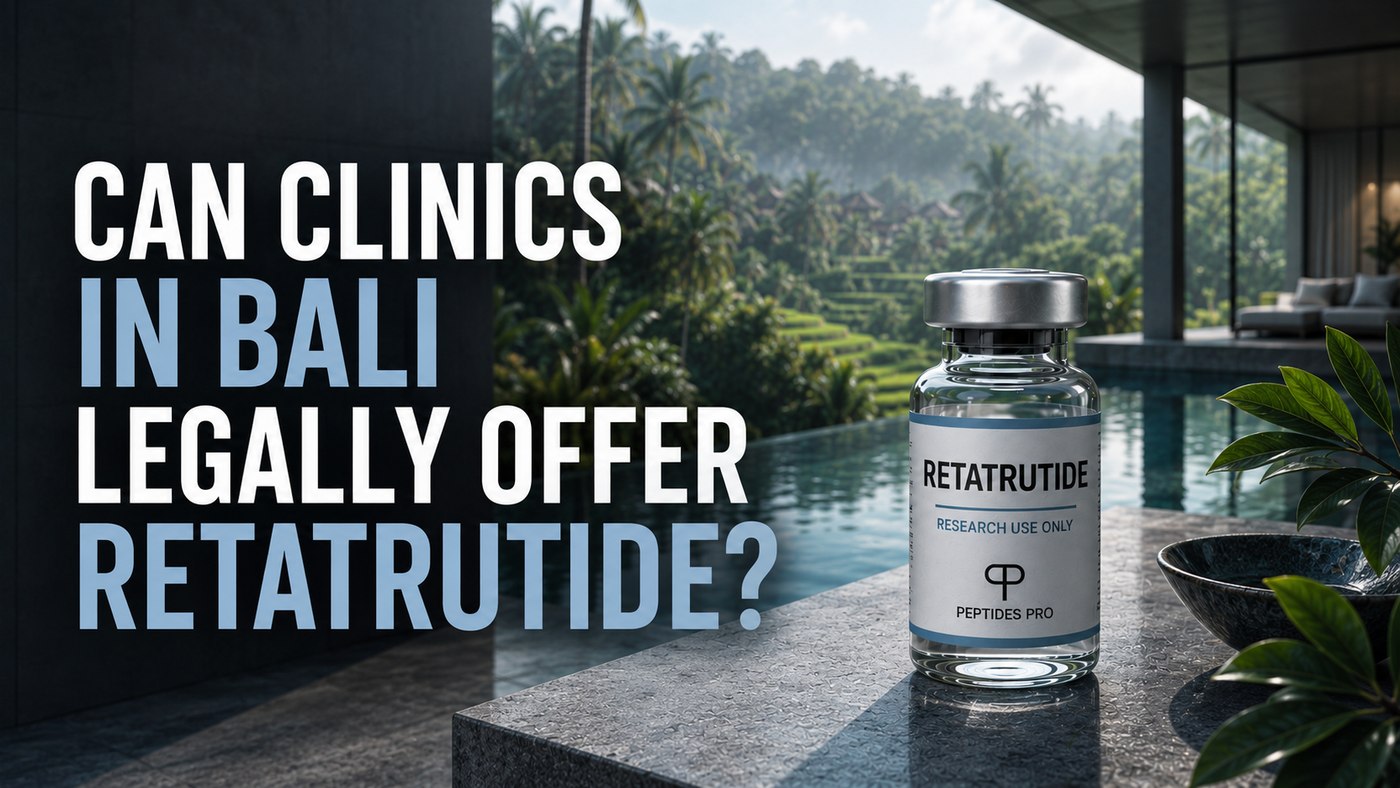
If you are searching for retatrutide in Bali, you may come across clinics, wellness providers, peptide websites, or social-media accounts claiming that the experimental drug is available.
That does not automatically mean it is legally available as a normal medical treatment.
As of 2026, retatrutide remains an investigational medicine. Eli Lilly, the company developing it, says that retatrutide has not been approved by any regulatory agency and is currently being studied in Phase 3 clinical trials. Lilly also states that retatrutide is not available for public use outside its clinical-trial programme. :contentReference[oaicite:0]{index=0}
For someone in Bali, therefore, the important question is not simply:
"Does a clinic offer retatrutide?"
It is:
"Under what Indonesian regulatory pathway is the product being supplied and administered?"
That distinction is crucial.
What Is Retatrutide?
Retatrutide, also known as LY3437943, is an investigational medicine developed by Eli Lilly.
It is sometimes called a triple agonist because it activates three hormone receptors:
- GIP
- GLP-1
- Glucagon
This is different from semaglutide, which primarily activates the GLP-1 receptor, and tirzepatide, which activates GIP and GLP-1 receptors.
The idea behind retatrutide is that combining these three biological pathways may produce stronger effects on appetite, energy metabolism and body weight.
That idea has produced some impressive clinical results.
In a Phase 2 trial published in the New England Journal of Medicine, 338 adults with obesity or overweight plus a weight-related health condition were studied for 48 weeks. The highest retatrutide group experienced an average weight reduction of 24.2%, compared with 2.1% with placebo. Gastrointestinal side effects were the most common adverse events, and researchers also observed dose-dependent increases in heart rate. :contentReference[oaicite:1]{index=1}
Those results explain why retatrutide has become one of the most closely watched drugs in obesity research.
But promising research is not the same thing as regulatory approval.
So, Is Retatrutide Approved?
No.
According to Eli Lilly's most recent public information, retatrutide is still investigational and has not been approved by the FDA or any other regulatory agency. Lilly says it remains in Phase 3 clinical development across obesity and several related conditions. :contentReference[oaicite:2]{index=2}
This is the first thing consumers should understand before looking at clinics in Bali.
Retatrutide should not currently be treated as though it has the same regulatory status as an approved medicine such as semaglutide.
The distinction is especially important because the internet can make experimental drugs appear much more established than they actually are.
A product can have:
- Professional-looking packaging
- A laboratory certificate
- A peptide-clinic website
- A doctor discussing the molecule
- Thousands of social-media posts
- Impressive clinical-trial results
and still be an investigational drug rather than an approved medicine.
What Does Indonesian Regulation Mean for Retatrutide?
This is where the situation becomes more nuanced.
Indonesia regulates medicines through the Badan Pengawas Obat dan Makanan (BPOM).
Ordinarily, medicines distributed in Indonesia require the appropriate regulatory authorisation.
However, Indonesia also has a mechanism called the Special Access Scheme (SAS).
According to BPOM, SAS can permit the entry of medicines that do not yet have an Indonesian marketing authorisation for specific purposes, including personal use, research, product development, clinical trials, government programmes, urgent national interests and certain special healthcare circumstances. :contentReference[oaicite:3]{index=3}
This is an important distinction.
It means that saying:
> "Retatrutide does not have ordinary marketing approval, therefore it can never legally enter Indonesia under any circumstances"
would be too simplistic.
But the opposite statement is equally misleading:
> "Retatrutide has a Special Access Scheme, therefore any Bali clinic can sell it."
That is not what BPOM's system means.
A special regulatory pathway has its own requirements and limitations.
Could a Bali Clinic Use Retatrutide Through a Special Access Pathway?
Potentially, depending on the exact circumstances and authorisation involved.
But that would be very different from offering retatrutide as an ordinary commercially available weight-loss medicine.
BPOM specifically describes SAS as a mechanism for bringing in medicines without an ordinary marketing authorisation for defined purposes. It also states that medicines imported for personal use under the scheme must meet specific conditions and cannot simply be resold. :contentReference[oaicite:4]{index=4}
So if a Bali clinic claims:
> "We legally offer retatrutide through a special access programme."
the appropriate response is not automatically to believe or reject the claim.
Instead, ask:
What is the specific authorisation?
Who obtained it?
For what purpose?
Who is the responsible healthcare professional?
Is the product being used within the scope of that authorisation?
Those details matter.
What About Clinical Trials?
Clinical research is another legitimate situation in which an investigational medicine can be used.
Retatrutide is currently being studied in clinical trials, including Phase 3 programmes.
This is very different from a wellness clinic simply selling an experimental peptide.
A clinical trial has a defined research protocol, investigators, participants who meet specific criteria, regulatory oversight and procedures for monitoring safety.
The fact that a drug is being studied does not mean that every clinic can administer it as part of its normal services.
For consumers, this is an important distinction:
| Situation | What it means |
|---|---|
| Approved medicine | Can be used according to its approved indication and local regulations |
| Clinical trial | Investigational use under an authorised research protocol |
| Special access | Specific regulatory pathway with defined conditions |
| "Research use only" vial | Not automatically an approved medicine |
| Online peptide seller | Advertising does not establish regulatory approval |
| Clinic advertisement | Does not by itself prove the product is legally authorised |
Why Does Retatrutide's Research Matter?
The fact that retatrutide is not yet approved does not mean the science behind it is weak.
Quite the opposite.
The molecule has attracted substantial scientific attention because of its clinical-trial results.
The 2023 Phase 2 New England Journal of Medicine study found substantial weight loss over 48 weeks. The researchers also reported that participants continued to lose weight throughout the study period rather than reaching an obvious plateau by week 48. :contentReference[oaicite:5]{index=5}
The study was led by Ania Jastreboff, MD, PhD, an endocrinologist and obesity researcher at Yale.
The findings were important enough to move retatrutide into larger Phase 3 programmes.
But this is exactly why the regulatory distinction matters.
A promising Phase 2 result tells us:
"This drug deserves further investigation."
It does not automatically tell us:
"This drug is ready for routine clinical use."
What Are Researchers Still Trying to Learn?
Retatrutide's development is not simply about proving whether people lose weight.
Researchers also need to understand its broader safety and effectiveness across different populations and medical conditions.
Current Phase 3 development includes investigation in areas such as:
- Obesity
- Type 2 diabetes
- Knee osteoarthritis associated with obesity
- Obstructive sleep apnoea
- Cardiovascular outcomes
- Chronic low back pain
- Metabolic dysfunction-associated steatotic liver disease
Lilly says these studies are part of its ongoing Phase 3 programme. :contentReference[oaicite:6]{index=6}
That breadth is one reason retatrutide is receiving so much attention.
It also shows why it is premature to think of the molecule simply as "the next weight-loss injection."
Researchers are still establishing where its benefits and risks fit within medicine.
What Should You Be Careful About in Bali?
Bali has a large wellness and medical-tourism industry.
That can be useful for people looking for legitimate healthcare, but it also means visitors can encounter a wide range of products and services with very different levels of regulatory oversight.
When an experimental peptide becomes popular online, marketing can move faster than regulation.
This is particularly relevant for retatrutide because demand is already high despite the drug not being publicly approved.
A clinic saying:
> "We have retatrutide."
does not answer the most important questions.
You should still ask:
Is the product authorised in Indonesia?
If yes, ask for the relevant registration or authorisation details.
If it is not registered, what legal pathway is being used?
A clinic should be able to explain whether the product is being used under an applicable special-access or research pathway.
Who manufactured it?
The name of an overseas peptide supplier is not the same thing as an established pharmaceutical manufacturer.
Is it part of a clinical trial?
If the clinic says it is research, ask what trial, institution and protocol are involved.
Is the product labelled "research use only"?
If so, that should prompt additional caution rather than reassurance.
Can the clinic explain the regulatory status in writing?
A legitimate healthcare provider should not be uncomfortable with reasonable questions about the origin and regulatory status of an investigational medicine.
"Research Use Only" Does Not Mean "Safe for Human Use"
This is one of the most important points in the modern peptide market.
A research-use label does not mean:
"This is an approved medicine, but only researchers are allowed to buy it."
It generally indicates that the product is being marketed outside the normal framework for approved human medicines.
Eli Lilly has warned consumers against products claiming to contain retatrutide outside legitimate clinical trials. The company says unapproved products may contain unknown ingredients, contaminants, impurities, incorrect amounts of active ingredient or even a different substance entirely. :contentReference[oaicite:7]{index=7}
That is why the phrase "99% pure" should not be treated as a substitute for pharmaceutical regulation.
Purity is only one part of product quality.
For an injectable medicine, questions can also involve identity, sterility, manufacturing controls, storage, stability, contaminants and consistency.
Is Retatrutide the Same as Semaglutide?
No.
Both are being studied for obesity and metabolic disease, but their pharmacology is different.
| Retatrutide | Semaglutide | |
|---|---|---|
| Main receptor targets | GIP + GLP-1 + glucagon | GLP-1 |
| Drug status | Investigational | Approved medicine |
| Development | Phase 3 | Established clinical use |
| Main research interest | Obesity and metabolic disease | Diabetes and obesity, depending on product |
| Public availability | Not approved for routine use | Available under approved products in relevant markets |
The important difference for someone in Bali is therefore not simply how much weight each drug might help someone lose.
It is their regulatory status.
Semaglutide belongs to an established pharmaceutical system.
Retatrutide is still moving through that system.
What If a Clinic Says Its Retatrutide Is "Pharmaceutical Grade"?
This phrase deserves careful attention.
"Pharmaceutical grade" can sound reassuring, but consumers should ask what exactly the term means in the context of the product.
It does not automatically demonstrate that a retatrutide product has Indonesian marketing authorisation.
Likewise, a certificate of analysis can provide information about a tested sample without proving that the product is authorised for routine human use.
The strongest evidence is not how professional the vial looks.
It is the regulatory and pharmaceutical chain behind the product.
Five Questions to Ask a Bali Clinic
If you encounter a Bali clinic advertising retatrutide, consider asking these five questions before assuming it is a legitimate approved treatment:
1. Is retatrutide registered with BPOM?
2. If not, under what specific regulatory pathway is it being supplied?
3. Who is the manufacturer and authorised supplier?
4. Is its use part of an approved clinical trial or special-access arrangement?
5. Can you provide documentation supporting the product's legal status?
A vague answer to these questions should be treated as a reason to investigate further.
The Bigger Problem With "Available" Peptides
One of the biggest misunderstandings in the peptide market is that availability equals legitimacy.
It doesn't.
An experimental peptide can be advertised online.
It can appear on a clinic's menu.
It can be shipped internationally.
It can arrive in professional-looking packaging.
None of those things automatically establish that it is an approved medicine.
This is particularly important in a destination such as Bali, where medical tourism means consumers may be unfamiliar with the Indonesian regulatory system.
The safest approach is to separate three different concepts:
Availability
A product can be obtained.
Legality
A product can be legally imported, possessed or supplied under a particular regulatory pathway.
Approval
A medicine has received marketing authorisation for defined uses.
These are not interchangeable.
So, Can Clinics in Bali Legally Offer Retatrutide?
The answer requires more nuance than a simple yes or no.
Retatrutide is not currently an approved medicine for ordinary public use in Indonesia. Eli Lilly continues to classify it as investigational and says it is legally available through its clinical trials rather than as a normal consumer medicine. :contentReference[oaicite:8]{index=8}
Indonesia does, however, have specific regulatory mechanisms such as the Special Access Scheme for certain medicines without ordinary marketing authorisation. BPOM lists research, clinical trials and certain special healthcare circumstances among the purposes for which this pathway may apply. :contentReference[oaicite:9]{index=9}
Therefore, a clinic cannot reasonably point to the existence of SAS and conclude that it has a blanket right to sell retatrutide.
The exact authorisation, purpose and circumstances matter.
For an ordinary consumer in Bali, an advertised retatrutide injection should not be assumed to be equivalent to an approved prescription medicine.
What This Means for People Looking for Retatrutide in Bali
The growing interest in retatrutide is understandable.
The clinical research has been impressive, and its triple-receptor mechanism has made it one of the most closely watched molecules in obesity medicine.
But that excitement can create a dangerous gap between what the research suggests and what is legally and medically available today.
If a Bali clinic claims to offer retatrutide, do not judge the treatment by the bottle, the marketing, the social-media following or the promised results.
Look at the regulatory pathway.
Ask where the product came from.
Ask who is responsible for its use.
And ask whether the product is actually authorised for the purpose for which it is being offered.
That is a much better way to evaluate a peptide clinic than simply asking whether it has the latest compound.
Frequently Asked Questions
Is retatrutide approved in Indonesia?
Retatrutide remains investigational and is not currently an approved medicine for routine public use. Its developer, Eli Lilly, says it has not been approved by any regulatory agency. :contentReference[oaicite:10]{index=10}
Can I buy retatrutide from a Bali clinic?
The fact that a clinic advertises or claims to sell retatrutide does not establish that it is legally authorised to provide the drug as an ordinary treatment. The regulatory pathway needs to be verified.
Is retatrutide the same as Ozempic?
No. Ozempic contains semaglutide, which is a GLP-1 receptor agonist. Retatrutide is an investigational triple agonist targeting GIP, GLP-1 and glucagon receptors.
Why is retatrutide so popular?
Clinical trials have shown substantial weight reduction, and researchers are interested in whether its three-receptor mechanism can produce benefits beyond those seen with earlier incretin-based medicines. :contentReference[oaicite:11]{index=11}
Does "research use only" retatrutide mean it is safe?
No. A research-use label does not establish that a product is approved or suitable for human use. Eli Lilly specifically warns against products claiming to be retatrutide outside legitimate clinical trials. :contentReference[oaicite:12]{index=12}
Can unregistered medicines ever enter Indonesia?
Yes, Indonesia has specific mechanisms such as the Special Access Scheme for defined circumstances, including research, clinical trials and certain special healthcare uses. These mechanisms have conditions and do not represent blanket permission to commercially sell unregistered medicines. :contentReference[oaicite:13]{index=13}
Is retatrutide available through clinical trials?
Retatrutide is being studied in clinical trials, including Phase 3 programmes. Eli Lilly states that it is not available for general public use outside its clinical-trial programme. :contentReference[oaicite:14]{index=14}
Final Takeaway
Retatrutide may be one of the most exciting drugs in obesity research right now, but research excitement and regulatory approval are two different things.
For Bali consumers, that distinction matters.
A clinic advertising retatrutide is not automatically offering an approved medicine. At the same time, Indonesian regulation contains specific pathways for certain unregistered medicines in defined circumstances.
The sensible approach is therefore not to assume that every retatrutide offer is illegal — or that every clinic offering it is legitimate.
Instead, ask the question that actually matters:
What regulatory authorisation allows this specific product to be supplied and administered to patients in Indonesia?
If a clinic cannot give you a clear answer, that is information worth taking seriously.
Medical Disclaimer
This article is intended for educational and informational purposes only. It does not constitute medical, legal or regulatory advice and does not recommend purchasing, importing or using retatrutide. Retatrutide remains an investigational medicine, and its regulatory status may change as clinical trials and regulatory reviews progress. Anyone considering an investigational medicine should consult a qualified healthcare professional and independently verify current information with the relevant Indonesian authorities.