
Education
Could WhatsApp Become the New Pharmacy Counter for Peptides in Bali?
Published 2 Oct 2026, 21:00 Bali time
Bali peptide sellers are increasingly using WhatsApp for orders, consultations and same-day delivery. We examine what that means for safety, regulation and the growing gray market.
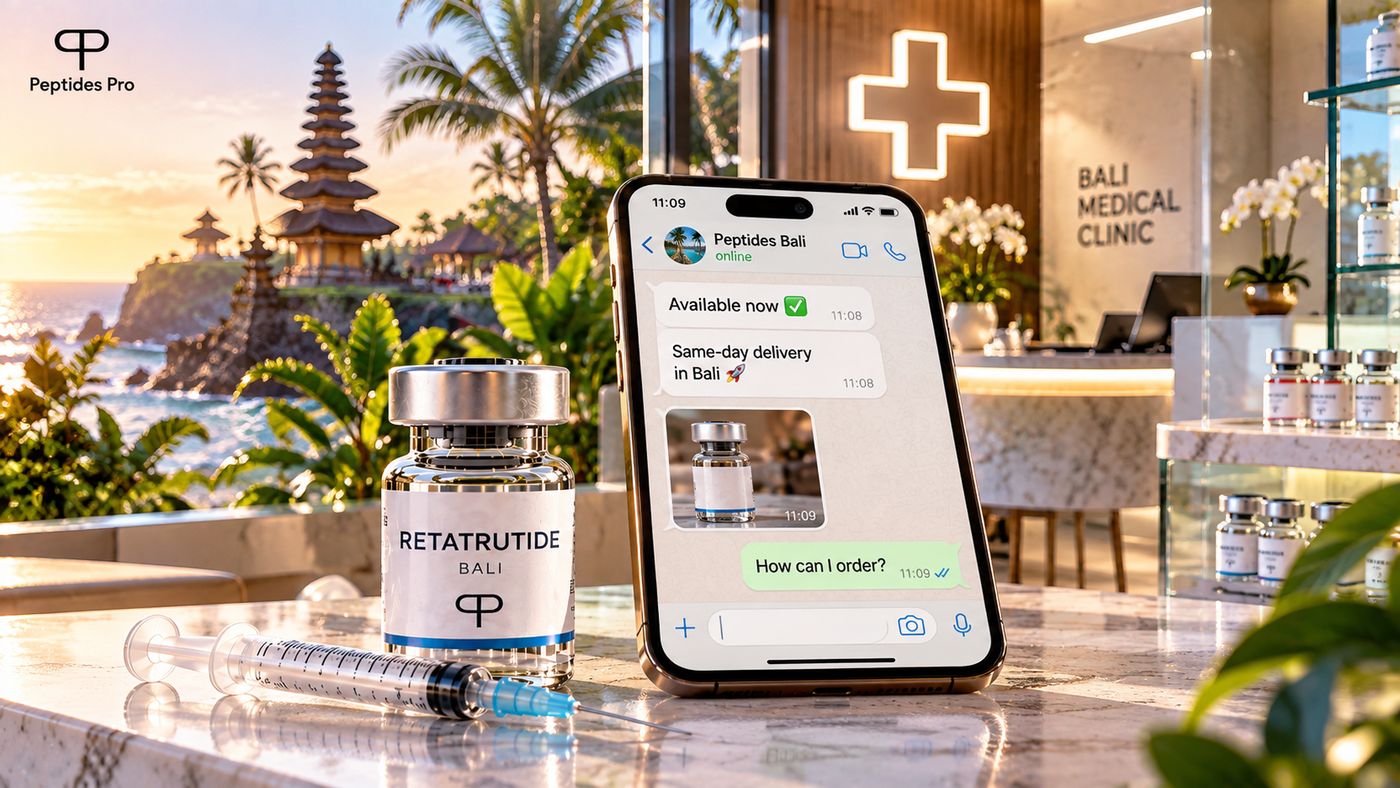
The storefront is a website.
The product catalogue contains compounds such as BPC-157, retatrutide, GHK-Cu and TB-500.
But when it is time to actually order, something interesting happens.
The customer leaves the website and opens WhatsApp.
Across Bali's emerging peptide market, several sellers now openly direct customers to WhatsApp to check stock, discuss products, confirm prices, arrange payment and organise delivery to villas, hotels and homes.
One Canggu-focused seller describes WhatsApp and Telegram as its current ordering system. Another says its Bali team can arrange same-day dispatch through WhatsApp. A third tells visitors they do not need an account or local phone number: simply message the compound they want and their accommodation address.
At first glance, this looks like ordinary Indonesian e-commerce. WhatsApp is deeply embedded in everyday business across the country.
But peptides make the situation much more complicated.
Some of the products being discussed are established medicines.
Some are investigational drugs.
Others are experimental research compounds with little human evidence.
Some sellers explicitly state that their products are for laboratory research only, while neighbouring pages offer consultations, "protocol" discussions, syringes, body-composition categories and same-day delivery.
And Indonesia has increasingly specific rules governing how medicines may be advertised and distributed online.
So the interesting question is not whether WhatsApp itself is a problem.
It is whether a messaging app can quietly collapse several traditionally separate functions into a single chat:
product catalogue → consultation → recommendation → transaction → delivery
That starts to look remarkably similar to a pharmacy counter, without necessarily providing the regulatory infrastructure of one.
The short answer
WhatsApp is becoming an important commercial channel in Bali's peptide market.
Publicly accessible websites from several Bali-based or Bali-facing suppliers direct customers to WhatsApp for ordering, product questions, availability checks and delivery arrangements.
That does not mean every WhatsApp transaction involving a peptide is automatically unlawful.
The regulatory position depends on what the substance is, how it is classified, what claims are being made, who is supplying it and whether it is being sold as a medicine or as a research material.
However, the distinction matters because Indonesia already regulates online medicine distribution closely.
BPOM's 2024 regulation on online distribution specifically restricts certain medicines from direct online sale to the public. Notably, its prohibited list includes injectable drug preparations other than insulin intended for self-use. The same regulation requires prescription-only medicines supplied online to be based on a valid prescription and creates record-keeping, pharmacy-system and professional-accountability requirements for regulated online medicine distribution. (peraturan.bpk.go.id)
In 2026, BPOM strengthened medicine advertising rules further and specifically highlighted restrictions involving the use of two-way social-media communication features as a means of buying and selling medicines. (pom.go.id)
WhatsApp therefore sits in an increasingly important regulatory grey area when it is used not merely for customer service, but as the entire infrastructure through which a product with pharmacological claims is selected, purchased and delivered.
What does the Bali market actually look like?
This is not hypothetical.
Peptides Pro reviewed several public Bali-facing websites in September 2026.
Peptides Pro Indonesia
A Canggu-specific guide states that orders are currently handled through WhatsApp and Telegram.
The page says customers can use the messaging services to confirm:
- availability
- Indonesian rupiah pricing
- delivery options
- next steps
It also advertises consultation support before ordering. (peptidespro.id)
Mito Labs Bali
Mito Labs publicly lists products including tirzepatide, retatrutide, semaglutide, BPC-157, TB-500, CJC-1295, ipamorelin and GHK-Cu.
Its website tells customers they can either use the online shop or message the Bali team directly on WhatsApp for same-day dispatch.
The company states that its products are intended strictly for in-vitro research and laboratory use and are not intended for human or animal consumption. (mitolabsbali.com)
BioPepTech
BioPepTech also routes orders through WhatsApp.
Its Bali page states that customers can message the business to discuss the product, availability, address, documentation and delivery.
Another page specifically tells international visitors that they can send their accommodation address, requested compounds and preferred delivery time through WhatsApp.
The business states that its products are research-grade materials not approved for human consumption or medical treatment. (biopeptech.id)
Peptide+
Peptide+ currently tells customers that normal online ordering is paused and that orders are being taken through WhatsApp.
Its storefront advertises research products including retatrutide, BPC-157/TB-500 blends, GHK-Cu and other compounds, with same-day dispatch from Canggu.
Its retatrutide-focused site goes further, telling customers to select a product through WhatsApp and offering same-day delivery to villas, hotels and homes around Bali. (peptideplus.shop)
These are sellers' own representations.
They do not establish that the products contain what is claimed, that customers use them personally or that a particular business is violating Indonesian law.
But collectively they demonstrate something significant:
WhatsApp is no longer merely the contact button at the bottom of the page. For parts of Bali's peptide market, it is becoming the checkout system.
Why WhatsApp works so well for this market
The appeal is obvious.
Traditional pharmacy transactions contain friction.
There may be a prescription.
A pharmacist may ask questions.
The product has a formal registered name.
There is documentation.
A physical pharmacy may close at a particular time.
WhatsApp removes much of that friction.
A customer can send:
> "Do you have retatrutide?"
The seller can answer immediately.
Stock can be confirmed.
A location pin can be sent.
Payment instructions can follow.
A courier can arrive at a villa several hours later.
No separate account is required.
No conventional checkout page is necessary.
For tourists and digital nomads, the system is particularly attractive because many already use WhatsApp as their primary way of interacting with Bali businesses.
That convenience is not inherently problematic.
Restaurants, drivers, hotels and legitimate healthcare businesses all use messaging applications.
The issue is that the more medically consequential the product becomes, the more important the systems surrounding the transaction become too.
Indonesia already treats online medicine sales differently from ordinary e-commerce
BPOM Regulation No. 14 of 2024 provides one of the clearest indications of how seriously Indonesia treats online medicine distribution.
The regulation covers medicines and other regulated health products distributed through electronic systems.
It defines online distribution broadly as activities involving the distribution or supply of regulated products using electronic transaction media. (peraturan.bpk.go.id)
For regulated medicines, this is not simply a question of putting a product on a website and hiring a courier.
The framework includes requirements involving electronic pharmacy systems, responsible pharmaceutical personnel, transaction records and regulatory access to information.
For example, transaction data for medicines distributed online must be archived and traceable for at least five years.
The regulation also requires information including the facility conducting the transaction, transaction date, medicine involved, quantity, purchaser details and transaction-document number.
That is a very different model from an informal chat disappearing into someone's WhatsApp inbox.
Prescription medicines still require prescriptions online
The same 2024 regulation states that prescription-only medicines supplied to patients online must be based on a prescription issued in accordance with applicable regulations.
Moving a transaction onto the internet does not remove the underlying requirements that apply to the medicine.
This is an important misconception.
Online medicine does not mean medicine without pharmacy rules.
Technology changes the interface.
It does not automatically change the legal category of the substance.
For certain medicines, Indonesia even requires a closed electronic prescription system in which the prescription is transmitted directly from the doctor to the healthcare facility.
That is essentially the opposite of an informal buyer sending a product name through a messaging application.
There is an even bigger issue for injectable products
One provision is particularly relevant to peptide culture.
The annex to BPOM Regulation No. 14 of 2024 lists products prohibited from direct online distribution to the public.
Among them are:
injectable drug preparations, except insulin intended for self-administration.
That is an unusually important rule in the context of peptides because many products promoted by the international peptide market are sold in injectable formats.
It would be legally overbroad to assume that every vial labelled "research peptide" automatically falls within the Indonesian legal definition of a medicine.
Classification can depend on the product, intended use, claims and regulatory context.
However, if a product is legally treated as a medicine, its injectable format can have major consequences for whether direct online supply to the public is permitted.
This makes the wording used by peptide sellers particularly important.
A vial described strictly as a laboratory reagent raises one regulatory question.
The same vial marketed around human weight loss, recovery, longevity or medical outcomes raises another.
The "research use only" disclaimer becomes crucial
Most sophisticated peptide sellers understand this distinction.
That is why phrases such as these appear repeatedly:
- "Research use only."
- "Not for human consumption."
- "For laboratory use."
- "For qualified researchers."
Those disclaimers matter.
But regulators generally evaluate more than a single sentence at the bottom of a website when assessing how a product is being presented.
The surrounding context can also matter.
Consider a hypothetical site that says:
NOT FOR HUMAN CONSUMPTION
but also provides:
- body-weight claims
- personal testimonials
- "protocol" consultations
- syringes
- advice about how long a vial lasts
- same-day delivery to a customer's villa
The disclaimer and the surrounding commercial message may point in different directions.
That does not automatically determine the legal outcome.
It does mean that "research use only" should not be interpreted by consumers as evidence that the product has undergone medicine approval or that its intended use has somehow been clinically validated.
BPOM is already watching WhatsApp-style medicine distribution
This is not a theoretical concern for Indonesian regulators.
In 2026, the BPOM office in Denpasar discussed the increasingly complex distribution of unregulated drug products through digital channels.
Its cyber-patrol work during 2024–2025 identified more than 1,100 links involving certain problematic drug sales across marketplaces, social media and communication applications including WhatsApp. (denpasar.pom.go.id)
The products involved in that enforcement discussion were not peptides.
That distinction is important.
But the regulatory lesson applies directly to the distribution channel:
BPOM is already treating private messaging applications as part of the online medicine-distribution environment it needs to monitor.
This matters because WhatsApp commerce can be less visible than a conventional web shop.
A regulator can scan a public product page.
A private conversation is harder to observe unless it is reported, documented through an investigation or connected to public advertising.
Indonesia tightened medicine advertising rules again in 2026
BPOM introduced another relevant regulation in April 2026.
Regulation No. 7 of 2026 covers medicine promotion and advertising.
According to BPOM's own explanation of the new rules, the agency specifically added restrictions on using two-way communication features on social media as a means of conducting medicine transactions.
The regulation also strengthened restrictions involving:
- medicine samples offered to the public
- bonuses involving drugs or pharmaceutical preparations
- excessive discounts and commissions
- influencer promotion of medicines
BPOM described the update as a response to changing technology and communication channels. (bpkom.pom.go.id)
The agency's announcement refers specifically to social-media functionality.
Whether and how a particular WhatsApp transaction falls within individual provisions can depend on the facts and legal interpretation, so it would be inappropriate to claim that every WhatsApp conversation involving medicine violates this regulation.
But the regulatory direction is unmistakable.
Indonesia is moving towards more oversight of conversational medicine commerce, not less.
Even WhatsApp's own business rules are relevant
There is another layer many customers may never consider.
WhatsApp Business itself restricts commerce involving regulated goods.
Its current Business Messaging Policy states that WhatsApp Business services cannot be used to buy, sell, promote or otherwise facilitate the exchange of certain regulated or restricted products.
The list includes:
- prescription and other drugs
- medical and healthcare products
WhatsApp states that these restrictions apply regardless of licences, registrations or approvals a business may hold. (business.whatsapp.com)
That does not mean every conversation between a pharmacy and a patient is prohibited in every context; WhatsApp distinguishes different business functions and healthcare communication arrangements.
But using WhatsApp Business itself as a direct commerce mechanism for restricted health products can create a separate platform-policy issue in addition to national regulation.
The three questions therefore become:
- Is the product permitted under Indonesian law?
- Is the manner of online sale permitted?
- Does the transaction comply with WhatsApp's own platform rules?
These are not necessarily answered the same way.
Why private messaging changes the safety equation
The regulatory debate is not only bureaucratic.
Traditional pharmaceutical distribution includes safeguards precisely because medicines can cause harm.
WhatsApp-based peptide commerce can make several of those safeguards less visible.
Who is actually advising the customer?
A profile picture and first name do not establish someone's professional qualification.
If someone recommends a product through chat, the customer may not know whether they are speaking with:
- a pharmacist
- a doctor
- a salesperson
- a customer-service representative
- the business owner
- an independent reseller
For experimental products, this becomes particularly consequential.
The person giving advice may be discussing a compound whose human safety evidence is limited or whose regulatory status is still investigational.
Where is the medical history?
Medicines can interact with medical conditions and other treatments.
A conventional clinical consultation may review medical history, pregnancy status, allergies, concurrent medicines and relevant laboratory results.
A WhatsApp sales conversation may or may not include any of these.
If the main objective is completing a sale quickly, there is an obvious risk that medically important context becomes secondary.
Where is the permanent record?
BPOM's regulated online-medicine framework requires traceability.
WhatsApp conversations create records, but they are not inherently equivalent to formal healthcare or pharmacy records.
Messages can be deleted.
Accounts can disappear.
Customers may change phone numbers.
A reseller may stop operating.
That matters if a product is later recalled or associated with an adverse event.
The peptide itself may not even be approved
This makes WhatsApp ordering particularly different from ordering an ordinary registered medicine.
Consider three products that might appear in the same Bali conversation.
| Compound | Regulatory/evidence position |
|---|---|
| Tirzepatide | BPOM-authorised medicine exists in Indonesia for specified indications |
| Retatrutide | Investigational; no approved commercial medicine as of September 2026 |
| BPC-157 | Experimental; no established approved therapeutic use and extremely limited human evidence |
The interface may look identical.
"Message us on WhatsApp."
But the underlying compounds could not be more different.
A customer scrolling through a catalogue may experience them as three neighbouring products.
Regulators and medical researchers see three completely different evidence categories.
This is one of the recurring problems with the peptide market.
A frictionless storefront makes scientifically unequal products look commercially equal.
For more context, see Tirzepatide vs BPC-157 in Bali: Why One Is a Medicine and the Other Isn't.
Retatrutide makes the WhatsApp issue especially striking
Retatrutide is still an investigational medicine.
Eli Lilly has published major Phase 3 results but has not yet received regulatory approval for the drug.
Yet Bali websites already advertise products under the retatrutide name and allow customers to initiate the transaction through WhatsApp.
One Bali-facing site offers a retatrutide product with same-day island delivery and explicitly tells customers to begin by messaging the business on WhatsApp.
That creates a remarkable timeline:
Phase 3 clinical trial → online publicity → WhatsApp order → Bali villa delivery
all before an approved retatrutide medicine exists.
The issue is not simply speed.
It is that clinical trial results apply to Lilly's controlled investigational product.
They cannot automatically be transferred to a commercial vial obtained from an unrelated supplier.
See Retatrutide Is Already Being Sold in Bali. But It Isn't Approved Anywhere Yet.
Lab testing does not turn WhatsApp into a pharmacy
Many Bali peptide sellers respond to quality concerns by displaying certificates of analysis.
That can be useful.
Appropriate testing may provide evidence about the identity, quantity or purity of a submitted sample.
But laboratory testing and pharmaceutical distribution are different systems.
A certificate does not independently establish:
- BPOM marketing authorisation
- appropriate prescribing
- pharmacist oversight
- patient screening
- long-term clinical safety
- batch-to-batch consistency
- correct storage throughout the distribution chain
Nor does a purity report automatically establish sterility.
For injectable products, that distinction is particularly important.
See Bali's Peptide Sellers Are Showing Lab Reports. Can You Trust Them?.
Same-day delivery introduces another layer
WhatsApp also makes rapid delivery possible.
Several Bali peptide sellers advertise same-day or expedited delivery in Canggu and surrounding areas.
Speed is attractive.
But pharmaceutical logistics are not simply about how quickly something arrives.
Some biological or peptide products require defined storage conditions.
A regulated distribution system may need documented processes around:
- temperature
- packaging
- transport
- handling
- handover
- traceability
BPOM's online-distribution regulation requires delivery conditions appropriate to the characteristics of the product and documented handover.
For an approved medicine, storage requirements come from validated product information.
For a research peptide, comparable stability information may be incomplete or formulation-specific.
This is another reason "delivered cold" and "pharmaceutical cold chain" should not automatically be treated as equivalent claims.
The transaction can become almost invisible
There is a broader enforcement problem too.
A traditional website leaves a public trail.
Products are indexed.
Prices are visible.
Advertising claims can be captured.
A transaction that moves quickly into private messaging becomes harder for outsiders to evaluate.
The public website may simply say:
Contact us.
Inside the conversation, the customer may receive information about:
- price
- availability
- product combinations
- usage claims
- payment
- delivery
Researchers, journalists and regulators generally cannot see that conversation unless someone provides it.
This does not mean privacy itself is suspicious.
Medical communications deserve privacy.
But an opaque transaction system can make a gray market considerably more difficult to monitor.
Could WhatsApp actually be useful in legitimate healthcare?
Absolutely.
The technology is not inherently the problem.
A legitimate clinic might use WhatsApp to:
- schedule appointments
- confirm opening hours
- send administrative reminders
- answer non-clinical questions
- coordinate an already authorised prescription pickup
WhatsApp can make healthcare dramatically more accessible, particularly in places where messaging is the default form of digital communication.
The crucial distinction is whether WhatsApp is being used as a communication layer around regulated healthcare or whether the conversation itself has become the entire medical and commercial infrastructure.
Those are very different models.
Pharmacy counter versus peptide chat
| Traditional regulated pharmacy function | Informal WhatsApp peptide transaction may look like |
|---|---|
| Licensed pharmaceutical facility | Messaging account |
| Identifiable pharmacist or healthcare professional | Unknown adviser or salesperson |
| Registered medicine | May include approved, investigational or experimental compounds |
| Prescription where required | May or may not be requested |
| Formal medicine information | Chat-based guidance |
| Controlled transaction records | Message history |
| Regulated storage and distribution | Seller-described cold delivery |
| Pharmacovigilance framework | Uncertain adverse-event reporting pathway |
| Product traceability | Depends on seller documentation |
| Regulatory inspection | More difficult when transactions become private |
This does not prove every WhatsApp peptide transaction lacks these safeguards.
It shows why the messaging interface alone tells a consumer very little about what exists behind it.
What people often misunderstand
"Selling through WhatsApp automatically makes a peptide illegal"
No.
The product's legal classification, claims, supplier and type of activity all matter.
WhatsApp is a communication technology, not a legal category.
"If the seller says research use only, medicine regulations definitely do not apply"
Not necessarily.
A disclaimer is relevant, but product classification can involve additional factors, including intended use and the claims surrounding a product.
Only the relevant Indonesian authorities can determine the status of a specific product and activity.
"If something can be delivered to my villa, it must be approved"
No.
Commercial availability does not establish BPOM marketing authorisation.
The two questions are completely separate.
"WhatsApp ordering is the same as an online pharmacy"
No.
A regulated online pharmacy operates within a pharmaceutical framework involving authorised facilities, responsible professionals and applicable medicine-distribution rules.
A WhatsApp contact button alone establishes none of those things.
"Lab-tested means it is okay to buy privately"
Laboratory analysis can provide information about a sample.
It does not determine whether the commercial transaction complies with Indonesian regulation or whether the product is clinically appropriate.
"All peptide vials are covered by the online injectable-drug ban"
That cannot be assumed.
BPOM's rule applies to products legally treated as medicines.
Whether a particular "research peptide" falls within that category depends on its regulatory classification and the circumstances in which it is marketed and supplied.
What consumers in Bali can actually verify
A useful first step is to separate the seller from the product.
For a product represented as a medicine, check whether the exact finished medicinal product appears in BPOM's official registration system.
Do not search only for the molecule.
Approval applies to a specific registered product.
A vial labelled "tirzepatide", for example, does not automatically share the regulatory status of BPOM-authorised Mounjaro.
Useful questions include:
- What is the exact product name?
- Who manufactures it?
- Does it have a BPOM Nomor Izin Edar?
- Does that number match the official BPOM database?
- Is the person giving medicine advice professionally qualified?
- Is the product an approved medicine or explicitly an experimental research material?
- Does the laboratory report correspond to the current batch?
- Who is responsible if an adverse event occurs?
BPOM recommends its Cek KLIK approach for medicine and health-product purchases: check the packaging, label, marketing authorisation and expiry information.
The regulator also advises consumers to obtain medicines through authorised pharmacies or registered platforms rather than assuming that online availability establishes legitimacy. (pom.go.id)
Frequently Asked Questions
Are Bali peptide sellers really using WhatsApp for orders?
Yes.
Multiple publicly accessible Bali-facing peptide websites direct customers to WhatsApp for product availability, ordering and delivery arrangements.
Some also use WhatsApp for consultations or product-related questions.
Is it legal to buy peptides through WhatsApp in Bali?
There is no single answer covering every compound.
The regulatory status depends on the product, its classification, intended use, seller and manner of distribution.
Indonesia has specific rules governing online medicine sales, prescriptions, injectable medicines and medicine advertising.
Can prescription medicines be sold online in Indonesia?
Online medicine distribution is permitted within a regulated framework.
Prescription-only medicines supplied online must be supported by prescriptions in accordance with applicable requirements.
Online distribution is not a way to bypass prescription rules.
Can injectable medicines be sold directly online?
BPOM Regulation No. 14 of 2024 lists injectable drug preparations among products prohibited from direct online distribution to the public, with an exception for insulin intended for self-use.
Whether a specific research peptide legally qualifies as a drug preparation requires product-specific regulatory analysis.
Does BPOM monitor WhatsApp?
BPOM and its regional offices monitor online medicine distribution broadly.
The Denpasar BPOM office reported that cyber-patrol activity had identified drug sales through marketplaces, social media and communication applications including WhatsApp.
Does WhatsApp allow businesses to sell medicines?
WhatsApp Business policies restrict using its business services to buy, sell, promote or facilitate certain regulated goods, including prescription or other drugs and medical or healthcare products.
Those platform rules are separate from Indonesian law.
What if a peptide company says its products are "research use only"?
That indicates how the seller claims the products are intended to be used.
It does not establish BPOM medicine approval, clinical effectiveness or safety for human use.
Is WhatsApp itself unsafe for health communication?
No.
WhatsApp can be useful for appointment scheduling, administrative communication and other legitimate healthcare functions.
The concern arises when the messaging conversation replaces safeguards normally associated with prescribing, pharmacy supply and regulated medicine distribution.
The Bottom Line
WhatsApp probably will not replace Bali's pharmacies.
But in one rapidly growing corner of the wellness market, it is beginning to perform many of the functions customers once associated with a pharmacy counter.
A person can discover a peptide online, message a seller, discuss a product, confirm a price, send an address and arrange delivery without leaving the chat.
That is extraordinarily convenient.
It is also precisely why the regulatory questions matter.
Indonesia's online medicine framework assumes that pharmaceutical distribution requires more than a digital payment and a courier. It includes professional accountability, prescription requirements where applicable, traceable records and restrictions on certain products.
BPOM has also tightened its oversight of digital medicine promotion and has already identified WhatsApp as one of the communication channels through which problematic medicine sales can occur.
At the same time, Bali's peptide market increasingly mixes approved medicines, investigational drugs and experimental research compounds inside almost identical ordering flows.
The danger is not WhatsApp itself. It is how easily a familiar messaging app can make an experimental drug transaction feel as ordinary as ordering dinner.
That may be the defining regulatory challenge of Bali's next phase of the peptide boom.
Sources
- Badan Pengawas Obat dan Makanan (BPOM), Indonesia. Peraturan BPOM Nomor 14 Tahun 2024 tentang Pengawasan Obat dan Makanan yang Diedarkan secara Daring. Establishes Indonesia's current framework for online medicine distribution, including prescription requirements, transaction traceability and restrictions on direct online distribution of injectable drug preparations. Official regulatory record.
- BPOM, July 2026. BPOM Perkuat Pengawasan Promosi dan Iklan Demi Perlindungan Masyarakat. Explains Regulation No. 7 of 2026 and new restrictions concerning digital medicine advertising and two-way social-media communication used for medicine transactions. Read the BPOM announcement.
- Balai Besar POM di Denpasar, 2026. BPOM's Bali office reported that cyber-patrol monitoring in 2024–2025 identified more than 1,100 links involving problematic drug sales across marketplaces, social media and communication applications including WhatsApp. Read the Denpasar BPOM report.
- WhatsApp Business. Business Messaging Policy. Current platform rules restrict WhatsApp Business services from being used to buy, sell, promote or facilitate specified regulated products including drugs and medical or healthcare products. Read the WhatsApp Business policy.
- BPOM. Public guidance on illegal online medicine distribution and its cyber-patrol programme. BPOM has repeatedly warned that prescription medicines require appropriate medical oversight and that consumers should use authorised pharmacy channels. Read BPOM's online medicine guidance.
Local market sources: Publicly accessible websites from Peptides Pro Indonesia, Mito Labs Bali, BioPepTech and Peptide+ were reviewed in September 2026 to document how WhatsApp is currently being incorporated into peptide ordering and delivery in Bali. These are seller claims and are not evidence of regulatory approval, product quality or medical effectiveness.
Medical Disclaimer
This article is for educational and research-information purposes only. It does not provide medical advice, diagnosis, treatment recommendations or individual legal advice. The regulatory position of a peptide product depends on the specific compound, formulation, claims, supplier and intended use. Experimental peptides may lack established human safety and effectiveness. Consult a qualified healthcare professional about personal medical decisions and BPOM or an appropriately qualified Indonesian regulatory professional for product-specific legal or regulatory questions.