
Education
Oral Peptides: What Are They, Do They Actually Work, and Why Are They So Difficult to Make?
Published 19 Aug 2026, 21:00 Bali time
Curious about oral peptides? Learn how oral peptide medicines work, why most peptides struggle to survive digestion, which oral peptide drugs exist, and what “oral peptide” means in the Bali wellness market.
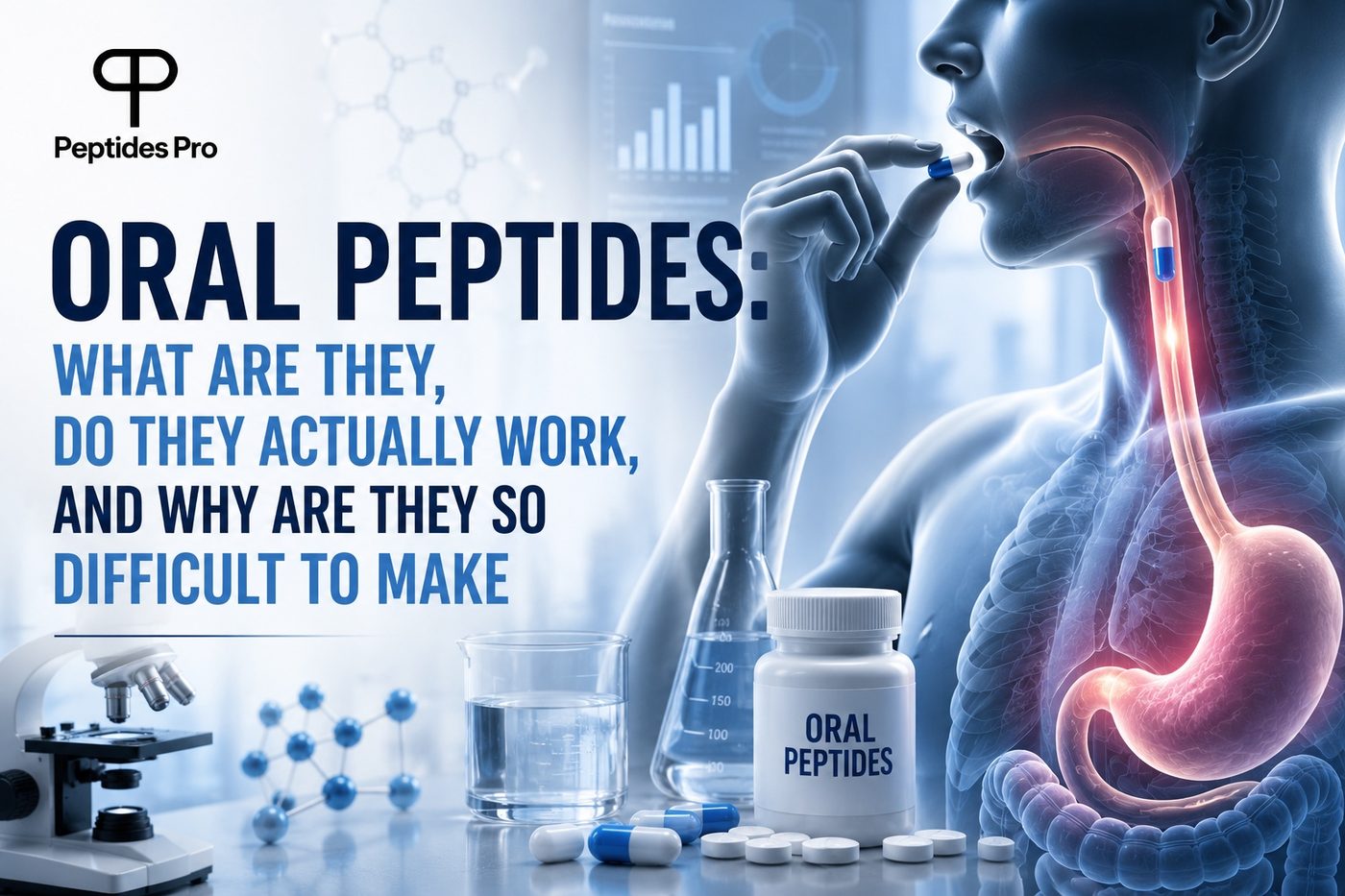
If you search for oral peptides, you will quickly find capsules, tablets, powders and products claiming to deliver peptides without an injection.
That raises an obvious question:
If peptides can be taken orally, why are so many peptide medicines still injected?
The answer comes down to what happens after a peptide reaches your digestive system.
Peptides are not ordinary small-molecule drugs. Many are relatively large molecules that can be broken down by digestive enzymes before enough of the intact peptide reaches the bloodstream. They can also have difficulty crossing the intestinal lining.
But oral peptide delivery is not impossible.
There are already approved oral peptide medicines, and pharmaceutical researchers have spent decades developing ways to make peptide molecules survive the gastrointestinal tract and become absorbable.
So the interesting question is not simply whether oral peptides work.
It is which peptides can be delivered orally, how the formulation makes that possible, and whether a product being sold as an “oral peptide” has the evidence to support its claims.
What Exactly Is an Oral Peptide?
An oral peptide is a peptide-based compound designed to be taken through the mouth, usually as a tablet, capsule or another oral formulation.
That sounds straightforward, but the formulation is often much more complicated than simply putting a peptide powder inside a capsule.
Once swallowed, the molecule has to survive a sequence of biological barriers.
It encounters stomach acid, digestive enzymes, mucus and the intestinal epithelial barrier. Even if some of the peptide survives digestion, it still has to cross the intestinal wall before reaching systemic circulation.
This is why pharmaceutical companies have developed specialised formulations rather than simply putting injectable peptides into an ordinary capsule.
Why Are Peptides So Difficult to Take Orally?
The digestive system is designed to break down proteins and peptides.
That is exactly what makes oral peptide delivery difficult.
In the stomach, the environment is strongly acidic and contains enzymes such as pepsin. Further along the digestive tract, enzymes including trypsin and chymotrypsin contribute to protein and peptide digestion.
A peptide intended to act as a medicine therefore has to survive an environment that is naturally designed to dismantle molecules like it.
There is then another problem.
The Peptide Still Has to Be Absorbed
Surviving digestion is only half the challenge.
The intestinal lining is a selective barrier. Large, hydrophilic molecules generally do not pass easily through it, which is one reason conventional oral peptide bioavailability can be very low.
This creates a chain of problems:
Swallowing → surviving digestion → reaching the intestinal surface → crossing the intestinal barrier → entering circulation → reaching the intended target.
A successful oral peptide formulation has to solve several of these problems at once.
Then How Does Oral Semaglutide Work?
This is where the subject becomes much more interesting.
Semaglutide provides a real-world example that an appropriately engineered peptide can be delivered orally.
The FDA-approved oral semaglutide formulation is not simply injectable semaglutide placed into a tablet.
The tablet is co-formulated with salcaprozate sodium, commonly referred to as SNAC, an absorption-enhancing ingredient designed to facilitate oral absorption.
The current FDA labeling states that absorption of oral semaglutide predominantly occurs in the stomach.
Even with this specialised formulation, the absolute bioavailability is relatively low.
The current FDA label reports approximately 0.4% to 1% absolute bioavailability for the listed oral RYBELSUS formulations and doses.
That number is important because it demonstrates something people often misunderstand:
Low bioavailability does not automatically mean a medicine does not work.
A drug can still produce a clinical effect if its formulation delivers enough active compound to the body.
The formulation, dose, pharmacokinetics and clinical evidence all matter.
Oral Does Not Automatically Mean Weaker
There is a common assumption that injections are always more effective than oral peptides.
That is too simplistic.
The route of administration changes how a molecule is absorbed and distributed, but effectiveness depends on the specific drug and formulation.
For example, oral semaglutide has been developed as a clinically effective pharmaceutical formulation despite the challenges of oral peptide delivery.
The more useful comparison is therefore not:
Tablet vs injection
It is:
Which molecule, which formulation, which route, and what clinical evidence?
That distinction matters enormously when looking at peptide products online.
Why Can't Every Injectable Peptide Simply Become a Capsule?
Because every peptide has its own chemical and biological characteristics.
Two compounds can both be called peptides while behaving very differently inside the gastrointestinal tract.
Researchers have investigated several approaches to make oral peptide delivery possible, including:
- Protective coatings
- Enteric delivery systems
- Absorption enhancers
- Enzyme inhibitors
- Chemical modification of peptide molecules
- Nanoparticle and lipid-based delivery systems
- Mucoadhesive formulations
- Targeted intestinal delivery
These strategies attempt to protect the peptide, improve its movement through the intestinal barrier or control where and how it is released.
Some approaches have reached clinical use.
Others remain experimental.
That difference should always be made clear.
What About Oral BPC-157, TB-500 and Other Research Peptides?
This is where online peptide discussions can become confusing.
You may see products advertised as:
BPC-157 capsules
TB-500 capsules
GHK-Cu capsules
or other products described as oral peptides.
The fact that a capsule exists does not establish that the peptide has demonstrated the same pharmaceutical performance as an approved oral peptide medicine.
There are several separate questions:
| Question | What It Tells You |
|---|---|
| Is the molecule a peptide? | Its chemical identity |
| Can it survive the digestive tract? | Its potential stability |
| Can it cross the intestinal barrier? | Its potential absorption |
| Has oral delivery been studied? | The strength of the evidence |
| Is the formulation standardised? | How consistently it may deliver the compound |
| Is it an approved medicine? | Its regulatory status |
| Is the seller legitimate? | Who is actually supplying the product |
These questions should not be collapsed into one.
A product being marketed online as an “oral peptide” does not automatically make it an approved oral medicine.
What Does “Oral Peptide” Mean in Bali?
Bali has a large wellness market, so visitors can encounter peptide-related products through clinics, wellness businesses, online sellers and international biohacking communities.
But oral availability is not the same thing as regulatory approval.
A capsule appearing on a website or being offered by a local seller does not establish that it has been approved as a medicine in Indonesia.
It also does not establish its identity, purity, stability or clinical effectiveness.
For anyone researching peptides in Bali, it is therefore worth separating three things:
What is scientifically possible.
What has actually been demonstrated in humans.
What is legally approved and supplied as a medicine.
Those categories can overlap, but they are not interchangeable.
Are Oral Peptide Supplements the Same as Oral Peptide Medicines?
No.
This distinction is particularly important.
A product marketed as a supplement may contain ingredients described as peptides, peptide fragments, collagen-derived peptides or other compounds.
A pharmaceutical peptide medicine is a different category.
An approved medicine has gone through a defined regulatory process involving manufacturing, quality, safety and clinical evaluation appropriate to its indication.
The word peptide on a label does not tell you which category the product belongs to.
What Should You Look for When Researching an Oral Peptide?
Instead of starting with the question:
“Does this capsule work?”
start with better questions.
1. What Is the Exact Molecule?
The full chemical or generic name should be identifiable.
“Peptide complex” is not enough.
2. Has Oral Administration Actually Been Studied?
Look for human clinical evidence rather than relying solely on laboratory experiments or testimonials.
3. What Formulation Was Studied?
This is especially important.
A study involving a specialised pharmaceutical formulation does not automatically validate every capsule containing the same peptide.
4. What Is the Evidence for Absorption?
A peptide can theoretically survive digestion but still have poor systemic absorption.
5. Is the Product Approved?
Approval is different from laboratory evidence.
A compound can have interesting research behind it without being an approved medicine.
6. Who Manufactured It?
Manufacturing quality matters because the actual product needs to match what the label claims.
7. Is There Batch-Specific Quality Documentation?
For research products, a genuine certificate of analysis can provide useful information about what was tested for that particular batch.
It still does not prove clinical effectiveness or regulatory approval.
Oral Peptides vs Injectable Peptides
| Feature | Oral Peptides | Injectable Peptides |
|---|---|---|
| Administration | Tablet, capsule or other oral formulation | Injection |
| Digestive exposure | Yes | No |
| Enzymatic degradation risk | Significant for many peptides | Much lower before systemic absorption |
| Intestinal absorption barrier | Yes | Bypassed |
| Formulation complexity | Often high | Varies |
| Convenience | Generally higher | Generally lower |
| Bioavailability | Highly dependent on molecule and formulation | Often more predictable |
| Clinical evidence | Depends heavily on the specific product | Depends heavily on the specific product |
| Approval status | Must be assessed for the specific medicine | Must be assessed for the specific medicine |
The table shows why it is difficult to make a universal statement that one route is “better.”
The molecule and formulation determine much of the answer.
Why Are Pharmaceutical Companies Interested in Oral Peptides?
The reason is obvious to patients.
Taking a tablet is generally simpler than receiving an injection.
Oral delivery can potentially improve convenience, acceptability and adherence. Researchers therefore continue to investigate technologies that can protect peptide molecules and improve their absorption.
But convenience creates a difficult engineering problem.
The pharmaceutical industry is essentially trying to make a molecule survive one of the body's most effective defence systems: digestion.
That is why oral peptide delivery remains an active area of pharmaceutical research.
The Most Important Distinction: Oral Does Not Mean Automatically Effective
This is probably the biggest takeaway.
A capsule can contain a peptide.
That does not necessarily mean the peptide reaches the bloodstream in a meaningful amount.
A product can also contain a genuine peptide and still have insufficient evidence to support the claims being made about it.
And a product can have laboratory testing without being an approved medicine.
These are separate questions.
Identity, purity, absorption, clinical evidence and regulatory approval are different things.
A good oral peptide article, product page or consultation should make those distinctions clear.
What Is Actually Established Today?
The strongest evidence for oral peptide therapy comes from specific pharmaceutical products that have been deliberately engineered and clinically evaluated.
Oral semaglutide is a useful example. Its formulation uses an absorption-enhancing component, and FDA labeling documents its pharmacokinetics and oral bioavailability.
Meanwhile, the broader field of oral peptide delivery is still developing. Researchers continue to investigate ways of overcoming gastrointestinal degradation, mucus barriers and limited intestinal permeability.
That means the phrase “oral peptide” covers a much wider category than the relatively small number of oral peptide medicines with established clinical and regulatory pathways.
If You're Researching Oral Peptides in Bali
A useful checklist is:
- Identify the exact peptide.
- Find out whether oral human studies exist.
- Check whether the formulation studied is the same formulation being sold.
- Separate laboratory evidence from clinical evidence.
- Check whether the product is an approved medicine in the relevant jurisdiction.
- Ask who manufactured the product.
- Look for batch-specific quality documentation where appropriate.
- Do not assume that a capsule is equivalent to an approved oral medicine.
- Do not assume that an injectable formulation can simply be taken orally.
This approach is much more useful than judging a peptide product by its packaging or the number of testimonials attached to it.
The Bottom Line
Oral peptides are real, but “oral peptide” is not automatically a synonym for proven peptide therapy.
The digestive tract creates major barriers to peptide delivery, including acidic conditions, digestive enzymes, mucus and limited intestinal permeability.
Pharmaceutical science has found ways around some of these barriers. Oral semaglutide demonstrates that a carefully engineered peptide formulation can achieve clinically meaningful systemic exposure, even though its absolute bioavailability is only a fraction of the administered dose.
The bigger online peptide market is much less straightforward.
If you see an oral peptide in Bali, the important question is not simply “Is it a capsule?”
Ask:
What exactly is it, how is it absorbed, what evidence supports it, who made it, and what is its regulatory status?
That is the difference between understanding an oral peptide product and simply believing the label.
FAQ
Are Oral Peptides Real?
Yes. Some peptide medicines have been developed as oral formulations. Oral semaglutide is a prominent example, with FDA-approved oral formulations and documented pharmacokinetics.
Why Are Most Peptide Medicines Not Taken Orally?
Many peptides are vulnerable to digestive enzymes and have difficulty crossing the intestinal lining. These barriers can result in very low oral bioavailability.
Does an Oral Peptide Work the Same as an Injection?
Not necessarily. The route can change absorption, bioavailability and pharmacokinetics. The answer depends on the specific peptide and formulation.
Is Oral Semaglutide Just Injectable Semaglutide in Tablet Form?
No. The oral formulation uses a specialised formulation containing SNAC to facilitate absorption. FDA labeling states that absorption predominantly occurs in the stomach.
Can Every Peptide Be Made Into a Capsule?
No. Different peptides have different stability, permeability and absorption characteristics. Researchers use specialised delivery technologies to overcome these barriers.
Are Oral BPC-157 or TB-500 Capsules Approved Medicines?
You should not assume that a product is an approved medicine simply because it is sold in capsule form. The regulatory status must be checked for the specific substance, formulation and jurisdiction.
Does “Oral Peptide” Mean It Has Good Bioavailability?
No. Oral bioavailability varies substantially between peptide molecules and formulations. Even an approved oral peptide can have relatively low absolute bioavailability while still producing a clinical effect.
Are Oral Peptides Available in Bali?
Peptide-related oral products may be advertised or sold in Bali, but availability does not establish regulatory approval, quality or clinical effectiveness. Those questions need to be assessed separately.
Primary Sources
- FDA prescribing information for oral semaglutide
- FDA drug information and labeling
- Peer-reviewed research on oral peptide delivery
- Peer-reviewed research on gastrointestinal barriers to peptide absorption
- Research on pharmaceutical strategies for improving oral peptide bioavailability
Disclaimer: This article is for educational purposes only and is not medical advice. The term “oral peptide” covers products with very different evidence, formulations and regulatory statuses. Do not assume that a peptide sold online or described as research grade is approved for human use. Always verify the current regulatory status of a specific product and speak with an appropriately qualified healthcare professional before using peptide-based medicines or other peptide products.