
Education
Retatrutide Is Already Being Sold in Bali. But It Isn't Approved Anywhere Yet
Published 1 Oct 2026, 21:00 Bali time
Bali peptide sellers are advertising retatrutide with same-day delivery even though the drug remains investigational. Here is what the clinical evidence and regulators actually say.
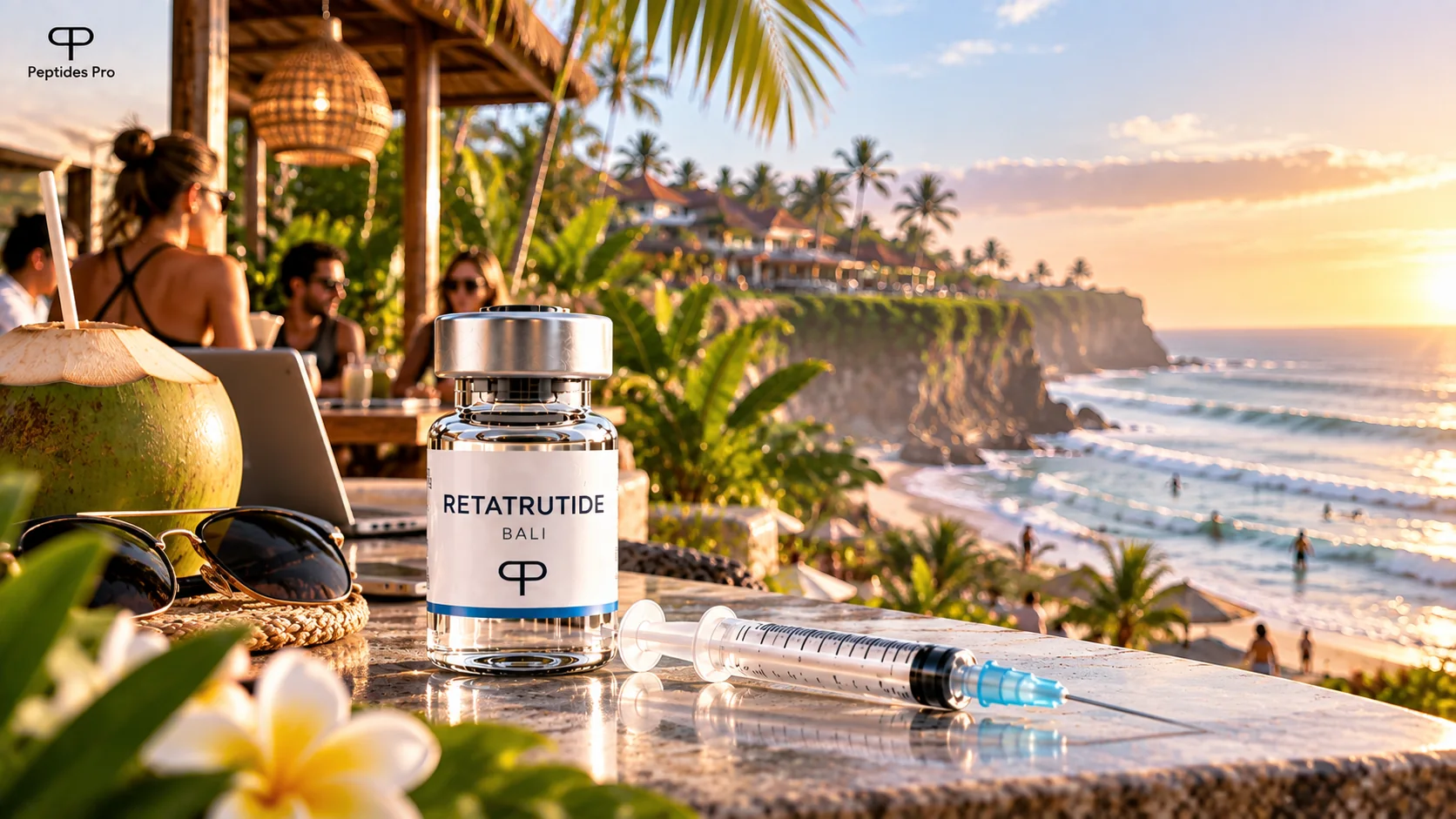
There is something unusual happening with retatrutide in Bali.
The medicine is still being investigated by Eli Lilly.
The company does not expect to submit its first US regulatory application until 2027.
The FDA says retatrutide has not been found safe and effective for any condition.
Eli Lilly says it has not been approved by any regulatory agency anywhere in the world and should currently be available only through authorised clinical trials.
And yet in Bali, you can already find websites advertising it for same-day delivery.
Not one website.
Several.
Some advertise delivery to Canggu, Seminyak, Ubud, Uluwatu and Denpasar. Others promote third-party laboratory reports, temperature-controlled delivery or products described in terms of weight management and body composition.
One Bali-facing retailer reviewed by Peptides Pro advertises retatrutide as available from a Canggu facility with same-day dispatch. Another promises island-wide delivery. A third says orders can be delivered to Bali addresses on the same day depending on stock and courier availability.
This creates one of the clearest examples yet of how quickly the gray-market peptide industry can move.
Retatrutide has become commercially available to consumers in Bali before the medicine's developer has even submitted it for regulatory approval in the United States.
That does not mean every Bali seller is supplying the same product, that every product is incorrectly labelled or that every sale automatically violates Indonesian law.
It does mean that the substance being marketed locally is not an approved retatrutide medicine.
And recent international investigations show why that distinction matters.
The short answer: Is retatrutide approved in Bali?
As of September 2026, retatrutide remains an investigational medicine.
Eli Lilly states that it has not been approved by any regulatory agency and is not available for public use outside its clinical-trial programme.
Peptides Pro also found no Indonesian BPOM marketing authorisation for a retatrutide medicine in the official drug-registration material reviewed for this article.
That should not be interpreted as a blanket legal conclusion covering every possible research, importation or laboratory context. Indonesian rules can distinguish between clinical research, medicinal-product registration, importation and commercial therapeutic use.
But one thing is clear:
A vial being advertised online in Bali is not an approved retatrutide medicine simply because its label says "retatrutide" or because a seller provides a laboratory certificate.
At the same time, Bali-facing suppliers are openly advertising products under the retatrutide name.
That is the gap this article examines.
Retatrutide is no longer obscure experimental science
Part of the reason demand has moved so quickly is that retatrutide's clinical results are genuinely significant.
Retatrutide is a single molecule designed to activate three hormone receptors:
- GIP
- GLP-1
- glucagon
Semaglutide primarily targets GLP-1 receptors.
Tirzepatide activates GIP and GLP-1 receptors.
Retatrutide adds glucagon-receptor activity, creating what researchers describe as a triple hormone receptor agonist.
Its early human results attracted enormous attention.
A 2023 Phase 2 trial published in the New England Journal of Medicine enrolled 338 adults with obesity or overweight plus a weight-related condition.
Participants were randomly assigned to different retatrutide regimens or placebo and followed for 48 weeks.
Researchers reported substantial reductions in body weight, particularly in the higher-dose trial groups.
The study was randomised, double-blind and placebo-controlled, making it fundamentally different from online testimonials or uncontrolled observations.
But retatrutide's story has advanced considerably since then.
Phase 3 results have made the hype much bigger
In May 2026, Eli Lilly announced results from TRIUMPH-1, a pivotal Phase 3 obesity trial.
Participants receiving the highest studied dose lost an average of 28.3% of their body weight at 80 weeks.
Among participants with a baseline BMI of at least 35 who continued into the extension, average weight loss reached 30.3% at 104 weeks.
Then came additional Phase 3 results.
In July 2026, Lilly reported that participants with obesity or overweight and type 2 diabetes in TRIUMPH-2 lost up to an average of 20.8% of their body weight at 80 weeks.
In TRIUMPH-3, participants with severe obesity and established cardiovascular disease lost up to an average of 22.6%.
These are company-reported topline results from pivotal trials, and not every result has yet undergone the same level of peer-reviewed publication.
But they explain the extraordinary consumer interest.
Retatrutide no longer looks like a speculative molecule with nothing but animal research behind it.
It has advanced human clinical data.
That makes the current situation more complicated, not less.
A drug can have impressive Phase 3 results and still not be an approved medicine.
The regulatory process has not finished
Clinical trials and regulatory approval answer different questions.
Phase 3 trials generate evidence regulators can use to decide whether a medicine's benefits outweigh its risks for a defined indication.
The regulator still has to evaluate that evidence.
Manufacturing, pharmaceutical quality, labelling and risk-management information also form part of the process.
As of September 2026, retatrutide has not completed that process.
Lilly announced in July that it plans to submit a US Biologics License Application for retatrutide in the first quarter of 2027.
The FDA continues to describe retatrutide as unapproved and states that it has not been found safe and effective for any condition. The agency also says retatrutide cannot legally be used in drug compounding under US federal law.
So, as of today, there is no FDA-approved retatrutide product.
There is also no Eli Lilly retail retatrutide product for consumers to purchase.
That makes the products already circulating online something different.
Meanwhile, Bali sellers are advertising same-day delivery
This is where the story becomes distinctly local.
Peptides Pro reviewed multiple publicly accessible websites marketing retatrutide specifically to customers in Bali during September 2026.
Mito Labs Bali
Mito Labs advertises a product described as "Retatrutide (RT3-GLP)" with same-day delivery across Bali.
Its public page lists Canggu, Seminyak, Ubud, Uluwatu, Sanur, Denpasar and Jimbaran among its delivery areas.
The company says every batch is supplied with an independent certificate of analysis.
The same page also describes the product as being for laboratory research and not an approved medicine.
Peptonomy
Peptonomy similarly advertises retatrutide research products with same-day delivery across Bali, including Canggu, Seminyak, Denpasar and Ubud.
Its public materials describe the product as intended for laboratory research rather than human or veterinary use and advertise batch-level documentation.
Peptide+
Another Bali-facing site, Peptide+, advertises retatrutide alongside weight-management language and states that products can be dispatched on the same day from its Canggu operation.
Its public homepage also promotes products according to consumer-oriented categories including fat loss, recovery and longevity.
A related retatrutide-focused page goes further, advertising the compound around appetite, body composition and metabolic effects while offering island-wide delivery.
BioPepTech
BioPepTech publicly lists retatrutide for Bali delivery and describes effects involving appetite and metabolic signalling.
The page also advertises third-party testing and includes supplies with orders.
These websites do not prove how many people are purchasing retatrutide in Bali.
They do not establish how much product is being sold.
And Peptides Pro has not independently tested the products being advertised.
What they establish is simpler:
A commercial market using the retatrutide name already exists in Bali while retatrutide itself remains investigational.
The disclaimers create an unusual contradiction
Several suppliers describe their products as intended only for research or laboratory use.
That type of disclaimer is important.
But surrounding marketing can sometimes look much more consumer-facing.
A website might state:
"research use only"
while simultaneously advertising:
- same-day home or villa delivery
- weight-management categories
- body-composition effects
- WhatsApp ordering
- syringes or other supplies
- customer support
- Canggu delivery
- consumer testimonials
Those two messages sit uneasily together.
Peptides Pro cannot determine from a webpage alone how a product is actually used after purchase or whether individual customers are laboratory researchers.
Nor does the presence of consumer-oriented marketing automatically establish that a seller is violating Indonesian law.
But readers should understand that a "research use only" statement does not turn a product into an approved medicine.
And it does not establish that the product was manufactured to the standards expected of a medicine intended for injection into humans.
Research retatrutide is not Lilly retatrutide
This may be the most important distinction in the entire story.
When someone reads that retatrutide produced 28.3% average weight loss in a Phase 3 trial, those results concern the investigational medicinal product developed and manufactured for Eli Lilly's controlled clinical programme.
They do not automatically apply to every vial on the internet carrying the word "retatrutide".
Clinical-trial participants receive a defined investigational product manufactured under controlled conditions.
Researchers know what the substance is supposed to contain.
The protocol specifies how it is administered.
Participants are medically monitored.
Adverse events are systematically recorded.
A gray-market vial arrives through a completely different chain.
Even when independent laboratory testing is supplied, additional questions remain:
| Question | Lilly clinical-trial product | Independently sold Bali vial |
|---|---|---|
| Is the exact investigational product known? | Yes, within the controlled trial system | Must be independently established |
| Manufacturing framework | Controlled clinical-development manufacturing | Depends on supplier and manufacturer |
| Participant medical screening | Required by study protocol | Depends on circumstances |
| Adverse-event monitoring | Systematic | Not necessarily |
| Regulatory approval | Still investigational | Not an approved medicine |
| Clinical evidence applies directly to product? | Trial data concern this investigational programme | Cannot be assumed solely from the label |
| Batch identity and quality | Controlled within sponsor programme | Requires product-specific evidence |
This is why "the molecule has Phase 3 evidence" and "this vial is clinically validated" are not equivalent statements.
A recent Australian case shows exactly why this distinction matters
On September 14, 2026, Australia's Therapeutic Goods Administration issued an unusually relevant warning.
A consumer had used a product marketed as retatrutide and developed uncontrollable vomiting.
The vomiting was severe enough to tear the person's oesophagus and require hospital treatment.
The TGA obtained a sample of the product and tested it.
The result:
It contained no retatrutide.
Instead, the regulator found undeclared semaglutide.
The quantity of semaglutide detected was approximately eight times higher than the level found in semaglutide products assessed by the TGA and included in the Australian Register of Therapeutic Goods.
That does not mean retatrutide products being sold in Bali contain semaglutide.
There is no evidence supporting that conclusion.
It demonstrates the wider product-identity problem surrounding unapproved drugs.
A label can say retatrutide.
The contents can be something else.
For a deeper look at this issue, see They Bought BPC-157, PT-141 and Retatrutide. The Lab Found Something Else..
Independent lab testing helps, but it does not solve everything
Several Bali sellers recognise this concern and advertise independent certificates of analysis.
That is better evidence than having no analytical information at all.
Appropriate testing can provide useful information about the identity, quantity and purity of a submitted sample.
But a laboratory report has limits.
A certificate concerning one submitted sample does not automatically establish:
- that every vial contains identical material
- that the certificate corresponds to the current batch
- that the entire batch was manufactured consistently
- that a product is sterile
- that bacterial endotoxins are within an appropriate specification
- that storage conditions remained controlled
- that the finished product is clinically safe
- that it has received BPOM approval
This is particularly relevant in Bali because laboratory certificates have become a visible part of peptide marketing.
For a detailed guide, see Bali's Peptide Sellers Are Showing Lab Reports. Can You Trust Them?.
A genuine lab result can answer an important chemical question.
It cannot perform the role of a national medicine regulator.
What about BPOM?
Indonesia's National Agency of Drug and Food Control, BPOM, regulates medicinal products in Indonesia.
The importance of that framework becomes obvious when retatrutide is compared with tirzepatide.
Tirzepatide received Indonesian marketing authorisation for type 2 diabetes in February 2026, followed by an additional weight-management indication in July.
Its Indonesian authorisation can be traced through BPOM's official medicinal-product records.
Retatrutide is different.
Peptides Pro did not identify a corresponding BPOM marketing authorisation for a retatrutide medicine in the official drug-registration sources reviewed for this article as of September 2026.
That is consistent with Lilly's current global statement that retatrutide has not yet been approved by any regulatory agency.
For more on why this distinction matters in Bali, see Tirzepatide vs BPC-157 in Bali: Why One Is a Medicine and the Other Isn't.
Does that mean every retatrutide-related activity in Indonesia is illegal?
That conclusion would go too far.
An unapproved investigational medicine can potentially exist in legitimate clinical research under the appropriate regulatory and ethical framework.
Indonesia has a formal clinical-trial authorisation system overseen by BPOM.
Clinical research is different from selling a substance as an ordinary consumer medicine.
Whether a specific sale, import, advertisement or activity complies with Indonesian law depends on the exact circumstances and applicable regulations.
The absence of marketing authorisation is nevertheless highly relevant:
A commercially advertised retatrutide vial should not be represented as a BPOM-approved retatrutide medicine when no such approval has been established.
Why demand has moved ahead of approval
The situation in Bali is not difficult to explain.
Retatrutide may be one of the most anticipated metabolic medicines currently in development.
Its Phase 3 numbers have generated international headlines.
People already familiar with semaglutide and tirzepatide understand the GLP-1 market.
The idea of a "triple agonist" sounds like the next technological step.
And unlike a decade ago, consumers do not have to wait for a medicine to arrive in pharmacies before learning its name.
Clinical-trial results circulate instantly through:
- TikTok
- YouTube
- Telegram groups
- bodybuilding communities
- weight-loss forums
- biohacking communities
A molecule can become famous while it is still in clinical development.
Gray-market suppliers can then begin selling products using the same name.
The result is a completely different sequence from traditional drug development.
The traditional sequence
Clinical trials → regulatory submission → regulator review → approval → pharmacies → consumers
The gray-market sequence
Clinical result → viral attention → online demand → research supplier → consumer availability → regulatory submission later
Retatrutide may be one of the clearest examples of this reversal yet.
Canggu is particularly well positioned for the trend
This connects directly with Canggu's developing peptide and biohacking scene.
The area brings together:
- international digital nomads
- surfers
- gym communities
- entrepreneurs
- longevity enthusiasts
- wellness practitioners
- people already familiar with GLP-1 medicines
Local businesses increasingly advertise biomarker testing, recovery technology, peptide services and performance optimisation.
That environment helps experimental health trends spread rapidly.
A consumer may hear about retatrutide on an American podcast in the morning and find a Bali supplier advertising same-day delivery by the afternoon.
See Why Is Canggu Becoming Bali's Peptide and Biohacking Hotspot?.
The clinical evidence is promising, but the safety story is still developing
It would also be misleading to frame retatrutide as though nothing is known about it.
The molecule has now been studied in thousands of clinical-trial participants.
Its development programme is far more advanced than experimental peptides such as BPC-157.
But that does not mean every safety question has been answered.
In the original Phase 2 obesity trial, gastrointestinal adverse events were the most commonly reported side effects and occurred in a dose-related pattern.
Researchers also observed dose-related increases in heart rate that peaked and then declined later in treatment.
The larger Phase 3 programme is designed partly to provide a much more detailed understanding of safety across different patient populations.
Regulators will ultimately review that evidence.
That process has not happened yet.
This distinction is essential:
"Promising enough to submit for approval" is not the same as "already approved."
Retatrutide and tirzepatide should not be treated as interchangeable
The similarities between the names and their metabolic mechanisms can create confusion.
Tirzepatide is a dual GIP/GLP-1 receptor agonist.
Retatrutide activates GIP, GLP-1 and glucagon receptors.
Both were developed by Eli Lilly.
But their regulatory positions in Indonesia are currently very different.
| Question | Tirzepatide | Retatrutide |
|---|---|---|
| Human clinical evidence | Extensive | Extensive and still developing |
| Phase 3 programme | Completed for multiple approved indications | Major Phase 3 results available |
| Indonesian BPOM-authorised medicine | Yes, for specified indications | No marketing authorisation identified |
| FDA-approved | Yes, through specific tirzepatide products | No |
| Available as an authorised commercial Lilly medicine | Yes | No |
| Regulatory submission for obesity | Already through approval process | US submission planned for Q1 2027 |
| Products advertised by Bali peptide sellers | Yes | Yes |
| Does Bali availability establish approval? | No | No |
This last row is important.
Even with an approved molecule such as tirzepatide, an online vial is not automatically the same thing as an authorised Mounjaro product.
Regulation attaches to specific finished medicines, manufacturers, formulations and indications.
What people often misunderstand
"Retatrutide has completed Phase 3 trials, so it is basically approved"
No.
Phase 3 data may support an application for approval.
The regulator still has to evaluate the evidence and make a decision.
Lilly currently plans its first US regulatory submission in 2027.
"If a Bali website sells it openly, it must be legal medicine"
Commercial availability does not establish BPOM marketing authorisation.
A seller may describe a product as a research chemical rather than a medicine.
The regulatory status of the exact product and activity must be evaluated separately.
"If a laboratory confirms retatrutide, it is the same as Lilly's clinical-trial product"
No.
Chemical identity is important, but pharmaceutical equivalence involves more than confirming the molecule.
Manufacturing controls, formulation, sterility, quantity, stability and batch consistency also matter.
"Retatrutide is just a stronger version of Ozempic"
That is too simplistic.
Semaglutide is primarily a GLP-1 receptor agonist.
Retatrutide acts on GIP, GLP-1 and glucagon receptors.
It is a distinct investigational medicine with its own clinical-development programme.
"The Australian fake retatrutide case proves Bali products contain semaglutide"
No.
The TGA finding concerned a specific product investigated in Australia.
It provides evidence that mislabeled retatrutide products exist, not that products sold in Bali have the same contents.
"Research use only means a product has been approved for experimental treatment"
No.
A commercial "research use only" label does not itself establish clinical-trial authorisation, medical supervision or regulatory approval for human treatment.
What we still do not know about Bali's retatrutide market
Several important questions cannot currently be answered from public information.
We do not know how many people in Bali are purchasing products sold as retatrutide.
We do not know what proportion of buyers are genuine laboratory researchers versus consumers.
We do not have independent testing covering all products currently being sold.
We do not know whether products from different sellers originate from the same manufacturers.
We do not know the true local adverse-event rate.
We also cannot infer from the existence of a seller's certificate that every vial in circulation matches the tested sample.
Those gaps are important.
The strongest statement the evidence currently supports is not:
"Bali has a fake retatrutide crisis."
It is:
"Bali already has a visible consumer-facing market for products sold under the retatrutide name even though no retatrutide medicine has yet received regulatory approval."
That finding alone is significant.
Frequently Asked Questions
Can you buy retatrutide in Bali?
Multiple Bali-facing websites publicly advertise products labelled retatrutide, including suppliers offering same-day delivery.
That commercial availability does not mean the products are approved retatrutide medicines.
Is retatrutide approved in Indonesia?
Peptides Pro did not identify a BPOM marketing authorisation for a retatrutide medicine in the official Indonesian registration material reviewed as of September 2026.
Eli Lilly also states that retatrutide has not yet been approved by any regulatory agency globally.
Is retatrutide FDA-approved?
No.
The FDA currently describes retatrutide as unapproved and says it has not been found safe and effective for any condition.
When could retatrutide be approved?
Approval is not guaranteed.
Eli Lilly has stated that it plans to submit a US regulatory application in the first quarter of 2027.
Regulators will then evaluate the evidence before making a decision.
Does retatrutide really produce large amounts of weight loss?
Clinical trials have produced substantial average weight reductions.
In TRIUMPH-1, Lilly reported average weight loss of 28.3% at 80 weeks in participants receiving the highest studied dose.
Those results concern participants in a controlled clinical trial using Lilly's investigational product.
Are online retatrutide products fake?
It is not possible to generalise across every product.
However, regulators have identified counterfeit products.
In September 2026, Australia's TGA tested one product marketed as retatrutide and found no retatrutide but instead undeclared semaglutide at a very high concentration.
Does a certificate of analysis prove a Bali retatrutide product is safe?
No.
Appropriate independent testing can provide evidence about a submitted sample's chemical identity, purity or quantity.
It does not by itself establish sterility, batch consistency, clinical safety or regulatory approval.
Is retatrutide the same as tirzepatide?
No.
Tirzepatide activates GIP and GLP-1 receptors.
Retatrutide additionally activates the glucagon receptor.
Tirzepatide is already available through approved medicines; retatrutide remains investigational.
The Bottom Line
Retatrutide is no longer a distant laboratory experiment.
Its clinical results are strong enough that Eli Lilly is preparing regulatory submissions.
The drug may eventually become an important approved treatment for obesity and related metabolic disease.
But eventually is the important word.
As of September 2026, retatrutide remains investigational.
The FDA has not approved it.
BPOM has not been shown to have authorised a retatrutide medicine in Indonesia.
Lilly itself says it is not currently available for public use and has not been approved by any regulatory agency.
Yet in Bali, multiple businesses are already advertising products labelled retatrutide with same-day delivery.
That gap between science, regulation and consumer availability is the real story.
The Phase 3 trials tell us what Lilly's investigational retatrutide may be capable of under controlled conditions.
They do not establish what is inside every vial being delivered to a villa in Canggu.
Recent counterfeit-product investigations demonstrate why that distinction cannot be treated as technical fine print.
Bali's retatrutide market has arrived before retatrutide itself has officially arrived as a medicine.
What happens next — regulatory approval, enforcement, tighter quality controls or further expansion of the gray market — may become one of the most important peptide stories to watch in Bali.
Sources
- Eli Lilly and Company (2026). Current developer information states that retatrutide remains investigational, has not been approved by any regulatory agency and is not available for public use outside Lilly's clinical trials.
- Eli Lilly and Company, July 23, 2026. Phase 3 TRIUMPH-2 and TRIUMPH-3 results and announcement that Lilly plans a US retatrutide regulatory submission in Q1 2027.
- Jastreboff AM et al. (2023). Triple-Hormone-Receptor Agonist Retatrutide for Obesity — A Phase 2 Trial. New England Journal of Medicine. Randomised, double-blind, placebo-controlled trial involving 338 adults.
- U.S. Food and Drug Administration (2026). Current FDA information states that retatrutide is not a component of an FDA-approved medicine, has not been found safe and effective for any condition and cannot be used in compounding under US federal law.
- Therapeutic Goods Administration, Australia (September 14, 2026). Official safety investigation identified undeclared semaglutide and no retatrutide in a product sold as retatrutide after a consumer suffered a serious adverse event requiring hospital treatment.
Local market sources: Publicly accessible Bali-facing product pages from Mito Labs, Peptonomy, Peptide+, BioPepTech and other sellers were reviewed in September 2026 to document the existence and marketing characteristics of the local market. Their claims about product identity, testing and delivery are seller claims and should not be treated as independent evidence of clinical safety, effectiveness or regulatory approval.
Medical Disclaimer
This article is for educational and research-information purposes only. It does not provide medical advice, diagnosis, treatment recommendations or individual legal advice. Retatrutide remains investigational as of September 2026 and has not been approved by the FDA or identified by Peptides Pro as a BPOM-authorised medicine in Indonesia. Products sold outside regulated clinical trials may not be equivalent to the investigational medicine studied by Eli Lilly. Speak with a qualified healthcare professional about personal medical decisions and consult BPOM for current Indonesian product-specific regulatory information. ```
This article is for educational purposes only and does not replace medical advice.