
Education
Semaglutide and Tirzepatide in Bali: Dosing Calculator for Vials and Pens
Published 17 Aug 2026, 21:00 Bali time
Bali clinics supply GLP-1 weight loss peptides in two formats: pre-mixed pens and reconstituted vials. The dosing math is completely different between them. Here is how to calculate yours correctly either way.
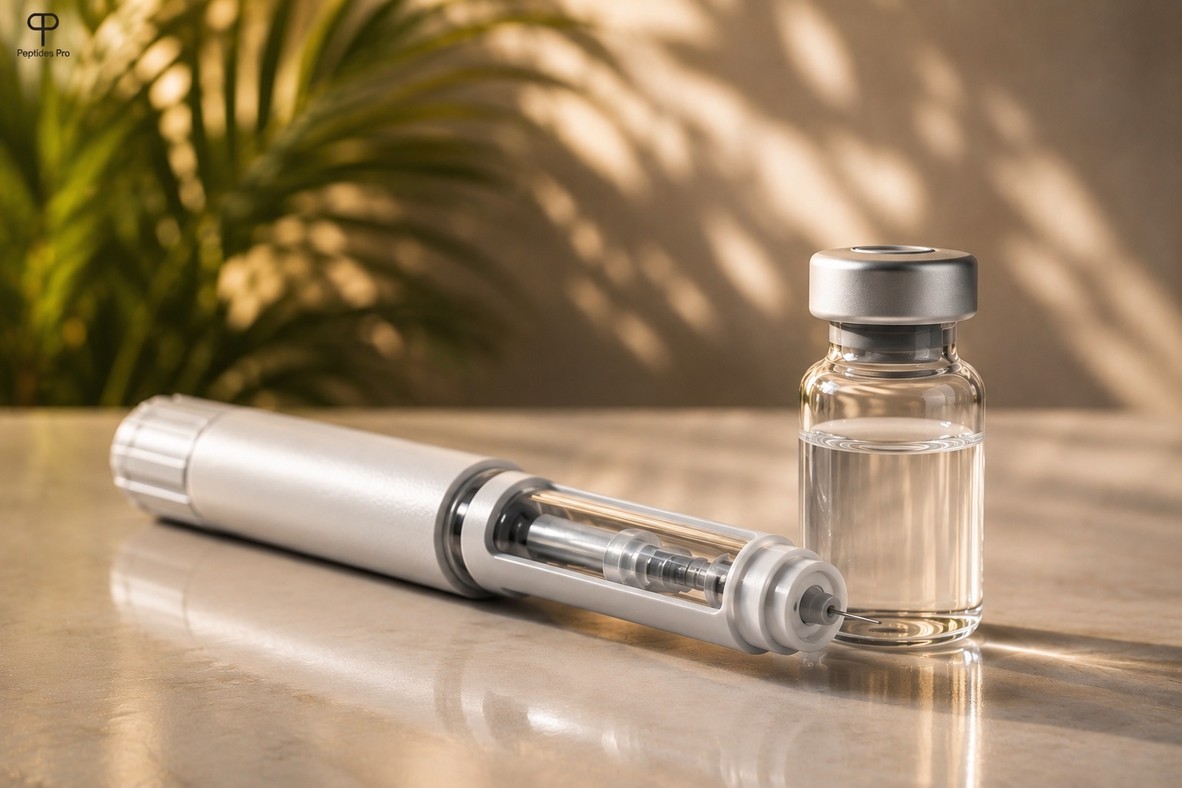
Bali has become a significant destination for GLP-1 weight loss therapy. Semaglutide and tirzepatide are available through wellness clinics, medical tourism facilitators, and direct compounding contacts at a fraction of the cost of branded products in most Western countries. People are flying to Canggu specifically to start or maintain a GLP-1 protocol during an extended stay.
The challenge that almost nobody warns about: GLP-1 peptides in Bali come in two completely different physical formats, each with its own dosing logic. Getting the calculation wrong between them is the fastest way to have a terrible first week, a wasted vial, or a medical situation that interrupts your entire trip.
Use the Peptides Pro calculator whenever you switch formats, change vial sizes, or move to the next phase of your titration. The calculation takes 30 seconds. The consequences of skipping it can last a week given semaglutide's half-life.
The Two Formats You Will Encounter in Bali
Format 1: Compounded powder vials
A small glass vial containing freeze-dried powder. You (or the clinic) add bacteriostatic water to reconstitute it into an injectable solution. The concentration depends on how much water is added, and you draw your dose in units using an insulin syringe.
This format requires reconstitution math. The same dose (say, 0.25 mg of semaglutide) is a different number of syringe units depending on how much water the clinic or you used to reconstitute it.
Format 2: Pre-mixed pens or ready-to-inject vials
Some Bali clinics supply semaglutide or tirzepatide in pre-mixed form, either in a pre-loaded injection pen (similar to Ozempic or Mounjaro) or in a vial that has already been reconstituted to a known concentration and arrives labelled as "X mg/mL."
This format requires less math but a different type of verification. With a pre-mixed pen, your dose is typically dialled in milligrams directly. With a pre-mixed vial at a stated concentration, you calculate units from that concentration rather than reconstituting yourself.
The critical point: these two formats look similar (both are small injectables), but the number of units you draw for the same dose is completely different between them.
Dosing Math for Compounded Powder Vials
This is the format that requires active calculation. The math works the same way as any reconstituted peptide, but semaglutide and tirzepatide doses are expressed in milligrams rather than the micrograms more common with other peptides, so the conversion requires one extra step.
Step 1: Calculate your concentration
When the powder vial is reconstituted with bacteriostatic water, every drop of water you add determines how concentrated the resulting solution is.
Formula: mcg per unit = (Vial mg × 10) ÷ mL of water
Example: 5 mg semaglutide vial + 2 mL water. (5 × 10) ÷ 2 = 25 mcg per unit
Step 2: Convert your dose from mg to mcg
Semaglutide doses: 0.25 mg = 250 mcg. 0.5 mg = 500 mcg. 1 mg = 1,000 mcg.
Step 3: Calculate units to draw
Units = Dose in mcg ÷ Concentration in mcg per unit.
At 25 mcg/unit, a 0.25 mg dose: 250 ÷ 25 = 10 units At 25 mcg/unit, a 0.5 mg dose: 500 ÷ 25 = 20 units At 25 mcg/unit, a 1 mg dose: 1,000 ÷ 25 = 40 units
Or skip the calculation entirely and enter your numbers into the Peptides Pro calculator.
Semaglutide vial reference table (most common Bali clinic configurations)
| Vial | Water | Conc. | 0.25 mg | 0.5 mg | 1 mg | 1.7 mg |
|---|---|---|---|---|---|---|
| 5 mg | 1 mL | 50 mcg/unit | 5 units | 10 units | 20 units | 34 units |
| 5 mg | 2 mL | 25 mcg/unit | 10 units | 20 units | 40 units | 68 units |
| 10 mg | 2 mL | 50 mcg/unit | 5 units | 10 units | 20 units | 34 units |
| 10 mg | 4 mL | 25 mcg/unit | 10 units | 20 units | 40 units | 68 units |
Tirzepatide vial reference table
Tirzepatide follows the same calculation logic. The starting dose is lower (0.5 mg weekly for first four weeks under the Mounjaro titration schedule) and the maximum studied dose is 15 mg weekly.
| Vial | Water | Conc. | 0.5 mg | 1 mg | 2.5 mg | 5 mg |
|---|---|---|---|---|---|---|
| 5 mg | 1 mL | 50 mcg/unit | 10 units | 20 units | 50 units | 100 units |
| 5 mg | 2 mL | 25 mcg/unit | 20 units | 40 units | 100 units | — |
| 10 mg | 2 mL | 50 mcg/unit | 10 units | 20 units | 50 units | 100 units |
| 10 mg | 5 mL | 20 mcg/unit | 25 units | 50 units | 125 units | — |
For tirzepatide at higher doses (5 mg+), a 10 mg vial with 2 mL water (50 mcg/unit) gives the most practical unit amounts. Dashes in the table indicate the draw would exceed a standard 1 mL syringe.
Dosing with a Pre-Mixed Pen
If a Bali clinic provides you with a device that looks like an EpiPen with a dose dial, it is almost certainly a GLP-1 pen. These pens are dose-dialled in milligrams and do not require you to calculate units.
You rotate the dial to your prescribed dose (0.25 mg, 0.5 mg, etc.), attach a pen needle, prime the pen per the device instructions, and inject. There is no water to measure and no units to draw. The pen's internal mechanism controls the volume per dose.
The verification task with a pen is different: confirm the dial is set to your prescribed dose (not a different one), and confirm the device has enough remaining product for your current dose. Pens have a window showing remaining volume.
One thing to watch for: in Bali, some clinics supply pens originally intended for the European or US market (Ozempic, Wegovy, Mounjaro, Zepbound), and some supply generic or biosimilar pens from Asian manufacturers. The dosing mechanics are typically the same, but the dose increments and cartridge sizes can differ. Verify your dose against the pen's label, not by assumption.
The Titration Question: Why Your Dose Changes in Bali
People beginning a GLP-1 protocol in Bali sometimes have the impression they can jump to the "effective" dose immediately. The titration schedule exists for a specific clinical reason: the gastrointestinal side effects of semaglutide and tirzepatide (nausea, vomiting, diarrhoea) are dose-dependent and most severe when the dose is increased too quickly. Starting at 0.25 mg and titrating up over weeks is not conservative caution — it is the mechanism that makes the protocol tolerable long-term.
Specific to the Bali context: starting a GLP-1 protocol the week before a food-heavy holiday, or during an intensive travel schedule with meals at restaurants every day, compounds the GI side effects because dietary fat and volume interact with the gastric emptying slowdown these compounds produce. Starting at the lowest titration dose is even more important in this context.
The titration schedule for semaglutide (standard): - Weeks 1 to 4: 0.25 mg once weekly - Weeks 5 to 8: 0.5 mg once weekly - Weeks 9 to 12: 1 mg once weekly - Weeks 13 to 16: 1.7 mg once weekly - Week 17+: 2.4 mg (maintenance)
The titration schedule for tirzepatide (standard): - Weeks 1 to 4: 0.5 mg once weekly (note: lower starting dose than semaglutide in mg terms) - Weeks 5 to 8: 1 mg once weekly - Weeks 9 to 12: 2.5 mg once weekly - Weeks 13 to 16: 5 mg once weekly - Continuing up to 10 mg or 15 mg as tolerance allows
Each phase change is also a unit calculation change. Do not assume your previous unit amount carries forward — your dose in mg changes, your units change with it.
Comparing Semaglutide and Tirzepatide Side Effects in a Bali Context
This matters for dosing strategy. Tirzepatide (which adds GIP receptor agonism to GLP-1) produces somewhat lower nausea rates than semaglutide at equivalent efficacy doses in head-to-head comparisons. For people whose primary concern is GI tolerability during a Bali trip, tirzepatide may be the more manageable option.
Practically: both produce nausea most prominently in the first few days after each injection. Timing your weekly injection so that the peak nausea window (days 1 to 3 after injection) falls during lower-activity, lower-social days of your Bali schedule is a practical strategy that experienced GLP-1 users in wellness communities discuss frequently.
Neither is appropriate to combine with heavy tropical food exploration in the first few weeks. Bali's food culture (warung meals, high-fat coconut-based dishes, frequent restaurant dining) is not an ideal backdrop for a first GLP-1 injection without the titration buffer.
One Practical Note on Sourcing in Bali
The quality of compounded GLP-1 products in Bali varies. Products from licensed compounding pharmacies with identifiable lot numbers and concentration labels represent a different safety tier than unlabelled vials from informal networks. If the vial label does not state the compound, the mg content, and the concentration (if pre-mixed), you cannot verify your dose and you cannot trust the product's content.
The Peptides Pro calculator requires accurate inputs to produce accurate outputs. A vial labelled "5 mg semaglutide" that actually contains 3 mg will produce a calculated result that is wrong regardless of how precisely you do the math. Vendor transparency is the upstream prerequisite for dose accuracy.
This article is for educational and informational purposes only. It does not constitute medical advice, diagnosis, or treatment. Semaglutide and tirzepatide are prescription medications in most jurisdictions. Consult a qualified healthcare professional before use.