
Wellness
Staying on Your Peptide Protocol While in Bali: Dosing, Heat Storage, and Recalculating
Published 16 Aug 2026, 21:00 Bali time
Traveling to Bali while on a peptide protocol creates three problems most guides ignore: tropical heat degrades your vials, different local vial sizes break your unit calculations, and customs has opinions about syringes. Here is how to handle all three.
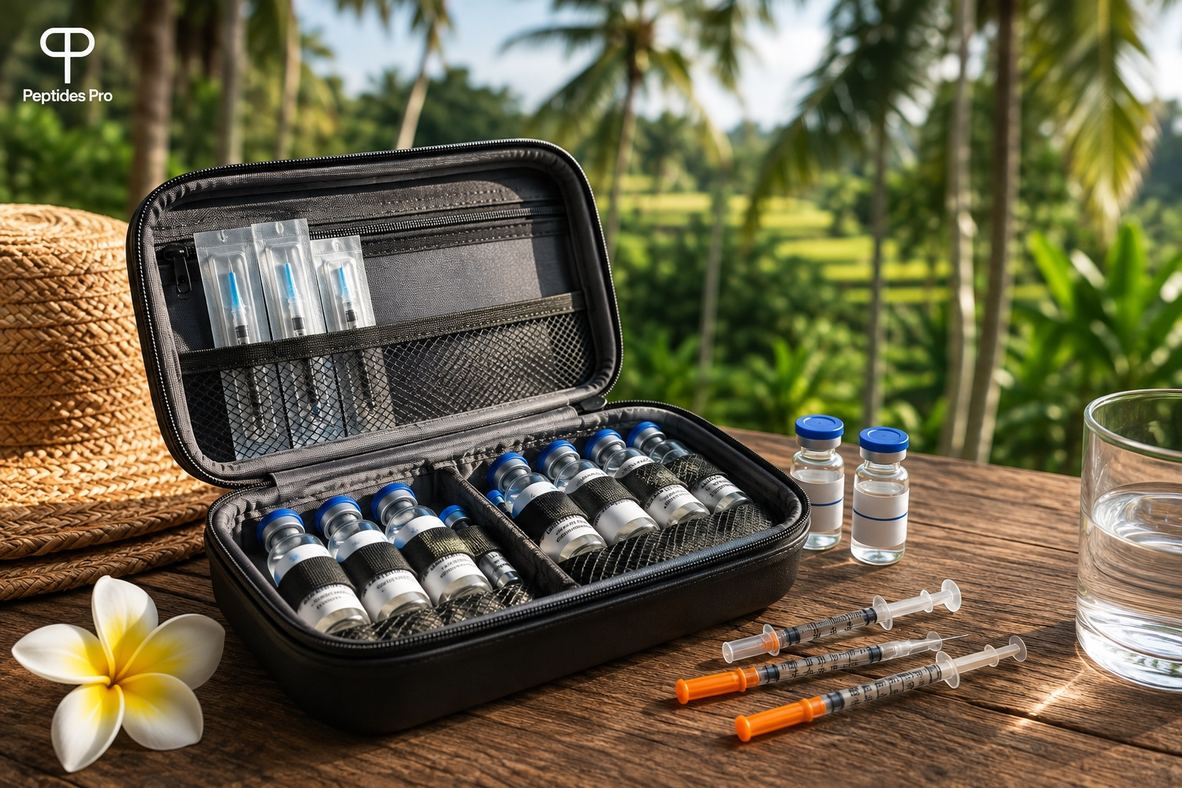
More people arrive in Bali already on a peptide protocol than most wellness content acknowledges. Someone three weeks into a BPC-157 injury healing cycle, someone mid-titration on a GH secretagogue stack, someone who just started semaglutide and booked a three-week stay — they all face the same practical problem: how do you maintain a protocol designed for a controlled home environment when you are in one of the hottest, most humid places on the equator, potentially without a refrigerator you can control, and with Indonesian customs forming opinions about your syringes?
This guide addresses the three real problems. Not the theoretical ones — the ones that actually end protocols early or cause dosing errors.
Problem 1: Bali's Heat Will Damage Your Peptides If You Let It
What heat does to lyophilised peptides
Freeze-dried peptide powder is stable at room temperature for weeks to months depending on the compound, but room temperature in Bali is not room temperature in London or New York. Ambient temperatures in Bali range from 26 to 35°C (78 to 95°F). In direct sun, surfaces routinely exceed 40°C. Hotel rooms without strong air conditioning can hit 30°C when the system is off.
Most peptide manufacturers rate lyophilised powder stability at 25°C or below. Above this threshold, degradation accelerates. You will not see it happen — the powder still looks the same, the solution reconstitutes normally. But potency falls, and your dose becomes less reliable.
Reconstituted peptides (already mixed with bacteriostatic water) are more temperature-sensitive than powder. Once reconstituted, most peptides should be refrigerated between 2 and 8°C and used within 4 to 6 weeks. A reconstituted BPC-157 vial sitting in a Bali hotel room at 30°C for two weeks is a stability question worth taking seriously.
Practical cold chain management in Bali
Most mid-range to upper-end hotels in Canggu, Seminyak, and Ubud have mini-fridges. Request one at check-in or verify it is present before you arrive. Storing reconstituted vials in the fridge between uses is non-negotiable.
During travel days (airport, transit, day trips), a small insulated travel case with a reusable ice pack or gel cooler keeps vials at acceptable temperatures for 6 to 12 hours depending on ambient conditions. Pharmacy-grade insulated cases designed for insulin travel work perfectly.
Travel rule: freeze-dried (unreconstituted) powder travels at ambient temperature for short journeys. Reconstituted vials need to stay cool. Do not reconstitute your vials until you arrive and have access to reliable refrigeration.
If you are going on a day trip to Ubud, Mount Batur, or the Gili Islands and need to bring a dose, use a small personal cooler — the kind that keeps drinks cold. The vial should go in with an ice pack wrapped in a cloth (never let the vial touch ice directly, as freezing damages peptides just as heat does).
Never freeze a reconstituted vial
Freezing and thawing destroys peptide integrity. If your hotel freezer accidentally freezes your reconstituted vial, discard it. The peptide is almost certainly denatured. This is a mistake that happens to travellers who do not label their storage clearly when shared fridges or enthusiastic hotel staff are involved.
Problem 2: Different Vial Sizes Break Your Existing Calculations
This is the most underappreciated dosing risk for travellers maintaining a protocol.
You have been taking 250 mcg of BPC-157 twice daily. You reconstituted your usual 5 mg vial with 2 mL of bacteriostatic water. You know from memory — or from a note on the vial — that you draw 10 units per injection. You have been doing this for three weeks without thinking about it.
You run out of your home supply midway through your Bali stay. You source a BPC-157 vial locally — from a Bali clinic, a Canggu supplement contact, or an Indonesian compounding pharmacy. This vial is 2 mg, not 5 mg.
Your old draw amount is now wrong. With a 2 mg vial and 2 mL of water, your concentration is 10 mcg per unit — not 25. A 250 mcg dose now requires 25 units, not 10. If you draw 10 units out of habit, you receive exactly 100 mcg — 60% less than your intended dose.
The inverse error is equally possible: if you sourced a 10 mg vial without knowing it and used your standard 10-unit draw, you receive 250 mcg from 50 mcg/unit concentration only if you used 2 mL water — but if the concentration differs, you could be significantly over or under.
Any time you switch vials — same compound, different mg size, different supplier, different water volume — recalculate from scratch. Do not carry previous unit numbers across to a new vial of a different size.
Use the Peptides Pro calculator every time you open a new vial. Enter the new vial's mg, the water you added, and your target dose. Get the correct units. Write it on the new vial immediately.
Bali-specific vial sizes to know about
Compounded and research peptides available through Bali sources commonly come in:
BPC-157: 5 mg most common, 2 mg and 10 mg also circulate. TB-500: 5 mg and 10 mg both common. Semaglutide: 2.5 mg, 5 mg, and 10 mg all present in the Bali market. Tirzepatide: 5 mg and 10 mg. CJC-1295 + Ipamorelin: Often supplied as a blended vial (varying total peptide content) — ask for the specific mg of each compound separately.
If you cannot confirm the vial size from a legible label, do not use the product. Guessing at concentration is not dosing — it is gambling.
Problem 3: Customs, Syringes, and Indonesian Law
The legal status of peptides in Indonesia
Research peptides occupy a grey area in Indonesian pharmaceutical law. They are not specifically scheduled as controlled narcotics in the way some jurisdictions treat them, but they are also not licensed pharmaceutical products. Bringing them into Indonesia as personal-use research compounds is the most common approach for travellers, and most people do so without incident.
The realistic customs risk: Indonesian customs at Ngurah Rai International Airport (Denpasar) focuses primarily on narcotics, alcohol volumes, and undeclared currency. Small quantities of unlabelled vials are generally not the primary target of customs enforcement. However, if stopped, the absence of a label or prescription creates a conversation you would rather not have.
Practical approach that experienced peptide travellers use:
Bring vials in their original, labelled packaging where possible. A labelled compounding pharmacy vial with your name on it reads as a personal prescription regardless of jurisdiction. Generic unlabelled vials are harder to explain.
Keep quantities plausible for personal use during your stay. Enough peptide for a four-week Bali stay (the common long-stay duration) for one person is clearly personal use. Bringing 30 vials of five different compounds looks like distribution.
Syringes and needles
Insulin syringes are widely available in Indonesia — pharmacies (apotek) throughout Bali stock them, as do some convenience stores. You are unlikely to need to bring a large supply. However, bringing a week's supply from home avoids the first-day hassle of locating an apotek in an unfamiliar area.
Syringes with attached needles may raise questions at airport security. Most travellers bring the syringes in the original pharmacy packaging (sealed blister packs), which reads clearly as medical equipment. Loose syringes in a bag invite more questions.
Bacteriostatic water for reconstitution is harder to source in Bali. It is not consistently stocked at Indonesian pharmacies, which typically carry sterile water for injection (WFI) rather than benzyl alcohol-preserved bacteriostatic water. Bring more than you think you need. It is stable at ambient temperature and presents no customs issues.
Calculating Your Supply Before You Leave
Work out your vial needs before packing, not at the airport.
For any compound:
Daily use (mcg) = Dose per injection × Injections per day Vial content (mcg) = Vial mg × 1,000 Days per vial = Vial content ÷ Daily use Vials needed = Trip days ÷ Days per vial (round up, add 1 extra)
Example: 30-day Bali stay on BPC-157 at 500 mcg twice daily. Daily use: 500 × 2 = 1,000 mcg per day. 5 mg vial = 5,000 mcg = 5 days per vial. 30 days ÷ 5 days per vial = 6 vials. Bring 7 to account for one potential loss or accident.
For weekly GLP-1 injections (semaglutide, tirzepatide), the math is simpler: One injection per week, one 5 mg vial typically covers multiple weeks at lower titration doses but only one week at higher doses. Calculate based on your specific titration phase.
The Peptides Pro calculator can help you work out how many doses each vial contains once you know your concentration — enter your setup and the total peptide content tells you how many injections you get per vial.
Adjusting for Bali's Effect on Your Body
One thing most protocol guides do not account for: your physiology changes in a tropical environment. Bali heat increases sweating and fluid loss significantly, which affects hydration, electrolytes, and by extension, how your body responds to compounds that interact with those systems.
GH secretagogues (CJC-1295, Ipamorelin, Sermorelin) can exacerbate water retention in the heat — the water retention already common in the first weeks of a protocol can feel more pronounced when you are also retaining heat-related fluid. This is cosmetic and not dangerous, but worth knowing.
Semaglutide and tirzepatide slow gastric emptying, which becomes more significant in the heat when you are already dehydrated and eating less. Staying well hydrated is more important during a GLP-1 protocol in Bali than in a temperate climate.
BPC-157 and TB-500 protocols are generally unaffected by climate beyond the storage considerations above.
None of these effects change your dose calculation. But they change the experience, and knowing to expect them prevents unnecessary alarm or premature protocol discontinuation.
This article is for educational and informational purposes only. It does not constitute medical advice, diagnosis, or treatment. Travel with any pharmaceutical or research compound should comply with the laws of all countries involved in your journey. Consult a qualified healthcare professional before using any peptide.