
Education
What Should a Legitimate Peptide COA Contain?
Published 21 Aug 2026, 21:00 Bali time
What should a legitimate peptide COA contain? Learn how to read a certificate of analysis and check batch numbers, identity testing, purity, assay, laboratory details and other important quality information.
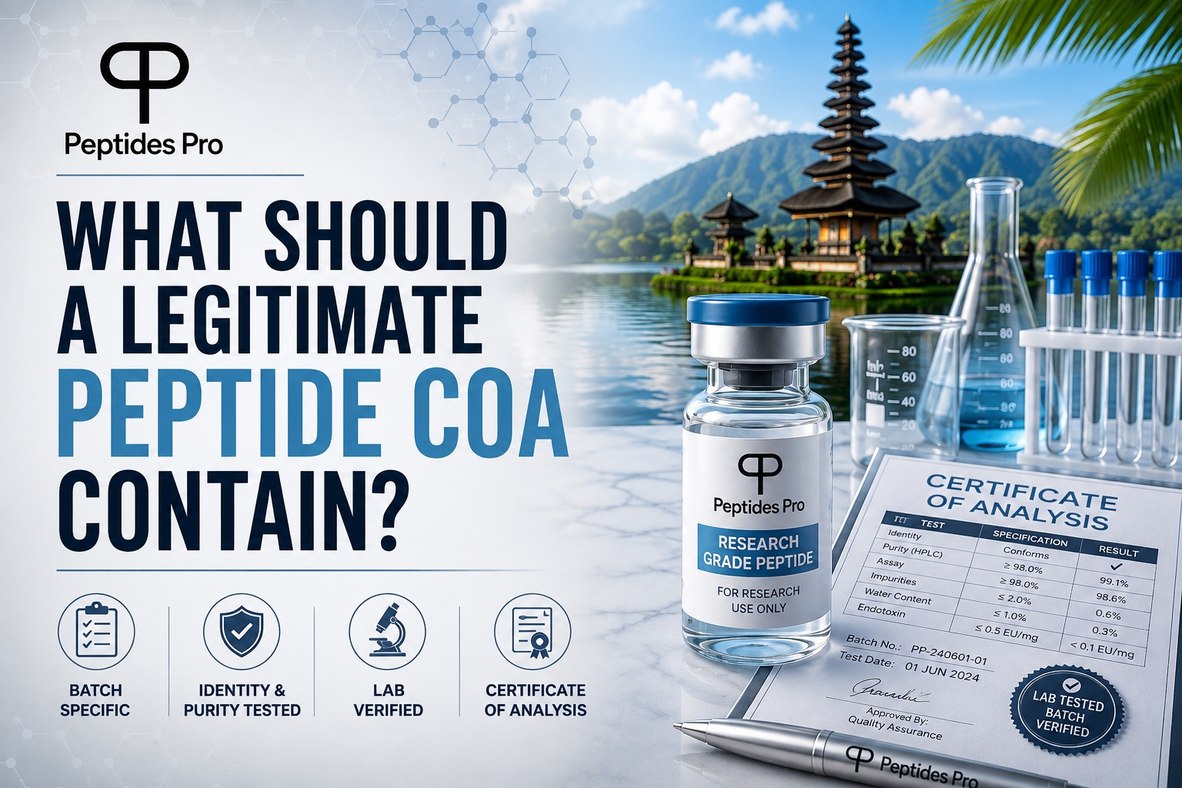
A legitimate peptide certificate of analysis (COA) should do more than display a purity percentage. It should connect a specific product and batch to identifiable testing, analytical methods, acceptance criteria and actual results.
For a peptide material, useful information can include identity testing, purity, assay or content, impurities and, where relevant, residual solvents, water content, microbial testing or endotoxin testing.
The most important point is simple: a COA is a quality document, not a marketing certificate.
FDA guidance on active pharmaceutical ingredients says an authentic COA should identify the material, batch number and release date, list the tests performed, provide acceptance limits and numerical results where applicable, and identify the manufacturer and authorized quality personnel. :contentReference[oaicite:0]{index=0}
What Is a Peptide COA?
A certificate of analysis, commonly called a COA, is a document that reports analytical testing performed on a particular material or batch.
In pharmaceutical manufacturing, specifications are built around tests, analytical procedures and acceptance criteria. FDA guidance describes a specification as a list of tests, analytical procedures and appropriate acceptance criteria used to determine whether a material meets defined quality requirements. :contentReference[oaicite:1]{index=1}
That makes the word batch extremely important.
A document that simply says:
> Peptide X: 99% purity
provides much less information than a document showing the exact batch, testing method, laboratory, acceptance specification and actual result.
1. The Exact Product Name
The COA should clearly identify what was tested.
It should not simply say:
"Peptide"
or:
"Research compound."
The material should be identified by its specific name or appropriate designation.
If the vial identifies one compound but the COA identifies another, the documents do not establish that they refer to the same material.
2. A Batch or Lot Number
A legitimate COA should connect the analytical results to a specific batch.
Look for something such as:
Batch number: ABC12345
The batch or lot number should correspond to the product documentation or packaging where applicable.
This is one of the simplest checks a buyer can make.
A COA for Batch A does not automatically prove the quality of Batch B.
FDA guidance specifically states that the batch number should appear on the certificate of analysis. :contentReference[oaicite:2]{index=2}
3. The Date of Analysis or Release
A useful COA should contain dates that help establish when the material was tested or released.
Depending on the document, you may see:
- Date tested
- Date released
- Manufacturing date
- Retest date
- Expiry date
Not every COA will contain every one of these dates.
What matters is that the document provides enough information to understand when the reported testing occurred and how it relates to the batch.
FDA's API guidance specifically calls for the release date and, where applicable, expiry or retest dates to be included. :contentReference[oaicite:3]{index=3}
4. The Manufacturer
The document should identify the original manufacturer.
This is different from simply identifying the website or seller that supplied the product.
FDA guidance says certificates should show the name, address and telephone number of the original manufacturer. If a repacker or reprocessor performed the analysis, the certificate should identify that party and reference the original manufacturer. :contentReference[oaicite:4]{index=4}
A document that only says:
"Premium Peptide Supplier"
does not tell you who actually manufactured the material.
5. The Testing Laboratory
If an independent laboratory performed the testing, the COA should identify that laboratory.
Useful information can include:
- Laboratory name
- Address
- Report number
- Testing date
- Contact information
- Accreditation information where applicable
The purpose is traceability.
A PDF uploaded by a seller is not automatically equivalent to independent laboratory verification.
6. Identity Testing
One of the biggest mistakes people make is assuming that purity proves identity.
It does not.
Identity testing is intended to establish what the material actually is.
FDA's Q6A guidance says identity testing should be specific enough to discriminate between closely related compounds. It gives examples including infrared spectroscopy and combinations such as HPLC/MS. It also notes that a single chromatographic retention time alone is not considered sufficiently specific. :contentReference[oaicite:5]{index=5}
For peptide materials, analytical documentation may therefore reference techniques such as:
- HPLC
- Mass spectrometry
- LC-MS
- Other appropriate spectroscopic or chromatographic techniques
The correct testing strategy depends on the specific material.
7. Purity With the Analytical Method
Purity is one of the first numbers most buyers look for.
A COA might report:
HPLC purity: 98.7%
But that number becomes much more useful when the document also identifies the analytical method and acceptance criterion.
Look for:
- Analytical method
- Actual result
- Acceptance specification
- Relevant test conditions where provided
A statement such as:
"Purity >99%"
without an analytical method or batch information gives you much less evidence.
FDA's guidance treats specifications as a combination of tests, analytical procedures and acceptance criteria, rather than simply one percentage printed on a page. :contentReference[oaicite:6]{index=6}
8. Assay or Peptide Content
Purity and assay are not automatically the same measurement.
A COA may include a separate result for:
Assay
or:
Content
depending on the material and analytical method.
The important thing is that the document explains what the reported number represents.
A COA stating that a sample has 99% purity by HPLC is not necessarily making the same claim as a quantitative assay of the actual peptide content.
9. Impurity Results
A useful analytical report should consider more than the desired compound.
Where relevant, testing can include:
- Related peptide impurities
- Degradation products
- Process-related impurities
- Residual solvents
- Other specified impurities
FDA's Q6A guidance identifies impurities and residual solvents as important categories that may need appropriate controls depending on the material. :contentReference[oaicite:7]{index=7}
This is why two COAs can both advertise 99% purity while providing very different levels of information.
10. Residual Solvent Testing
Peptide manufacturing can involve solvents and other processing materials.
Where residual solvent testing is relevant to the material, the COA should identify the test and reported result.
A technique such as gas chromatography may be used for appropriate solvent analysis.
The exact testing requirements depend on the manufacturing process and applicable specification.
11. Water or Moisture Content
Water content can be relevant for certain peptide materials, particularly dry or lyophilised materials.
A COA may therefore include a water-content test where appropriate.
FDA's Q6A guidance notes that water content can be important for drug substances that are hygroscopic or affected by moisture and identifies Karl Fischer titration as a specific method that may be appropriate. :contentReference[oaicite:8]{index=8}
Again, the key is relevance.
Not every peptide requires exactly the same COA panel.
12. Microbial and Endotoxin Testing
This is an area where the word "purity" can easily be misunderstood.
A high chemical purity result does not automatically prove sterility.
For applicable products, microbial limits, sterility and endotoxin testing can be separate quality considerations.
FDA's Q6A guidance states that microbial testing should depend on the nature of the material, manufacturing process and intended use. It also identifies sterility and endotoxin testing as relevant considerations for materials associated with injectable products. :contentReference[oaicite:9]{index=9}
So:
HPLC purity: 99.5%
does not automatically mean:
Sterile
and it does not automatically establish that a product is suitable for injection.
A Simple Peptide COA Checklist
| COA element | What to look for |
|---|---|
| Product name | Exact peptide or material name |
| Batch number | Specific lot tested |
| Manufacturer | Original manufacturer identified |
| Testing laboratory | Laboratory responsible for testing |
| Testing date | Date analysis was performed |
| Release information | Release status where applicable |
| Identity | Appropriate identity testing |
| Purity | Analytical method and actual result |
| Assay/content | Quantitative result where applicable |
| Impurities | Relevant impurity testing |
| Residual solvents | Result where relevant |
| Water content | Result where relevant |
| Microbial testing | Result where relevant |
| Endotoxin | Result where relevant |
| Acceptance criteria | Limit or specification for each test |
| Authorization | Appropriate quality-unit approval or signature |
The exact panel will vary according to the material and intended use.
A legitimate COA does not have to contain every possible test.
It needs to contain credible and traceable evidence for the quality attributes it claims to measure.
What Does a Weak COA Look Like?
There are several warning signs worth noticing.
Only One Big Number
A document that says:
"Purity: 99.9%"
but provides no analytical method, batch number, laboratory or acceptance criterion gives you very little information to evaluate.
No Batch Number
If the document cannot be connected to the specific batch being sold, its value is limited.
A generic report from another batch should not automatically be treated as evidence for the current product.
No Testing Method
"Purity tested" is not the same as explaining how purity was measured.
The analytical method matters.
No Laboratory Information
If there is no identifiable manufacturer or laboratory, independent verification becomes difficult.
It Looks Like a Marketing Flyer
A professional COA should primarily communicate analytical information.
Be cautious when a document is dominated by phrases such as:
"Premium Quality"
"Ultra Pure"
"Pharmaceutical Grade"
or:
"Best Quality"
while providing little actual analytical information.
Marketing language is not a substitute for testing data.
The Product and COA Do Not Match
This is one of the easiest red flags to identify.
If the vial has one batch number and the COA has another, ask the supplier to explain the discrepancy.
Do not assume the documents refer to the same material.
Does a COA Prove a Peptide Is Safe?
No.
A COA provides evidence about the testing and results reported in that document.
It does not automatically prove that a product is:
- Approved for human use
- Clinically effective
- Sterile
- Suitable for injection
- Legally authorised for sale
- Stored correctly after testing
- Authentic after leaving the laboratory
FDA guidance treats certificates of analysis as one part of a broader quality system rather than as proof of every aspect of product quality. :contentReference[oaicite:10]{index=10}
This distinction is particularly important with products marketed online as "research peptides."
A laboratory report can describe the material that was tested.
It does not turn an unapproved research compound into an approved medicine.
Can You Trust a COA From the Seller?
A seller-provided COA can contain useful information, but it should still be evaluated critically.
The important question is not simply:
"Does the seller have a COA?"
A better question is:
"Can this COA be traced to this exact batch, these tests, these methods and these reported results?"
FDA's API guidance describes controls around the use of supplier analytical results and emphasizes the reliability of testing and appropriate identity testing. :contentReference[oaicite:11]{index=11}
That is the difference between seeing a document and actually evaluating the evidence behind it.
A Five-Minute COA Check
Before treating a COA as useful evidence, check these five things.
1. Match the batch number.
Does the COA correspond to the exact product?
2. Check the dates.
When was the material tested or released?
3. Find the identity test.
What method was used to establish the material's identity?
4. Find the purity or assay result.
Is there an actual numerical result and analytical method?
5. Identify who tested it.
Can you identify the manufacturer or laboratory behind the document?
If several of these answers are missing, the document deserves closer scrutiny.
The Difference Between a COA and a Marketing Claim
This distinction is worth remembering.
"99% pure" is a claim.
"Batch ABC123, HPLC purity 99.2%, specification ≥98.0%, tested on [date] by [laboratory]" is analytical documentation.
The second example gives the reader information they can actually evaluate.
That is what makes a COA useful.
What About Research Peptides in Bali?
The same principles apply when evaluating peptide products advertised in Bali.
A local seller may show you a PDF, photograph or screenshot and describe it as a COA.
That does not automatically establish the product's regulatory status or suitability for human use.
If you are researching a peptide in Bali, separate three questions:
What is the product?
What does the testing document actually show?
What is the regulatory and medical status of the product?
Those questions should not be collapsed into one.
This is particularly important because "research grade" is a description commonly used in the research-chemical market. It should not automatically be interpreted as pharmaceutical approval or proof of suitability for human use.
The Bottom Line
A legitimate peptide COA should do more than advertise a purity percentage.
It should connect a specific product and batch to identifiable testing, analytical methods, acceptance criteria and actual results.
Depending on the material and intended use, useful information can include identity testing, purity, assay, impurities, residual solvents, water content, microbial testing and endotoxin testing.
The most important habit is to read a COA as a quality document, not a marketing document.
If the batch cannot be identified, the testing method is missing, the laboratory cannot be identified, or the document gives only a large purity number without supporting information, there is not enough evidence to judge the material from the COA alone.
A COA can be an important piece of evidence.
It is not a guarantee.
FAQ
What does COA stand for in peptides?
COA stands for Certificate of Analysis. It is a quality document that reports analytical testing performed on a particular material or batch.
What is the most important thing on a peptide COA?
Start with the batch number, identity testing, analytical method, purity or assay result, testing laboratory and acceptance criteria. Together, these details help establish what was tested and whether the document relates to the product being offered.
Does 99% purity mean a peptide is safe?
No. A purity percentage describes a particular analytical measurement. It does not automatically establish sterility, endotoxin status, regulatory approval, clinical effectiveness or suitability for human use. :contentReference[oaicite:12]{index=12}
Can a COA prove that a peptide is authentic?
Appropriate identity testing can provide evidence about the identity of the tested material. However, the COA should also be evaluated against the batch information, laboratory details and traceability of the sample.
Should a peptide COA include HPLC?
HPLC can be an important analytical method for peptide purity and related testing, but the appropriate testing panel depends on the specific material. A strong COA should identify the analytical method rather than simply present a purity percentage. FDA guidance recognizes chromatographic methods among techniques used for drug-substance testing. :contentReference[oaicite:13]{index=13}
Does every peptide COA need an endotoxin result?
Not necessarily. The appropriate testing depends on the material, manufacturing process and intended use. Endotoxin testing can be particularly relevant to materials associated with injectable products. :contentReference[oaicite:14]{index=14}
Primary Sources
- FDA: Q7A Good Manufacturing Practice Guidance for Active Pharmaceutical Ingredients
- FDA: Q6A Specifications, Test Procedures and Acceptance Criteria
Disclaimer: This article is for educational purposes only and is not medical, legal or regulatory advice. A certificate of analysis is evidence of the testing and results reported in that document. Product quality, regulatory status, sterility, clinical suitability and authenticity require separate evaluation where applicable. Always verify current requirements with the relevant authority or an appropriately qualified professional before purchasing or using a peptide product.