
Bali Peptides
What Should You Expect at a Peptide Consultation in Bali?
Published 22 Aug 2026, 21:00 Bali time
What happens during a peptide consultation in Bali? Learn what a doctor may ask, what records to bring, what testing may be needed, and what to check before treatment.
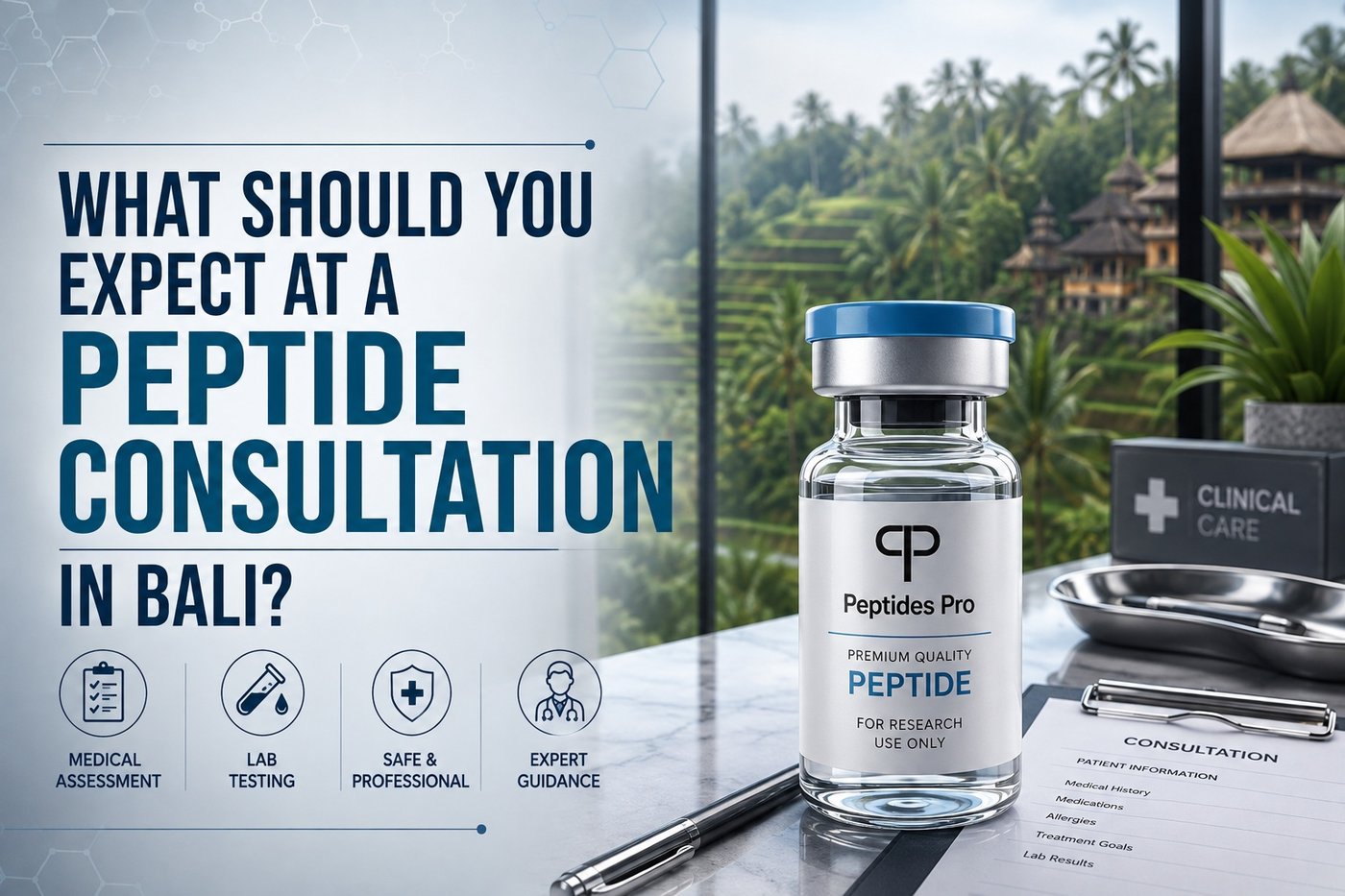
What Should You Expect at a Peptide Consultation in Bali?
A proper peptide consultation in Bali should start with a medical assessment, not a product sale. You should expect questions about your health history, current medicines, allergies, treatment goals, previous laboratory results and any relevant symptoms.
The clinician should then identify the exact product being discussed, assess whether it is appropriate for your situation, explain the available evidence and determine whether additional testing or medical follow-up is necessary.
This matters because “peptide” is not one single type of treatment. Some peptide-based medicines are approved pharmaceutical products, while other compounds commonly discussed online remain investigational or are sold as research products.
For visitors, the most useful question is therefore not simply:
“Which peptide should I get?”
It is:
“What should a legitimate medical consultation actually involve?”
1. Expect questions about your medical history
The consultation should begin with you, not the vial.
A clinician may ask about:
- Your current health
- Previous diagnoses
- Current symptoms
- Previous surgeries or major illnesses
- Prescription medicines
- Supplements
- Allergies
- Previous reactions to medicines
- Relevant family medical history
- Previous peptide use
- Your reason for seeking treatment
This information helps the clinician determine whether the treatment being discussed is medically appropriate.
Indonesia's Ministry of Health has described healthcare services for tourists in Bali that include medical history assessment and health counselling. :contentReference[oaicite:0]{index=0}
2. Be clear about what you want to achieve
Instead of starting with a specific peptide, explain the outcome you are trying to address.
For example, you may be interested in:
- Weight management
- Recovery after training
- Sleep
- A diagnosed medical condition
- Hormonal concerns
- General wellness
- An existing treatment prescribed overseas
These are very different medical questions.
A clinician should establish whether a peptide is actually relevant to your goal rather than assuming that every concern requires peptide treatment.
3. Bring your medical records
If you have recent medical information, bring it with you.
Useful documents can include:
- Recent laboratory results
- Previous prescriptions
- Medication lists
- Relevant imaging reports
- Specialist letters
- Allergy information
- Previous treatment records
You do not need to bring every medical document you have ever received.
Focus on records relevant to the reason for your consultation.
If you are travelling internationally, keeping digital copies of important documents can also make the appointment easier.
4. You may be asked to complete laboratory testing
Not every peptide consultation requires blood testing.
Testing depends on the reason for the appointment and the treatment being considered.
A clinician may request laboratory work when the results could influence the treatment decision or identify a potential safety concern.
The important question is not how many tests are ordered.
It is:
“What decision will this test help you make?”
A good provider should be able to explain why a particular test is relevant.
5. Tell the clinician about medicines and supplements
Make a complete list of anything you are currently taking.
That includes:
- Prescription medicines
- Over-the-counter medicines
- Vitamins
- Herbal products
- Sports supplements
- Other peptide products
This matters because peptide medicines can have pharmacological considerations that depend on the individual and the specific product.
The FDA's clinical pharmacology guidance for peptide drug products discusses issues including drug-drug interactions, pharmacokinetics and immunogenicity. :contentReference[oaicite:1]{index=1}
6. Ask for the exact product name
“Peptides” is not enough information.
You should know:
| Question | Why it matters |
|---|---|
| What is the active ingredient? | Different peptides have different evidence and safety considerations |
| What is the exact product name? | Prevents confusion between similar compounds |
| Who manufactures it? | Helps establish product identity and provenance |
| Is it approved? | Approval determines the regulatory pathway |
| Is it prescription-only? | Determines how it can legally be supplied |
| Is it compounded? | Compounded products are not automatically equivalent to approved medicines |
| Is it a research product? | Research products should not automatically be treated as medicines |
This is particularly important with compounds frequently discussed online such as BPC-157, TB-500, CJC-1295 and other research peptides.
The FDA has identified specific safety concerns and limited safety information for several compounds commonly discussed in the research-peptide market. :contentReference[oaicite:2]{index=2}
7. Ask about the strength of the evidence
A good consultation should involve a discussion about evidence.
Ask:
“What human evidence supports this particular use?”
The evidence could come from:
- Large randomised clinical trials
- Smaller clinical studies
- Observational studies
- Early-stage human research
- Animal studies
- Laboratory research
These are not equivalent.
A peptide with large clinical trials supporting a specific indication has a very different evidence base from a compound supported mainly by laboratory or animal research.
This is one of the most important distinctions to understand when researching peptides.
8. Find out how the product is classified in Indonesia
The regulatory status matters.
BPOM distinguishes between different medicine categories. Medicines classified as Obat Keras, or hard drugs, require a doctor's prescription.
BPOM also advises consumers to check a medicine's packaging, label, marketing authorisation and expiry information before purchasing it. :contentReference[oaicite:3]{index=3}
So ask directly:
“Is this an approved medicine, a compounded product, or a research product?”
That question can tell you much more than simply asking whether the product is a peptide.
9. A consultation does not guarantee a prescription
A legitimate medical consultation can end without a peptide prescription.
The clinician may decide that:
- The requested peptide is not appropriate
- Another treatment has stronger evidence
- More testing is needed
- Your existing medicines need to be considered
- There is no clear medical indication
- The product is not available through the appropriate legal pathway
That is not necessarily a bad consultation.
A medical assessment is supposed to determine whether a treatment is appropriate, not guarantee that a requested product will be supplied.
10. Ask whether the product is approved or compounded
A professionally designed vial does not automatically mean that the product is an approved pharmaceutical medicine.
The FDA explains that compounded drugs are not FDA-approved and are not reviewed by the FDA for safety, effectiveness or quality before marketing. :contentReference[oaicite:4]{index=4}
Indonesia has its own regulatory framework, so US approval rules should not be treated as Indonesian law.
The broader principle remains useful:
Packaging is not the same thing as regulatory approval.
11. Ask how the product is stored
If a product requires temperature-controlled storage, ask how it is handled before and after the consultation.
Useful questions include:
- What temperature should it be stored at?
- Does it require refrigeration?
- How is it transported?
- How long can it remain outside controlled storage?
- What is the expiry date?
- Is the packaging intact?
This can be particularly relevant in Bali because the local climate is warm and humid.
BPOM recommends checking packaging, labels, marketing authorisation and expiry information when obtaining medicines. :contentReference[oaicite:5]{index=5}
12. Ask what happens after the consultation
Before leaving, understand the follow-up plan.
Ask:
- When should you follow up?
- What symptoms should you report?
- Will laboratory monitoring be required?
- Who should you contact if you have a problem?
- How will treatment be reviewed?
- What happens if the product is not tolerated?
This is particularly important for international visitors.
If you are only staying in Bali for a short period, you should know how follow-up will work before beginning any treatment.
What should you bring to a peptide consultation in Bali?
A simple preparation checklist can make the appointment much more useful.
Bring:
- Passport or identification requested by the provider
- Current medication list
- Supplement list
- Relevant laboratory results
- Previous prescriptions
- Relevant medical reports
- Allergy information
- Your main treatment goal
- Questions you want answered
- The exact name of any peptide you are asking about
If you already take a prescription medicine, bring the exact name and strength rather than relying on memory.
10 questions to ask during the consultation
Save these before your appointment:
- What exactly is the active ingredient?
- What is this product approved to treat?
- What human evidence supports its proposed use?
- Is it approved or registered in Indonesia?
- Is it prescription-only?
- Is it manufactured, compounded or a research product?
- Do I need laboratory testing?
- What are the important risks and contraindications?
- How should the product be stored?
- What alternatives have stronger clinical evidence?
These questions can help you distinguish a genuine medical consultation from a sales-focused appointment.
What should a good consultation not look like?
There are several warning signs.
Be cautious if the appointment focuses almost entirely on:
- Choosing a peptide from a menu
- Promising dramatic results
- Selling multiple products immediately
- Refusing to identify the active ingredient
- Avoiding questions about regulatory status
- Claiming every peptide is safe
- Treating research compounds as equivalent to medicines
- Saying testing is never necessary
- Guaranteeing results
A medical consultation should involve assessment and informed decision-making.
It should not feel like shopping for a product.
What if you are only in Bali for a few days?
Tell the provider when you book.
Ask whether you can complete the consultation during your stay, whether laboratory testing is available locally, whether a follow-up appointment is required and how long the process normally takes.
Some Bali providers specifically advertise physician consultations for peptide protocols, including in-person and teleconsultation options. That is a provider-specific service rather than a universal requirement for peptide treatment in Bali. :contentReference[oaicite:6]{index=6}
Do not assume that every clinic follows the same process.
Consultation versus buying directly
| Medical consultation | Informal direct purchase |
|---|---|
| Starts with medical history | Starts with the product |
| Reviews your treatment goal | Assumes you already know what you want |
| Can identify potential contraindications | Medical screening may be limited |
| Can review laboratory results | Testing may not be discussed |
| Can discuss clinical evidence | Marketing claims may dominate |
| Identifies the exact product | Product identity may be unclear |
| Can explain prescription requirements | Regulatory status may be unclear |
| Allows follow-up planning | Follow-up may not exist |
The difference is important.
Access to a product is not the same as access to appropriate medical treatment.
The Bali-specific reality
Bali serves a large international visitor population alongside local residents.
The Ministry of Health has described healthcare services specifically available to tourists in Bali, including clinics, hospitals and individual medical practices. :contentReference[oaicite:7]{index=7}
At the same time, Bali's wellness economy includes very different types of businesses.
A hospital, registered clinic, pharmacy, wellness centre and informal online peptide seller are not interchangeable.
The fact that two businesses are located in the same part of Bali does not mean they have the same medical or regulatory status.
The bottom line
A peptide consultation in Bali should feel like a medical assessment first and a product discussion second.
You should expect questions about your health history, medications, allergies and treatment goals. You may be asked to provide previous laboratory results or complete additional testing.
The clinician should identify the exact peptide, explain the evidence behind its proposed use, discuss its regulatory status and explain whether it is an approved medicine, compounded product or research product.
The best consultation is not necessarily the one that gets you a peptide fastest.
It is the one that leaves you knowing what the product is, why it is being considered, what evidence supports it, what the relevant risks are, and what happens next.
FAQ
How long does a peptide consultation in Bali take?
There is no single standard consultation length for every Bali provider. The appointment may involve a medical history, medication review, laboratory results and treatment discussion. Ask the provider about the expected consultation length when booking, especially if you are only staying in Bali for a few days.
Do I need blood tests before a peptide consultation?
Not automatically. Testing depends on your reason for seeking treatment, medical history and the specific product being considered. A clinician may request laboratory testing when the results could influence a treatment decision or identify a potential safety concern.
Can tourists have peptide consultations in Bali?
Yes. Bali has healthcare services that cater to international visitors, including clinics, hospitals and individual medical practices. Indonesia's Ministry of Health has specifically described healthcare services for tourists in Bali. :contentReference[oaicite:8]{index=8}
Does a consultation guarantee that I will receive a peptide?
No. A clinician can decide that a requested peptide is inappropriate, that more information is needed, that another treatment has stronger evidence, or that the product is not available through the appropriate legal pathway. A medical consultation is an assessment, not a guarantee of a prescription.
What should I bring to a peptide consultation?
Bring your identification, current medication and supplement lists, relevant laboratory results, previous prescriptions, medical reports and allergy information. If you have a particular peptide in mind, bring the exact product name and active ingredient rather than simply saying that you want “peptides.”
Are research peptides the same as approved peptide medicines?
No. Research products should not automatically be treated as approved medicines. The regulatory status and clinical evidence can be completely different. The FDA has identified limited safety information for several compounds commonly discussed in research-peptide markets, including BPC-157, CJC-1295, GHK-Cu for injectable use and TB-500. :contentReference[oaicite:9]{index=9}
Primary sources
- :contentReference[oaicite:10]{index=10}
- :contentReference[oaicite:11]{index=11}
- :contentReference[oaicite:12]{index=12}
- :contentReference[oaicite:13]{index=13}
- :contentReference[oaicite:14]{index=14}
Disclaimer: This article is for educational purposes only and is not medical or legal advice. Peptide products differ substantially in their regulatory status, clinical evidence and safety profiles. Indonesian requirements can change, and the appropriate treatment for an individual depends on their medical circumstances. Always consult an appropriately qualified healthcare professional and verify current Indonesian requirements before obtaining or using a peptide product.