
Education
Why Do Some Bali Clinics Offer Some Peptides but Not Others?
Published 16 Sept 2026, 21:00 Bali time
Why do some clinics in Bali offer certain peptides while others do not? Learn how approval, evidence, sourcing, regulation and clinical practice influence peptide availability in Bali.
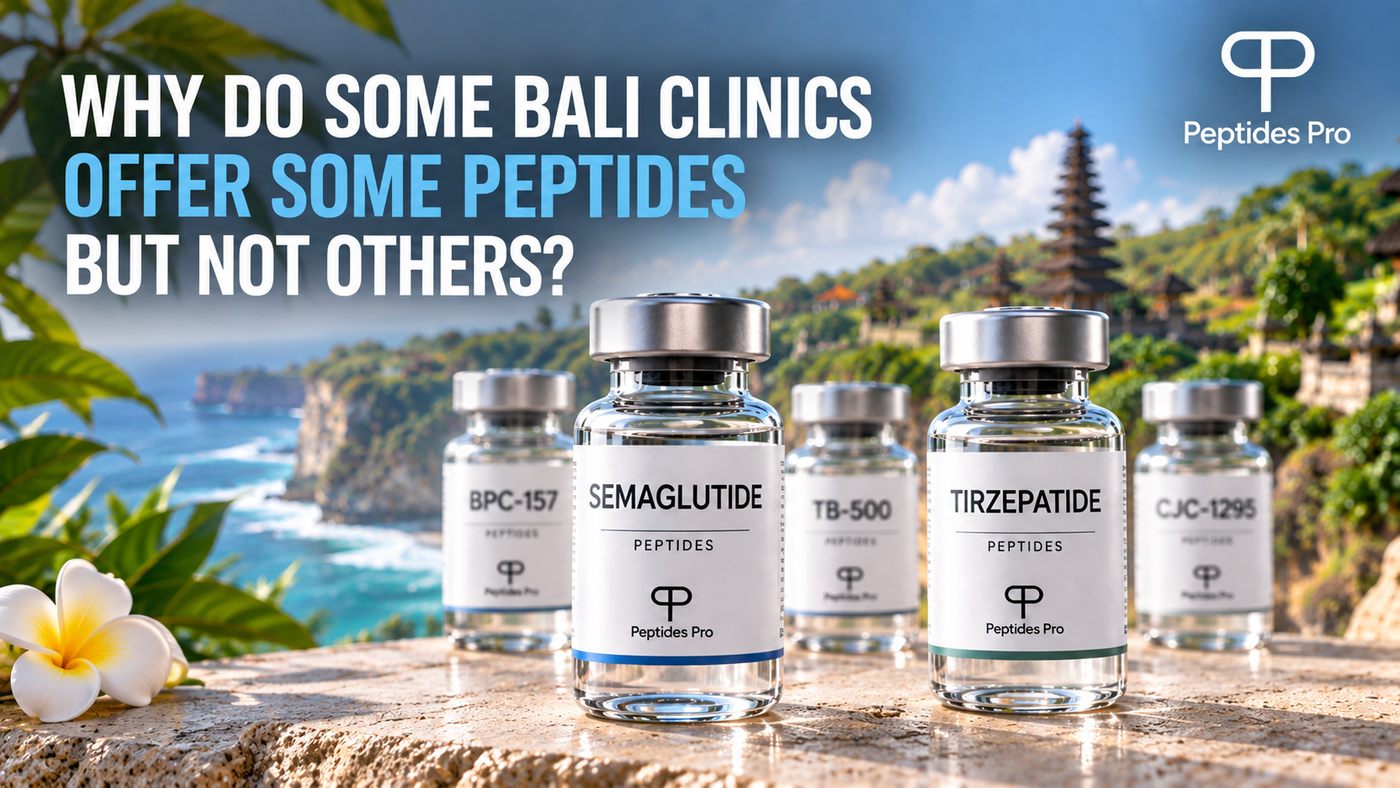
If you search for peptide treatments in Bali, you may notice something confusing: one clinic may discuss or offer a particular peptide, while another clinic does not offer it at all.
That does not necessarily mean that one clinic has better access, that the other clinic is hiding something, or that Bali has a single list of peptides that every clinic can provide.
The reality is more complicated.
What a clinic can legitimately offer depends on several factors, including whether the product has Indonesian marketing authorisation, what medical indication it is approved for, how the product is sourced, whether it is being used within an authorised clinical framework, and whether the clinic and its healthcare professionals can legally obtain, store and administer it.
This is especially important because the word "peptide" covers a huge range of substances.
Some peptide-based medicines are established pharmaceutical products with regulatory approval and extensive clinical evidence.
Others are experimental compounds that remain largely in the research stage.
Bali's wellness industry can bring these two worlds very close together, which can make peptide marketing confusing for visitors.
The First Important Point: "Peptide" Is Not a Regulatory Category
One of the biggest misunderstandings is treating peptides as if they are one type of medicine.
They are not.
A peptide is essentially a chain of amino acids. Pharmaceutical peptides can act on very different biological targets and can have completely different clinical and regulatory histories.
For example, semaglutide is a peptide-based medicine. The Indonesian BPOM database lists both Ozempic and Wegovy products containing semaglutide. Mounjaro, containing tirzepatide, is also listed in the BPOM database. :contentReference[oaicite:0]{index=0}
That is very different from an experimental compound such as BPC-157.
BPC-157 is widely discussed online, but it does not have the same regulatory status as an authorised pharmaceutical medicine.
Therefore, asking whether a Bali clinic "offers peptides" is not specific enough.
The more useful question is:
Which peptide, in which product, for what indication, under what regulatory pathway?
1. Regulatory Approval Can Make a Major Difference
The simplest reason one clinic may offer one peptide while another does not is regulatory status.
Indonesia's drug regulator, Badan Pengawas Obat dan Makanan (BPOM), oversees medicines and their distribution.
BPOM's current regulations require medicines distributed through regulated facilities to comply with applicable requirements, including marketing authorisation. Its 2026 regulation on the management of medicines and drug substances is specifically designed to strengthen control over the safety, efficacy and quality of medicines circulating in Indonesia. :contentReference[oaicite:1]{index=1}
This creates a major difference between an authorised medicine and an experimental peptide.
An authorised medicine has gone through a regulatory process that establishes its approved product information and permitted use.
An experimental peptide may have interesting laboratory research behind it but still lack approval as a medicine.
That difference can directly affect whether a clinic is prepared or permitted to offer it.
2. Some Peptides Have Much Stronger Clinical Evidence
Another reason availability differs is evidence.
A clinic may be comfortable providing a peptide-based medicine that has undergone extensive clinical development while declining to provide an experimental peptide with limited human data.
Semaglutide provides a useful example.
BPOM's assessment documents identify semaglutide products including Ozempic and Wegovy and provide information about their approved indications. :contentReference[oaicite:2]{index=2}
This does not mean that every person is automatically an appropriate candidate for these medicines.
It means that the substance has gone through a formal pharmaceutical development and regulatory process.
BPC-157 is a very different situation.
Its research history is dominated by laboratory and animal studies, with substantially less clinical evidence in humans.
A clinic therefore has a fundamentally different evidence base to consider.
3. The Exact Product Matters
Another issue that is often overlooked is that the name of a peptide does not tell you everything about the product.
A clinic may have access to a specific pharmaceutical product containing a peptide, while another business may be discussing a research-grade product sold under the same general substance name.
Those products should not automatically be treated as equivalent.
A pharmaceutical medicine has defined manufacturing, quality and regulatory requirements.
A product purchased online and labelled "research use only" does not automatically have the same level of quality assurance.
This is one reason professional clinics can be selective about which products they will handle.
4. A Clinic Cannot Simply Choose Any Peptide It Wants
It can be tempting to think that a clinic can simply order a peptide from an overseas supplier and add it to its menu.
The regulatory environment is not that simple.
BPOM's current framework covers the management of medicines and drug substances in pharmaceutical service facilities, including pharmacy installations within clinics and hospitals.
The regulation also places responsibilities around procurement, receipt, storage, dispensing, returns, destruction and reporting, with responsibility involving the pharmacist in charge of the relevant pharmaceutical service facility. :contentReference[oaicite:3]{index=3}
That means sourcing is not simply a commercial decision.
A clinic needs to consider whether the product can legally enter the Indonesian supply chain, whether it meets applicable standards and whether the facility has the appropriate framework to manage it.
5. Importation Is Not the Same as Approval
This is particularly important in Bali because international visitors may encounter information about bringing medicines into Indonesia.
Indonesia has a Special Access Scheme, commonly referred to as SAS, for certain medicines that do not have an Indonesian marketing authorisation.
However, SAS is not a general loophole allowing clinics to import any experimental peptide for routine commercial treatment.
BPOM describes SAS as a mechanism for specific purposes, including personal use, research, product development, donations, clinical trials, government programmes and certain special healthcare needs. :contentReference[oaicite:4]{index=4}
BPOM also states that medicines brought into Indonesia for personal use are subject to conditions, including limited quantities and a prohibition on resale. :contentReference[oaicite:5]{index=5}
That distinction is extremely important.
A pathway that permits a specific import does not automatically create general commercial approval for a clinic to sell or administer the product.
6. Clinical Trials Have Their Own Regulatory Pathway
Experimental medicines can be studied in Indonesia.
But research is different from ordinary commercial treatment.
BPOM states that clinical trials involving investigational products require Clinical Trial Approval, known as PPUK in Indonesia. Pre-marketing clinical trials cover products that do not yet have a distribution permit in Indonesia, while post-marketing trials can investigate authorised products for specified purposes. :contentReference[oaicite:6]{index=6}
This creates another important distinction.
A peptide can be:
- scientifically interesting
- under investigation
- involved in a clinical trial
- legally imported for a specific approved purpose
without being an ordinary medicine that a clinic can simply add to its commercial treatment menu.
7. The Clinic's Medical Focus Also Matters
Not every clinic is designed to provide the same services.
A dermatology-focused clinic may concentrate on skin-related medical care.
A metabolic-health clinic may focus on obesity, diabetes and related conditions.
A sports medicine practice may focus on musculoskeletal injuries.
A general medical clinic may have an entirely different scope.
Therefore, two legitimate clinics can have completely different treatment menus without either one necessarily being doing something wrong.
The important question is whether the products they offer are appropriate and lawful within their medical and regulatory framework.
8. Doctor Preference Can Also Influence Availability
Even where a medicine is legally available, a doctor does not have to offer it.
Healthcare professionals may differ in how they evaluate:
- clinical evidence
- patient suitability
- safety data
- potential adverse effects
- product quality
- manufacturer reliability
- regulatory risk
- long-term uncertainty
A doctor who is comfortable prescribing an authorised medicine may still refuse to use an experimental peptide because they do not believe the evidence is strong enough.
That is a clinical judgement rather than necessarily an indication that the peptide is impossible to obtain.
9. Product Supply Can Be a Practical Limitation
Availability can also be affected by ordinary pharmaceutical supply chains.
A clinic needs reliable access to a product, appropriate storage, documentation and a legitimate supply source.
Even an authorised medicine may not be continuously available at every clinic.
This is particularly relevant for medicines that require controlled temperature storage or have specific handling requirements.
A clinic may therefore decide not to stock a product simply because maintaining reliable supply is impractical.
10. Storage and Handling Requirements Matter
Many injectable pharmaceutical products have specific storage requirements.
Clinics need appropriate systems for receiving, storing and tracking medicines.
This is another reason a clinic cannot necessarily stock every injectable product that happens to be available online.
The product needs to fit into the clinic's pharmaceutical management system.
BPOM's current framework specifically covers areas such as procurement, receipt and storage of medicines in regulated pharmaceutical service facilities. :contentReference[oaicite:7]{index=7}
11. Quality Control Is Especially Important With Experimental Peptides
Experimental peptides create an additional quality problem.
If a substance is not being supplied through a conventional authorised pharmaceutical pathway, it can be harder for a consumer to establish exactly what is inside the vial.
Potential questions include:
- Is the labelled peptide actually present?
- Is the concentration accurate?
- Are impurities present?
- Was the product manufactured under appropriate conditions?
- Was it transported correctly?
- Was it stored correctly?
- Is the product sterile where sterility is required?
- Has the product been tested using reliable analytical methods?
A professional clinic may therefore decline a product not because it believes the underlying scientific idea is worthless, but because it cannot establish an acceptable level of product quality.
12. "Research Use Only" Does Not Mean "Clinic Approved"
This is one of the most important points for consumers.
You may see peptides advertised online with labels such as:
"For research use only."
That wording does not mean the product has been approved for injection into humans.
It also does not establish that the product has pharmaceutical-grade manufacturing or that Indonesian regulators have authorised it for clinical treatment.
The label describes how the seller is positioning the product.
It does not create medical approval.
Why One Clinic Might Offer Semaglutide but Not BPC-157
This is a useful example of why the distinction matters.
Semaglutide is an established pharmaceutical peptide-based medicine. BPOM's database lists authorised semaglutide products including Ozempic and Wegovy. :contentReference[oaicite:8]{index=8}
BPC-157 has a very different regulatory and evidence profile.
It is an experimental peptide with limited human clinical evidence and no equivalent Indonesian marketing authorisation as an established medicine.
Therefore, a clinic offering an authorised semaglutide product while declining to offer BPC-157 is not necessarily being inconsistent.
The two products exist in fundamentally different regulatory categories.
What About Tirzepatide?
Tirzepatide provides another example.
BPOM's database lists Mounjaro KwikPen products containing tirzepatide, with registrations recorded in 2026. :contentReference[oaicite:9]{index=9}
Again, this does not mean every Bali clinic stocks it.
A clinic still has to consider its own medical services, procurement arrangements, professional responsibilities and patient assessment.
But it demonstrates why the phrase "peptide" alone tells you very little about whether a particular product can be legitimately offered.
Why Some Clinics May Decline Popular Research Peptides
You may see BPC-157, TB-500, CJC-1295, ipamorelin and other compounds discussed heavily online.
Popularity on social media does not determine regulatory status.
A clinic may decline these products because:
- The product does not have the required Indonesian marketing authorisation.
- Human clinical evidence is limited.
- The clinic cannot verify the quality of the product.
- The clinic does not have an appropriate supply chain.
- The doctor does not consider the evidence sufficient.
- The clinic does not want to assume additional regulatory risk.
- The product is not part of the clinic's medical speciality.
- The product may only be appropriate for a research setting.
- The product may have anti-doping implications.
- The clinic may have a policy of using only established pharmaceutical products.
These reasons can exist independently or at the same time.
A Simple Way to Understand Peptide Availability in Bali
| Situation | What it means |
|---|---|
| Authorised pharmaceutical peptide | Has undergone a formal regulatory process and has approved product information |
| Experimental peptide | May have research behind it but lacks established approval for routine medical use |
| Clinical-trial peptide | May be legally studied under an approved research framework |
| Special Access Scheme product | May enter Indonesia for specific permitted purposes under applicable conditions |
| "Research use only" product | The label does not establish approval for human treatment |
| Product sold online | Availability does not prove quality or regulatory approval |
| Product offered by a clinic | Availability alone does not prove that the product is authorised |
| Product listed by BPOM | Indicates a regulatory record, but the specific product, strength and indication still need to be checked |
What Should You Ask a Bali Clinic?
If a clinic says it offers a particular peptide, you do not need to start with a complicated scientific interrogation.
A few straightforward questions can reveal a lot.
1. What is the exact product name?
Do not rely only on a generic peptide name.
2. Who manufactures it?
A legitimate pharmaceutical product should have identifiable manufacturer information.
3. Does the product have Indonesian marketing authorisation?
Ask for the relevant registration information where applicable.
4. What is the approved indication?
A medicine can be authorised for one medical use without being automatically authorised for every other use.
5. Is this an approved medicine or an investigational product?
Those are very different categories.
6. Where does the product come from?
The supply chain matters.
7. How is it stored?
Proper pharmaceutical storage can be important for product quality.
8. Why is this particular peptide being considered?
The answer should be based on the patient's medical circumstances and evidence, rather than simply its popularity online.
A Red Flag: "We Have Everything"
A clinic claiming to offer every peptide imaginable may sound attractive to someone looking for options.
But from a medical and regulatory perspective, a huge menu is not automatically a sign of quality.
In fact, it may be worth asking more questions.
A responsible clinic should be able to explain:
- what the product is
- where it comes from
- what evidence exists
- what its regulatory status is
- why it is being considered
- what the known uncertainties are
A long peptide menu without clear answers to those questions should not automatically inspire confidence.
What This Means for Wellness Travellers in Bali
Bali attracts people from around the world who are interested in wellness, fitness, longevity and recovery.
That international environment can make the peptide market look more straightforward than it actually is.
A visitor may see a peptide advertised on a website, hear about it from another traveller and then discover that one clinic offers it while another refuses.
That difference does not necessarily mean that one clinic is more advanced.
It may simply reflect differences in regulatory interpretation, sourcing, clinical philosophy, product availability and risk tolerance.
For visitors, the safest approach is to investigate the exact product, rather than relying on the broad label "peptide therapy".
The Bottom Line
Some Bali clinics offer certain peptides while refusing to offer others because peptides do not all occupy the same scientific or regulatory category.
An established peptide-based medicine such as semaglutide or tirzepatide can have a formal pharmaceutical regulatory pathway in Indonesia, while an experimental compound such as BPC-157 may have a very different status.
The difference can come down to:
approval, evidence, sourcing, quality control, clinical indication, storage, professional judgement and regulation.
Indonesia also has specific pathways for clinical trials and certain special-access imports, but these pathways should not be confused with routine commercial approval.
So if a Bali clinic says, "We offer this peptide but not that one," the most useful response is not simply to ask why the clinic is refusing it.
Ask what regulatory and scientific basis supports the product they are offering.
That is a much better way to understand the modern peptide market.
Frequently Asked Questions
Why does one Bali clinic offer a peptide while another does not?
Clinics can differ in their medical focus, sourcing arrangements, product availability, interpretation of evidence, risk policies and regulatory framework. A clinic's decision not to offer a particular peptide does not necessarily mean that the substance is unavailable everywhere.
Does a peptide have to be approved by BPOM to be discussed by a doctor?
Discussing a substance and supplying it as a medicine are different things. A doctor can discuss experimental research without that substance being an approved medicine. The regulatory requirements become particularly important when a product is being supplied, dispensed or administered.
Are all peptides in Bali experimental?
No. Peptides are a broad class of molecules. Some peptide-based medicines are established pharmaceutical products. For example, BPOM lists semaglutide products including Ozempic and Wegovy, as well as tirzepatide products such as Mounjaro. :contentReference[oaicite:10]{index=10}
Does Special Access Scheme approval mean a clinic can sell an experimental peptide?
No. BPOM describes the Special Access Scheme as a mechanism for specific purposes, including personal use, research and clinical trials. Personal imports are also subject to conditions and cannot simply be resold. :contentReference[oaicite:11]{index=11}
Why might a clinic refuse BPC-157?
A clinic may decline BPC-157 because of its experimental status, limited human evidence, product-quality concerns, sourcing issues or the clinic's own medical and regulatory policies.
Is "research use only" the same as medical approval?
No. "Research use only" does not establish that a product has been approved for human treatment. It is important to distinguish a research-labelled product from an authorised pharmaceutical medicine.
Can an experimental peptide be used in a clinical trial in Indonesia?
Potentially, but clinical trials are subject to a separate regulatory process. BPOM states that pre-marketing and post-marketing clinical trials require Clinical Trial Approval and must follow applicable clinical-trial requirements. :contentReference[oaicite:12]{index=12}
Does a clinic offering a peptide prove that the peptide is safe?
No. Availability is not proof of safety or effectiveness. Consumers should still consider the product's regulatory status, clinical evidence, manufacturer, sourcing and quality controls.
Conclusion
The peptide market in Bali can appear confusing because the word "peptide" covers everything from established pharmaceutical medicines to experimental compounds still being investigated.
That is why two clinics can have very different peptide menus.
The difference is not necessarily about who has better access.
It can reflect whether a product is authorised, whether there is sufficient clinical evidence, whether the clinic can source it through an appropriate supply chain, whether the product meets quality requirements and whether a healthcare professional considers its use appropriate.
For anyone exploring peptide services in Bali, the most important question is therefore not:
"Does this clinic offer peptides?"
It is:
"What exact product are they offering, what is its regulatory status, and what evidence supports its use?"
That question provides a much clearer picture of what you are actually being offered.
> Disclaimer: This article is for educational and informational purposes only. It is not medical or legal advice and does not recommend the use of any peptide. Regulatory requirements can change, and individual products may have different statuses, indications and restrictions. Anyone considering a peptide-based medicine or experimental peptide should consult an appropriately qualified healthcare professional and verify the current Indonesian regulatory status of the exact product.
Sources
- Badan Pengawas Obat dan Makanan (BPOM), Peraturan BPOM No. 5 Tahun 2026 on the management of medicines and drug substances in pharmaceutical service facilities and other facilities.
- BPOM, Special Access Scheme information.
- BPOM, Clinical Trial Approval information.
- BPOM assessment records for Ozempic and Wegovy.
- BPOM assessment records for Mounjaro KwikPen.
- BPOM information concerning pharmaceutical distribution and marketing authorisation.