
Education
Why Do Some Bali Peptide Clinics Ask for Blood Tests?
Published 31 Aug 2026, 21:00 Bali time
Why do some peptide clinics in Bali ask for blood tests before treatment? Learn what blood work can reveal, why clinics use baseline testing, and what to ask before starting peptide therapy.
If you have been researching peptide clinics in Bali, you may have noticed something that surprises many first-time visitors:
Some clinics ask for blood tests before discussing peptide treatment.
For someone who simply wants to learn about peptides, this can feel like an unnecessary extra step.
Why can't you just explain your goals, speak with a practitioner and start?
The reason is fairly simple.
Peptides can interact with biological systems in the body, and a blood test can give a clinician a clearer picture of your health before making treatment decisions.
But there is an important point that often gets lost online:
Not every person needs the same blood tests, and blood work is not automatically required for every peptide.
The appropriate testing depends on the specific product, the reason it is being considered, your medical history and the type of clinic you are visiting.
Why would a peptide clinic want blood work?
A consultation tells a clinician about how you feel.
Blood work can tell them more about what is happening inside your body.
That difference matters.
A clinic may want to establish a baseline before treatment. A baseline simply means having information about your health before anything is started.
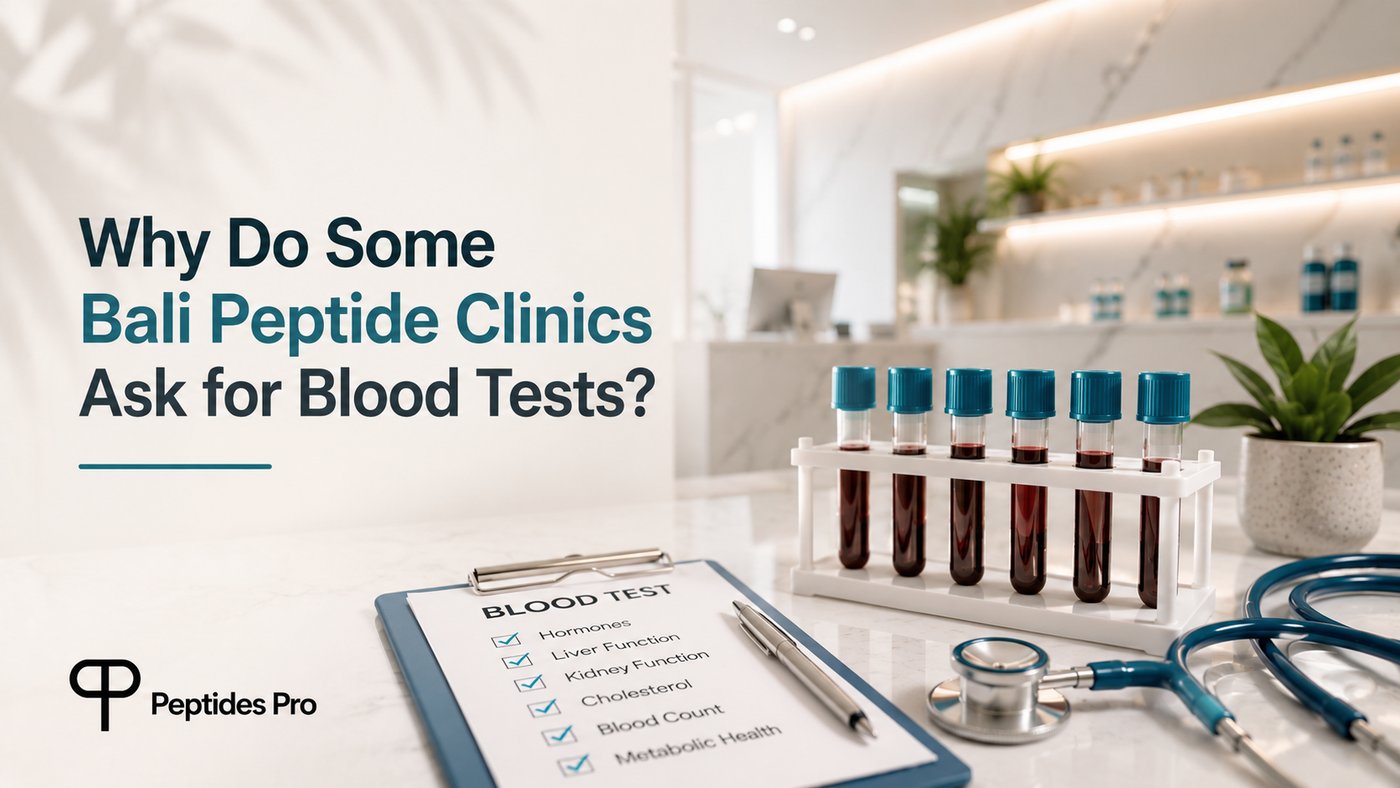
For example, depending on the situation, a clinician may be interested in things such as blood glucose, kidney function, liver function, blood counts, cholesterol or hormone-related markers.
The exact tests should be based on the person's circumstances rather than simply ordering the biggest possible panel.
Some Bali clinics specifically advertise baseline blood work as part of their peptide or longevity assessments. Others take a more conventional medical approach and only order tests they consider clinically relevant. :contentReference[oaicite:0]{index=0}
Blood tests can help identify things you cannot feel
One reason baseline testing can be useful is that some health problems do not cause obvious symptoms.
Someone may feel completely fine while having an abnormal glucose level, liver marker, kidney marker or another measurable health issue.
That does not mean every peptide user needs extensive testing.
It means that a clinician may want more information before deciding whether a particular treatment is appropriate.
This is especially relevant when a peptide-based medicine is being considered for a specific medical condition.
For example, Indonesia's BPOM has approved peptide-based medicines including semaglutide and tirzepatide for specific indications. Tirzepatide's approved indications in Indonesia were expanded in 2026 to include weight management. :contentReference[oaicite:1]{index=1}
These are pharmaceutical medicines, not simply products from the broader "research peptide" market.
What does a baseline blood test actually do?
Think of it as creating a starting point.
Imagine a person has a blood marker that is already outside the expected range before beginning treatment.
Without a baseline result, it may be difficult to know whether that finding was already present or appeared later.
With baseline information, a clinician has something to compare against.
This is one reason some clinics describe blood work as a form of health monitoring, rather than simply a requirement for buying a peptide.
What might a clinic test?
There is no universal "peptide blood test."
The tests should depend on the treatment being considered and the person's health.
Depending on the situation, a clinician may consider tests related to:
- Blood glucose and HbA1c
- Kidney function
- Liver function
- Cholesterol and other lipid markers
- Complete blood count
- Thyroid function
- Hormone levels
- Other markers relevant to the person's medical history
Some longevity clinics in Bali advertise much broader panels containing dozens of biomarkers, while other medical providers emphasize targeted testing based on the patient's circumstances. :contentReference[oaicite:2]{index=2}
That difference is worth understanding.
More tests do not automatically mean better healthcare.
The goal should be relevant information, not simply a huge list of numbers.
Why are blood tests particularly relevant for weight-loss peptides?
This is one area where people may encounter blood testing more often.
Medications containing semaglutide or tirzepatide affect metabolic pathways involving appetite, glucose regulation and other physiological processes.
For example, tirzepatide acts on GIP and GLP-1 receptors, and BPOM describes its role in diabetes treatment and weight management. :contentReference[oaicite:3]{index=3}
Because these medicines are used for specific medical indications, a healthcare professional may consider a person's metabolic health when deciding whether treatment is appropriate.
That does not mean every person taking a GLP-1 or related medicine needs the exact same laboratory panel.
It means the medical context matters.
What about peptides marketed for recovery or longevity?
This is where things become much less straightforward.
Bali has a growing wellness and longevity scene, and some clinics offer peptide-related programs alongside broader health assessments.
Some providers advertise blood testing before creating personalized programs, while others may recommend testing based on the person's goals and health history. :contentReference[oaicite:4]{index=4}
But you should be careful with broad claims about what blood tests can prove.
A blood test cannot automatically tell you whether a peptide "works."
It also cannot prove that a particular research peptide is safe simply because your results look normal.
Testing is one part of clinical assessment, not a guarantee of safety.
Does everyone need blood tests before peptides?
No.
This is one of the most important points.
There is no single blood-test checklist that applies to every peptide and every person.
Someone considering an approved prescription medicine for a medical condition may have different testing needs from someone visiting a longevity clinic.
Someone with an existing medical condition may need different assessment from a healthy person.
And some products discussed online are not approved medicines at all.
A responsible clinic should be able to explain why a particular test is relevant to you.
What if a clinic asks for a very large blood panel?
It is reasonable to ask questions.
If a clinic recommends dozens of tests, you can ask:
What is each test checking for?
Which tests are necessary before treatment?
Which ones are optional?
How will the results affect the treatment decision?
Will a doctor actually review the results with me?
You do not need to be an expert in laboratory medicine to ask these questions.
A good healthcare provider should be able to explain the purpose of testing in straightforward language.
Blood tests can also reveal when something should be investigated first
This is perhaps one of the most valuable reasons for testing.
Sometimes a consultation or laboratory result may reveal that the person needs further medical evaluation before considering a particular treatment.
That is not necessarily a bad outcome.
In fact, it can be exactly what a medical assessment is supposed to do.
The goal should not be:
"How quickly can I start a peptide?"
It should be:
"Is this appropriate for me in the first place?"
That is an important difference.
What about people visiting Bali for a short trip?
This is particularly relevant for Bali's large international wellness and medical tourism community.
A visitor may only be on the island for a few weeks and may want to start a treatment during their stay.
In that situation, clinics may ask whether the person already has recent blood results.
Some providers state that existing blood tests and other diagnostic information can be reviewed during a consultation, potentially avoiding unnecessary repeat testing. :contentReference[oaicite:5]{index=5}
If you already have recent laboratory results from your home country, it can therefore be useful to bring them with you.
The clinic can then decide whether additional testing is actually necessary.
Why reputable clinics may prefer testing before treatment
A clinic that asks questions about your medical history, medications and laboratory results may be taking a more cautious approach than a seller who simply asks what peptide you want.
That distinction matters.
A medical consultation should involve more than choosing a product from a list.
A clinician should consider your health history, current medications, goals and relevant medical information before making treatment decisions.
For approved medicines such as tirzepatide, BPOM specifically states that use should follow a doctor's prescription and supervision. :contentReference[oaicite:6]{index=6}
What if a clinic doesn't ask for blood tests?
That does not automatically mean the clinic is unsafe.
Blood testing is not universally required for every peptide-related consultation.
The more useful question is:
Does the clinic perform an appropriate medical assessment?
A clinic may decide that blood work is unnecessary for a particular situation.
Another clinic may consider it important.
What matters is whether there is a reasonable medical explanation behind the decision.
Blood tests do not make an unapproved peptide an approved medicine
This distinction is extremely important.
Imagine a clinic tests your blood, gives you a detailed report and then offers a product labelled "research use only."
The existence of blood testing does not change the regulatory status of that product.
Likewise, a professional-looking clinic does not automatically mean every peptide it offers is an approved medicine.
Indonesia's BPOM maintains a registration system for medicines, and approved products such as Ozempic, Wegovy and Mounjaro can be found within the regulatory database. :contentReference[oaicite:7]{index=7}
When evaluating a peptide product, it is therefore important to separate two questions:
Is the clinic performing appropriate health screening?
and
Is the product itself legally approved and appropriate for human use?
They are separate questions.
Questions to ask a Bali peptide clinic before getting blood tests
If a clinic recommends blood work, don't be afraid to ask for an explanation.
A few useful questions include:
Why do I need this test?
What are you looking for?
Will a doctor review my results?
Do I need the entire panel or only certain tests?
Can I use recent blood results from my home country?
What happens if one of my results is abnormal?
Is the peptide being discussed an approved medicine in Indonesia?
These questions can help you understand whether the clinic is approaching the process medically rather than simply selling a product.
The bottom line
So, why do some Bali peptide clinics ask for blood tests?
Because blood work can provide useful information about your health before treatment and create a baseline that can be used for future medical decisions.
But blood testing is not a magic safety check, and there is no universal panel that every peptide user needs.
The right approach depends on the specific peptide or medicine, the reason it is being considered, your medical history and the clinician's assessment.
If a Bali clinic asks for blood tests, don't automatically see it as an inconvenience.
Instead, ask why the tests are being recommended and how the results will affect the decision.
And if a clinic never asks about your health, medications or medical history and simply offers you a peptide after a quick message on WhatsApp, that is also worth thinking about.
With peptides, the consultation should be about more than the product.
Frequently Asked Questions
Do I need a blood test before taking peptides in Bali?
Not necessarily. Testing requirements depend on the specific product, your health history and the clinical reason for considering treatment. Some Bali providers recommend baseline testing, while others use more targeted assessments. :contentReference[oaicite:8]{index=8}
What blood tests are usually checked before peptide therapy?
There is no universal panel. Depending on the situation, a clinician may consider glucose, HbA1c, kidney function, liver function, blood counts, cholesterol, thyroid or hormone-related markers.
Can I bring blood tests from my home country?
Often, recent results may be useful for a clinician to review, although the provider may still recommend additional tests if the results are outdated or do not contain the information they need. Some Bali medical providers explicitly accept existing diagnostic information for review. :contentReference[oaicite:9]{index=9}
Why do some peptide clinics in Bali offer comprehensive blood panels?
Longevity and wellness clinics may use broader panels as part of their overall health assessments. However, a large panel is not automatically necessary for every person or every peptide. :contentReference[oaicite:10]{index=10}
Can blood tests tell me whether a peptide is working?
Not necessarily. Some laboratory markers may be relevant to a particular treatment, but blood work alone cannot prove that a peptide is effective or appropriate.
Is blood testing a sign that a peptide clinic is legitimate?
It can be a positive sign that a provider is taking health assessment seriously, but it is not proof by itself. You should also consider whether qualified medical professionals are involved and whether the product being offered is appropriately regulated.
Are peptide clinics in Bali medical clinics?
Not all businesses using the term "peptide clinic" operate in the same way. Some are doctor-led medical services, while others may be wellness or consulting businesses. Check who is providing the medical assessment and what qualifications and regulatory framework apply.
Are research peptides the same as prescription peptide medicines?
No. A research-use product should not automatically be treated as equivalent to an approved pharmaceutical medicine. Always check the regulatory status of the specific product.
Disclaimer: This article is for educational and informational purposes only. It is not medical advice and does not recommend starting, purchasing or self-administering peptide products. Peptide products and medicines can have different regulatory statuses, risks and appropriate uses. Always speak with a qualified healthcare professional and verify current Indonesian regulatory information before making decisions about treatment.