
Education
Why Is Canggu Becoming Bali’s Peptide and Biohacking Hotspot?
Published 30 Sept 2026, 21:00 Bali time
Canggu is developing a visible peptide and biohacking scene around gyms, longevity clinics, digital nomads and local suppliers. Here is what is driving it and where the science gets complicated.
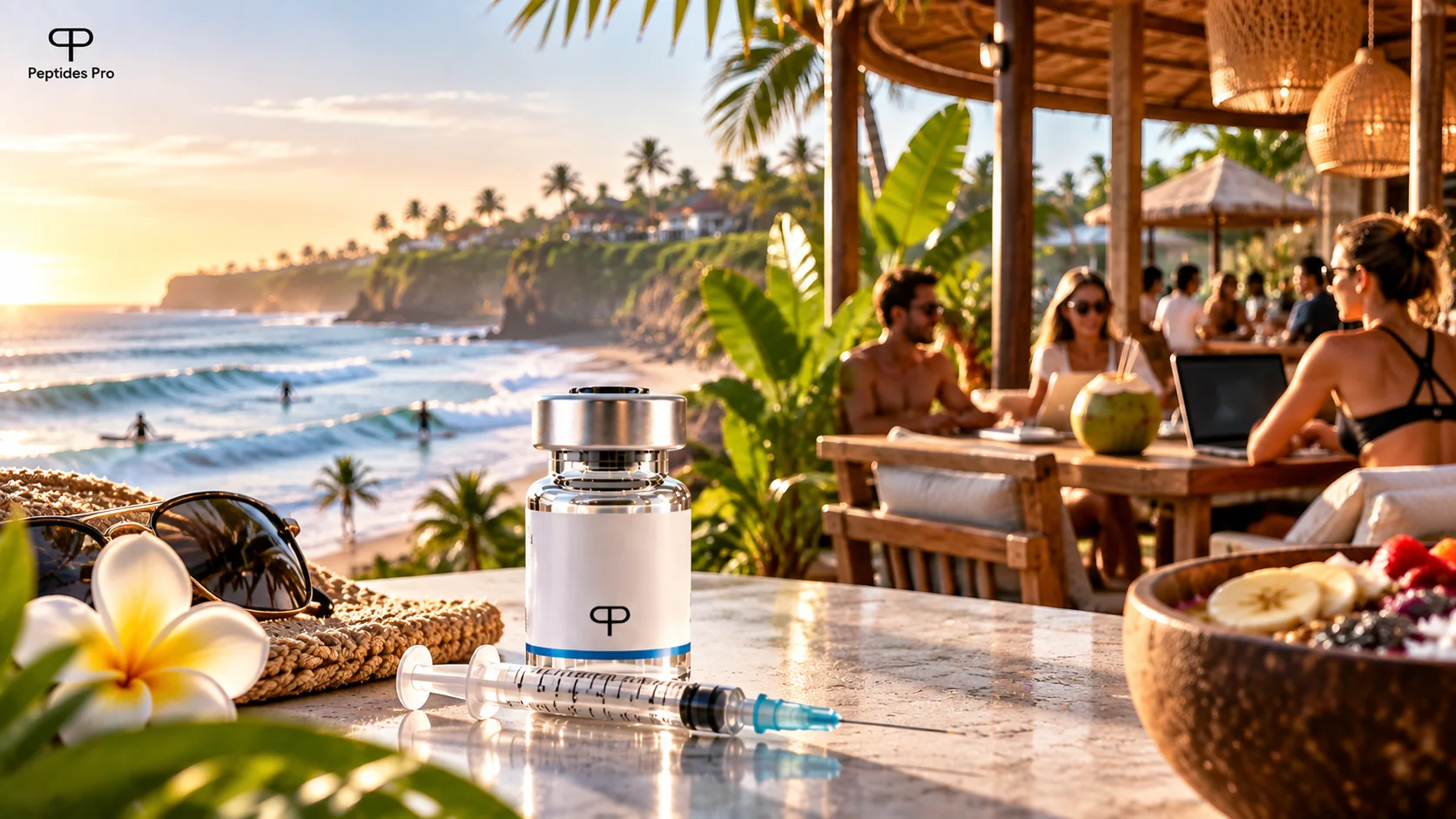
A few years ago, Canggu was primarily known internationally for surfing, cafés and remote workers.
Now another industry is quietly appearing between the gyms, recovery studios and coworking spaces:
Peptides.
Local suppliers openly market to Canggu residents. Longevity clinics advertise peptide protocols alongside blood testing, IV therapy and biomarker tracking. Biohacking studios offer cryotherapy, red-light treatments and recovery technologies. Fitness businesses increasingly describe Canggu as a destination for people who structure their lives around training, nutrition, recovery and measurable performance.
This is not simply marketing from one peptide company.
Independent travel reporting in May 2026 described Canggu as one of Bali's liveliest coastal areas, transformed by digital nomads, wellness devotees and creatives, with coworking cafés and boutique fitness studios now embedded into the neighbourhood.
At the same time, several businesses operating in Canggu now publicly advertise longevity medicine, peptide-related services or local access to research peptides.
The result is an unusually concentrated ecosystem.
Surfers train next to CrossFit athletes. Founders work from cafés after morning gym sessions. Digital nomads book blood tests and recovery treatments. Wellness clinics market optimisation rather than simply disease treatment.
And experimental peptides have entered that environment almost naturally.
But there is an important caveat.
There is currently no reliable population-level research showing how many people in Canggu actually use peptides.
What we can document is something slightly different: the infrastructure, businesses, marketing and communities surrounding peptide use are becoming increasingly visible.
That makes Canggu one of the most interesting places to watch the peptide boom develop in real time.
The short answer: Why Canggu?
Canggu combines several communities that already overlap heavily with global peptide culture:
- strength and endurance athletes
- surfers and combat-sport participants
- digital nomads and entrepreneurs
- longevity enthusiasts
- wellness practitioners
- people interested in body composition and metabolic health
- biohackers comfortable experimenting with emerging health technologies
That population is surrounded by gyms, recovery facilities, health-focused restaurants, diagnostic services, private clinics and businesses promoting experimental compounds.
A 2026 review published in Sports Medicine identified almost the same forces behind the wider rise of unapproved peptides: demand for accelerated injury recovery and performance enhancement has helped create a parallel gray market for compounds such as BPC-157, CJC-1295, GHK-Cu, ipamorelin and TB-500 despite limited rigorous human safety data.
Canggu did not invent this movement.
It may simply provide an unusually fertile environment for it.
Canggu has changed dramatically
Understanding the peptide story requires understanding what Canggu has become.
Channel News Asia described the area in May 2026 as a former sleepy surf outpost transformed into a vibrant coastal neighbourhood shaped by digital nomads, wellness devotees and creatives.
Boutique fitness studios, restaurants, cafés and longer-stay international residents have become part of everyday life.
Local fitness businesses tell a similar story.
Nirvana Life describes Canggu as an integrated wellness ecosystem built around fitness, nutrition, recovery and remote work, while local fitness guides document a dense network of strength gyms, yoga studios, CrossFit-style training, padel and recovery services.
Commercial descriptions should obviously be treated as marketing rather than independent epidemiology.
But taken together, they reveal the environment in which peptide interest is developing.
A person can live in Canggu and move almost seamlessly between:
coworking → gym → recovery centre → health café → blood testing → longevity clinic
That is a very different health culture from the traditional model in which someone visits a doctor only after becoming ill.
From wellness to optimisation
Much of Canggu's newer health industry is built around a different concept:
optimisation.
Instead of asking only whether someone has a disease, businesses increasingly market services around questions such as:
- Can you recover faster?
- Can you sleep better?
- Can you improve body composition?
- Can you increase energy?
- Can you monitor biomarkers?
- Can you improve longevity?
- Can you return to training sooner?
That language maps remarkably well onto the way peptides are marketed globally.
Cahaya Longevity Clinic, which operates in Canggu, publicly advertises blood testing, regenerative services, NAD+ infusions and personalised "therapeutic peptide" protocols based on biomarkers and individual goals.
AMO Vitality in Batu Bolong publicly describes a mix of IV therapy, injectables and peptide-related services alongside a larger recovery operation involving sauna, cold exposure and spa treatments.
Elevate Labs has also established a Canggu biohacking location offering a broader set of recovery and longevity technologies and explicitly describes Canggu as part of Bali's performance community.
None of these examples proves widespread peptide use.
They show that peptide-related services are no longer culturally out of place in Canggu.
They fit into an existing commercial ecosystem.
Local peptide suppliers are openly targeting the Canggu community
Another signal is the growth of businesses specifically advertising peptide products to people living or staying in Canggu.
BioPepTech describes Canggu as an active centre for performance optimisation and markets research peptides to people in areas including Canggu, Berawa, Batu Bolong, Echo Beach and Pererenan. Its own materials identify athletes, surfers, digital nomads and wellness-focused residents as part of its intended audience.
Peptides Pro Indonesia similarly publishes Canggu-specific material describing demand among athletes, digital entrepreneurs, wellness practitioners and biohackers.
These are sellers describing their own markets.
Their statements should therefore not be treated as independent evidence that Canggu has the highest peptide-use rate in Bali or Southeast Asia.
But the existence of multiple Canggu-specific peptide businesses is itself informative.
Companies generally create geographically targeted services where they believe demand exists.
What actually makes Canggu different?
Several characteristics seem to reinforce each other.
1. The fitness density
Canggu has developed a substantial strength, endurance, martial-arts and boutique-fitness scene.
That matters because sports recovery is one of the strongest entry points into experimental peptide use.
The 2026 Sports Medicine review identified a rapidly expanding direct-to-patient market for peptides promoted around musculoskeletal recovery and athletic performance.
The compounds reviewed included BPC-157, TB-500, CJC-1295, ipamorelin, GHK-Cu, MOTS-C and several others.
A separate 2026 critical review of peptide and peptide-analogue use in sport reported growing promotion of growth-hormone secretagogues, GHRH analogues and synthetic fragments for muscle growth, fat metabolism and recovery despite limited clinical evidence for the types of use occurring in recreational sport and bodybuilding.
Canggu's training culture therefore overlaps almost perfectly with the demographic being targeted by the international peptide market.
2. Surfing creates a recovery culture
Canggu's identity is still heavily connected to surfing.
Surfing does not automatically create peptide use, of course.
But a community involving frequent training, repetitive musculoskeletal stress and strong interest in getting back into sport creates demand for recovery products.
That is exactly where compounds such as BPC-157 and TB-500 tend to enter the conversation.
The problem is that their online reputations are much stronger than their human clinical evidence.
A 2026 review of BPC-157 found more than three decades of preclinical research but no approved formulation, no validated human dosing regimen and no completed Phase II clinical trial.
TB-500 has an even thinner human evidence base. The FDA says it has not identified human exposure data sufficient to characterise the safety of the thymosin beta-4 fragment marketed as TB-500.
The desire to recover is real.
The evidence behind some of the products being promoted for recovery is much less established.
3. Digital nomads bring global health trends with them
Canggu is not an isolated local market.
Its population constantly turns over.
Remote workers and long-stay visitors arrive from Australia, Europe, North America and elsewhere in Asia carrying health trends they encountered at home or online.
GLP-1 medicines, longevity testing, cold exposure, continuous glucose monitors, red-light therapy, nootropics and peptides all circulate through the same international wellness ecosystem.
Recent independent reporting continues to describe Bali, and Canggu in particular, as a major destination for digital nomads.
That creates an important effect.
A health trend does not need to originate in Indonesia to become popular in Canggu.
It only needs to arrive with enough people who already understand it.
4. The average customer may be unusually comfortable with self-experimentation
Biohacking culture differs from ordinary healthcare culture in one important way.
Experimentation is often part of the identity.
Tracking sleep, testing biomarkers, adjusting supplements, changing diets and evaluating performance data can encourage people to think of their bodies as systems that can continually be modified.
That philosophy can be useful when applied to evidence-based behaviours such as sleep, exercise and nutrition.
It becomes more complicated when the same mindset is extended to inadequately studied injectable compounds.
Experimental peptides can begin to look like just another optimisation variable.
They are not.
Some have meaningful pharmacological activity.
Some have unclear human safety profiles.
And some products sold under peptide names may not reliably match the pharmaceutical substances studied in scientific research.
From sauna to bloodwork to peptides: the ecosystem matters
One reason Canggu is interesting is that peptide culture does not exist by itself.
It sits inside a much larger recovery industry.
Local businesses advertise combinations of:
- biomarker testing
- cryotherapy
- sauna and cold exposure
- red-light therapy
- IV treatments
- regenerative medicine
- hormone-related services
- peptides
- fitness coaching
- nutrition
- longevity programmes
Rejuvo Life in Berawa, for example, markets itself as a comprehensive biohacking facility built around diagnostics, optimisation and medical-grade wellness services.
Elevate Labs similarly combines diagnostics and recovery technology inside its Canggu operation.
This matters because customers are not encountering peptides in isolation.
They encounter them as one option among technologies already presented as part of a sophisticated health-optimisation system.
That context can make an experimental substance feel more established than it actually is.
Not everything called a peptide in wellness marketing is actually a peptide
The language itself can become confusing.
For example, some Canggu wellness marketing groups NAD+ alongside peptide services.
But NAD+ — nicotinamide adenine dinucleotide — is a cellular coenzyme.
It is not a peptide.
This may sound like a minor technical distinction.
It illustrates a larger problem.
"Peptide" is increasingly being used as a wellness category rather than a precise biochemical description.
The same category can contain:
- genuine peptide medicines
- experimental peptides
- peptide fragments
- investigational metabolic drugs
- compounded preparations
- substances that are not peptides at all
That makes careful product-specific evaluation essential.
The biggest misunderstanding: "Peptides" are not one regulatory category
This is particularly important in Indonesia.
Tirzepatide demonstrates the difference.
Indonesia's BPOM granted marketing authorisation to Mounjaro KwikPen containing tirzepatide in February 2026 for type 2 diabetes.
BPOM approved an additional weight-management indication in July 2026. Its public registration database identifies specific Mounjaro products, strengths and Indonesian marketing authorisation numbers.
BPOM specifically states that authorised medicines undergo evaluation covering safety, efficacy and quality and continue to be monitored through pharmacovigilance after approval.
That is an approved peptide-based medicine.
BPC-157 is not in the same position.
TB-500 is not in the same position.
CJC-1295 is not in the same position.
Retatrutide is not in the same position.
Calling all of them "peptides" can conceal enormous differences in evidence.
For a more detailed explanation, see Tirzepatide vs BPC-157 in Bali: Why One Is a Medicine and the Other Isn't.
What the evidence hierarchy looks like
| Compound | Why it appears in Canggu-style wellness conversations | Evidence position |
|---|---|---|
| Tirzepatide | Weight management and metabolic health | BPOM-authorised medicine for specified indications in Indonesia |
| Semaglutide | Weight management and metabolic health | Established medicine with approved products |
| Retatrutide | Weight loss and metabolic optimisation | Investigational; not an approved medicine as of September 2026 |
| BPC-157 | Injury recovery, pain and gut claims | Predominantly preclinical research; extremely limited human evidence |
| TB-500 | Recovery and tissue-repair claims | Human safety and effectiveness remain inadequately established |
| CJC-1295 | Growth hormone, body composition and "anti-ageing" claims | Limited human pharmacology data; not an established general wellness therapy |
| Ipamorelin | Growth hormone stimulation, recovery and body composition | Limited human evidence; important safety gaps remain |
| Injectable GHK-Cu | Skin, hair and tissue claims | Limited injectable human safety information |
This table is why a Canggu peptide conversation cannot be reduced to whether "peptides work".
Some do.
Some are established medicines.
Some are promising experiments.
Some are primarily supported by animal data.
And some commercial products may not reliably correspond to the compounds being discussed in the research literature.
Canggu's peptide story is also a gray-market story
The same 2026 Sports Medicine review that documented growing peptide interest described a parallel gray market operating largely outside conventional regulatory oversight.
It noted that although many unapproved peptides produce interesting results in animal models, rigorous human safety data remain scarce.
This distinction matters in Canggu because products can be marketed with terms such as:
research grade
lab tested
high purity
research use only
None of those descriptions is equivalent to an Indonesian medicine authorisation.
Laboratory testing can provide useful information about a submitted sample.
It does not demonstrate that a compound works clinically.
Nor does an impressive purity percentage independently establish sterility or long-term human safety.
See Bali's Peptide Sellers Are Showing Lab Reports. Can You Trust Them?.
Retatrutide shows how quickly experimental medicine can become consumer culture
Retatrutide is another example worth watching.
It is an investigational metabolic medicine being studied for obesity and related conditions.
The US FDA currently states that retatrutide is not a component of an FDA-approved drug and has not been established as safe and effective for any condition.
The agency has also taken action against businesses marketing products labelled as retatrutide directly to consumers.
Yet retatrutide is already widely discussed in online peptide communities.
That is a remarkable reversal of the traditional pharmaceutical sequence.
Historically:
clinical development → regulatory approval → widespread consumer awareness
The internet can now produce:
early clinical results → social media hype → gray-market product → consumer experimentation → regulatory decision later
Canggu's internationally connected wellness community is particularly well positioned for that kind of trend to spread quickly.
The FDA's peptide concerns are relevant even outside America
The FDA does not regulate medicines in Indonesia.
BPOM does.
But FDA scientific reviews are still useful when evaluating the underlying evidence for experimental molecules.
Its current safety information identifies unresolved concerns for several compounds commonly discussed in biohacking communities.
For example:
- CJC-1295: limited clinical data, potential immunogenicity concerns and reports including increased heart rate and systemic vasodilatory reaction.
- Injectable GHK-Cu: limited human safety data and potential immunogenicity associated with aggregation and peptide-related impurities.
- Ipamorelin: limited safety information for several proposed routes and potential immunogenicity concerns.
- TB-500: the agency says it has not identified human exposure data sufficient to characterise safety.
- BPC-157: human safety information remains limited and unresolved concerns include immunogenicity and peptide-related impurities.
These findings do not prove that everyone using these substances will be harmed.
They explain why calling them established "recovery treatments" would go beyond the available evidence.
Signals that Canggu is becoming a peptide hub — and what they actually prove
| Signal | What it suggests | What it does not prove |
|---|---|---|
| Multiple Canggu-specific peptide suppliers | Commercial demand is believed to exist locally | How many residents actually use peptides |
| Longevity clinics advertising peptides | Peptide services have entered Canggu's wellness market | That every offered use has strong clinical evidence |
| Dense gym and recovery culture | A large potential audience interested in performance and recovery | That athletes need or benefit from experimental peptides |
| Large digital-nomad population | Global health trends can spread rapidly | That peptide use is more common than in other international hubs |
| Biohacking studios and biomarker testing | Optimisation culture is commercially established | That every optimisation intervention improves long-term health |
| Local discussion of lab testing and research peptides | Quality concerns are becoming part of the consumer conversation | That independently tested products are approved medicines |
This distinction is important.
There is enough evidence to say that Canggu has developed a visible peptide ecosystem.
There is not enough evidence to claim that a particular percentage of people in Canggu use peptides or that Canggu is definitively Southeast Asia's largest peptide market.
Social media makes the community larger than Canggu itself
The physical scene is only half of the story.
Peptide communities increasingly live on TikTok, Instagram, Reddit, Telegram and private groups.
That makes geographical communities porous.
Someone can discover a peptide from a US biohacker, discuss it with someone in Australia, buy a product while living in Bali and compare experiences with people across several countries.
Recent online peptide culture has even developed coded terms such as "peppers", "pepper farmers" and "ratatouille" to discuss substances while creators attempt to navigate social-media moderation.
See Why Are People Creating Secret Code Words for Peptides Online?.
Canggu is therefore not simply a local Indonesian peptide community.
It is a physical meeting point for an international online one.
Quality control may become the next major Canggu conversation
As peptide awareness grows, attention tends to move through stages.
First comes:
What does this peptide supposedly do?
Then:
Where can I find it?
Eventually:
How do I know what is actually in the vial?
That final question is increasingly important.
Recent investigations outside Indonesia have identified products sold under peptide or investigational-drug names that failed identity testing or contained unexpected active ingredients.
Those findings do not establish that products sold in Bali have the same problems.
They show why gray-market product identity cannot simply be assumed.
See They Bought BPC-157, PT-141 and Retatrutide. The Lab Found Something Else..
For Canggu, where laboratory reports are already appearing in peptide marketing, questions about batch traceability, sterility, identity testing and regulatory registration may become as important as the peptides themselves.
What people often misunderstand about the Canggu peptide scene
"If a Canggu clinic offers it, it must be an approved medicine"
Not necessarily.
Clinical availability and regulatory approval are different questions.
The status of the exact product and its intended use must be checked separately.
"If something is called a peptide, it is basically the same type of treatment as tirzepatide"
No.
Tirzepatide has undergone extensive clinical development and has BPOM-authorised indications in Indonesia.
Experimental peptides such as BPC-157 and TB-500 do not have comparable evidence.
"Canggu's biohacking culture proves these treatments work"
No.
A thriving market demonstrates interest and demand.
It does not establish effectiveness.
"Research-grade means pharmaceutical-grade"
No.
"Research grade" does not establish that a product has been approved for human treatment or manufactured under the same framework as an authorised medicine.
"99% purity means safe to inject"
No.
Chemical purity is only one quality attribute.
Identity, quantity, sterility, bacterial endotoxins, manufacturing conditions and clinical safety are separate questions.
"The FDA says a peptide is unapproved, so that automatically determines Indonesian law"
No.
The FDA regulates the United States.
BPOM regulates medicines in Indonesia.
FDA scientific reviews can inform discussion of evidence and safety but do not determine Indonesian regulatory status.
What we still do not know
The most important unanswered question is surprisingly simple:
How many people in Canggu are actually using peptides?
No reliable epidemiological survey currently answers that.
We do not know the prevalence by age, nationality, compound or reason for use.
We do not know how much use occurs through medical settings versus self-directed gray-market purchases.
We do not know how many adverse events occur locally.
We also cannot determine from marketing materials whether one neighbourhood has a higher peptide-use rate than another.
Those gaps matter.
Canggu's peptide story is currently visible primarily through commercial activity, wellness infrastructure and online culture rather than formal public-health data.
That means the safest conclusion is not that "everyone in Canggu is using peptides".
It is that the conditions for a significant peptide culture are clearly present, and businesses are increasingly responding to that interest.
Frequently Asked Questions
Are peptides popular in Canggu?
There are strong signs of growing interest.
Multiple local businesses now market peptide-related products or services specifically to Canggu's fitness, wellness and biohacking communities.
However, no reliable study currently establishes how many people in Canggu actually use peptides.
Why would Canggu attract peptide users?
Canggu combines a dense fitness scene, surfing, digital nomads, longevity clinics, recovery businesses and a strong optimisation culture.
Those groups substantially overlap with the audiences driving peptide interest internationally.
Can you get approved peptide medicines in Bali?
Indonesia has approved certain peptide-based medicines.
For example, BPOM authorised tirzepatide for type 2 diabetes in February 2026 and added a weight-management indication in July.
That does not mean every product marketed as tirzepatide or every substance described as a peptide is approved.
Is BPC-157 approved in Bali?
BPC-157 remains an experimental compound with extremely limited controlled human evidence.
Peptides Pro did not identify a comparable BPOM medicinal-product authorisation for BPC-157 in the official Indonesian registration material reviewed for this article.
That statement should not be expanded into a blanket legal conclusion about every research or import context.
Are peptides good for surfing injuries?
Some experimental peptides are promoted for musculoskeletal recovery, particularly BPC-157 and TB-500.
Human clinical evidence establishing their effectiveness for sports injuries remains inadequate.
Standard diagnosis, rehabilitation and evidence-based sports medicine should not be replaced by assumptions based on animal research.
Why are biohackers interested in peptides?
Peptides are attractive because some can influence highly specific biological signalling pathways.
That creates the idea that recovery, metabolism, growth hormone signalling or other processes can be selectively modified.
Whether that produces useful clinical outcomes depends entirely on the individual compound and the strength of its human evidence.
Are Canggu peptide products independently tested?
Some local sellers publicly advertise independent laboratory testing.
The value of a report depends on what was tested and whether the sample can be reliably traced to the product being sold.
Laboratory testing does not independently establish regulatory approval or clinical effectiveness.
Is Canggu becoming Asia's peptide capital?
There is not enough comparative data to make that claim.
Canggu clearly has a visible and growing peptide/biohacking ecosystem, but there are no reliable regional prevalence data demonstrating that it has more peptide use than every other Asian wellness hub.
The Bottom Line
Canggu's peptide story did not appear out of nowhere.
The neighbourhood spent years evolving from a surf destination into an international ecosystem built around remote work, fitness, wellness and self-optimisation.
Peptides fit neatly into that culture.
Athletes hear about recovery compounds.
Digital nomads encounter longevity medicine.
Biohackers monitor biomarkers.
Clinics add optimisation services.
Suppliers see commercial demand.
Social media connects everyone.
That combination explains why peptide culture can develop particularly quickly in a place like Canggu.
But visibility should not be confused with validation.
A thriving peptide market tells us that people are interested in these compounds. It does not tell us that every compound works, that every product is accurately labelled, or that every advertised use is medically established.
The most important distinction in Canggu may therefore be the same one shaping the peptide boom worldwide:
Between an approved medicine supported by human clinical evidence and an experimental compound that has become popular before the science is finished.
Canggu may be one of the clearest places to watch that distinction being tested in real time.
Sources
- Channel News Asia, 23 May 2026. Independent reporting describing Canggu's transformation from a surf outpost into a neighbourhood shaped by digital nomads, wellness devotees, boutique fitness studios and longer-term international residents.
- Mendias CL, Awan TM. (2026). Safety and Efficacy of Approved and Unapproved Peptide Therapies for Musculoskeletal Injuries and Athletic Performance. Sports Medicine. Reviews the expanding gray market for BPC-157, CJC-1295, GHK-Cu, ipamorelin, TB-500 and related compounds and highlights the lack of rigorous human safety data for many products.
- U.S. Food and Drug Administration. Certain Bulk Drug Substances for Use in Compounding That May Present Significant Safety Risks. Current safety information covering BPC-157, CJC-1295, injectable GHK-Cu, ipamorelin and TB-500.
- Badan Pengawas Obat dan Makanan (BPOM), Indonesia, July 2026. Official information confirming Indonesian marketing authorisation for tirzepatide for type 2 diabetes and the subsequent additional weight-management indication.
- Local market sources reviewed in September 2026. Public-facing Canggu materials from longevity clinics, biohacking businesses and peptide suppliers were used to document how peptide and optimisation services are currently being marketed locally. These sources demonstrate commercial activity and positioning, not independent evidence of treatment effectiveness or population-level peptide use.
Medical Disclaimer
This article is for educational and research-information purposes only. It does not provide medical advice, diagnosis, treatment recommendations or individual legal advice. Some peptides discussed are experimental and may not have established safety, effectiveness or regulatory approval for human therapeutic use. The availability of a product or service in Bali does not establish that it is medically appropriate or approved. Speak with a qualified healthcare professional about personal medical decisions and consult BPOM for current Indonesian product-specific regulatory information. ```
This article is for educational purposes only and does not replace medical advice.